

‘If All the Politicians were Clever…’
On December 15th the first joint Russian-American report by the Valdai Discussion Club working group on the future of U.S.-Russia relations was presented at the HSE.

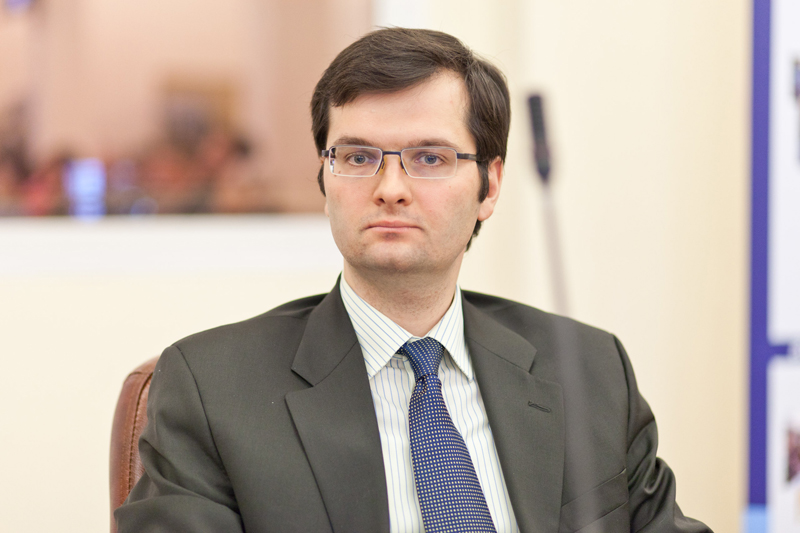

The report, ‘U.S.-Russia Relations in Post-Soviet Eurasia: Transcending the Zero-Sum Game’, was co-authored by Samuel Charap, Director for Russia and Eurasia and member of the National Security and International Policy team at the Center for American Progress, and Mikhail Troitsky, Associate Professor at the Russian Ministry of Foreign Affairs Moscow State Institute for International Relations (MGIMO).
This working group was created in 2010 as a joint initiative by the Higher School of Economics, Harvard University, the Valdai Discussion Club and the Council for Foreign and Defense Policy (SVOP). It is headed by Sergey Karaganov, Dean of the HSE Faculty of World Economy and International Affairs, Chairman of the Board at SVOP, and Timothy Colton, Chair of the Department of Government at Harvard University and member of the HSE International Advisory Committee.
The key aim of the working group is to form a joint view by the expert communities of Russia and the U.S. on topical problems of Russian-American relations, the foreign policies of both countries and key trends in international relations and global development, as well as to develop political recommendations on various aspects of the foreign policy of both countries. Meetings are held twice a year, alternately at the HSE and Harvard. Each meeting is dedicated to a specific problem, and the results of the discussion are reflected in summary reports which are prepared by two experts – one Russian, one American. Most of the working group’s experts are young researchers aged under 40 – representatives of a new generation of international relations researchers who will define and build the future of Russia-U.S. relations.
Since Samuel Charap was not able to visit Moscow to give his presentation, the report was presented at the HSE by his Russian colleague Mikhail Troitsky, and the American side was represented by Prof. Timothy Colton. The research and the associated paper by the two young researchers was dedicated to the analysis of Russian-American relations on post-Soviet regions, since it is here where the sharp contradictions and problems of misunderstanding most often determine the two countries’ relations. After an analysis of the main areas and reasons for tension in Russian-American relations as a result of their policy in CIS countries, the authors suggested possible solutions to the problems.
 During the multidimensional study, the young academicians concluded that the generally accepted belief that the two countries have fundamental, irreconcilable disagreements related to post-Soviet countries is false. ‘Indeed, the persistence of the zero-sum dynamic between the two countries regarding the region is highly contingent’, the paper emphasizes,’ it cannot be accounted for by immutable factors inherent to either of them or the international system. Whatever its source, not only has this dynamic been a key driver of past downturns in the bilateral relationship, but it has also done serious damage to the development of the independent states of post-Soviet Eurasia themselves’.
According to the authors of the report, the main sources of tension are: historically conditioned policy patterns; parochial agendas of actors such as business lobbies and “freelancing” government agencies; and mutual misperceptions. These are all obstacles to the search for mutually beneficial solutions, they slow down the political and economic development of post-Soviet countries and lead to the deepening or continuation of unsolved conflicts. The report suggests some specific solutions for this situation. It suggests it is necessary to implement greater transparency, which means that the United States and Russia should regularly convey information about their respective activities in the region to avoid misunderstandings. The paper also recommends regularizing bilateral consultations on regional issues. Officials from Washington and Moscow, the paper suggests, should take into account the domestic contexts of the U.S. and Russia. And, once high level negotiations have overtaken local concerns, it would be useful, the paper authors believe, to publicly affirm a positive-sum approach to bilateral interactions in the region.
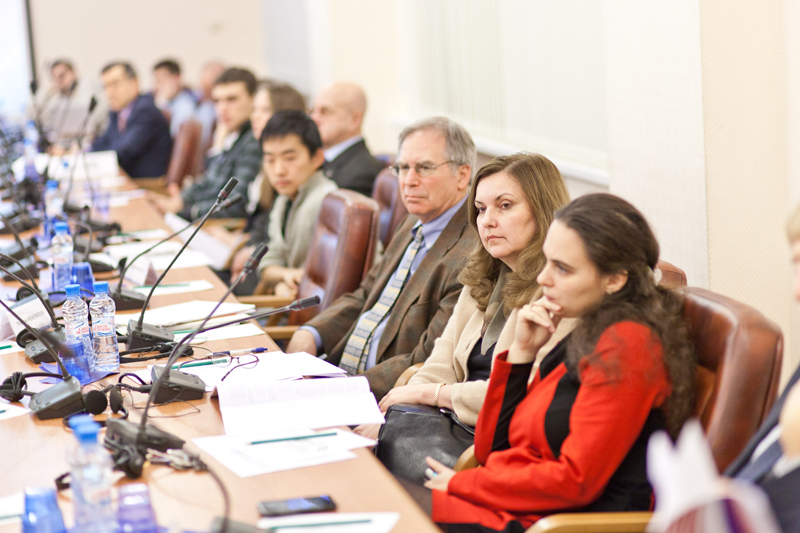
During the discussion which took place after the presentation, Alexander Golts, Editor-in-Chief of the Ezhednevny Zhurnal (Daily Magazine) internet edition, said, that in his view, the report is aimed at an ideal world and is based on the idea that the governments act rationally, but unfortunately this is not real. ‘It seems to me’, he said, ‘that people outside the academic community will listen to this and ask the authors: Who is this paper aimed at? Is it a kind of evangelical tract for governments? Or just an academic exercise which states that if all politicians were clever we wouldn’t have any problems, but since not all of them are clever, we cannot expect a good result?’
At the end of the discussion Sergey Karaganov emphasized that the paper by Mikhail Troitsky and Samuel Charap is the first joint publication by the working group and has received positive feedback in the USA and attracted interest from prominent politicians and staff of the State Department. ‘We are starting to prepare the next report’, he said, ‘on possible cooperation between Russia and the U.S. in the energy industry. Today’s discussion is important, since it has revealed both the strength and weaknesses of the preparation of the first report by the working group and this will all be taken into account in our future work’.
Valentina Gruzintseva, HSE News Service
Photos by Nikita Benzoruk
Timothy J. Colton
See also:

'Learning what You Really Need'
Anastasia Likhacheva was appointed Dean of the Faculty of World Economy and International Affairs in November 2021. During her first six months in this position, she has faced numerous new challenges. In her interview with HSE University Life, she explains how she and the Faculty have been coping, why she spent just one year working outside of academia, and how prospective students can rethink their future careers in international relations.
HSE Hosts International University Consortium for the First Time
From February 25 to March 2, HSE’s Faculty of World Economy and International Affairs hosted an academic module of the University Consortium, an inter-regional training programme for outstanding students that aims to promote mutual understanding, balanced analysis, and genuine dialogue among the US, EU, and Russia.
Students of Parallel Degree Programme in International Relations Perform Significantly Higher than International Average on University of London Exams
The number of HSE students who successfully passed the exams conducted at the University of London in 2018 was significantly higher than the average for other universities participating in the international programme there. HSE received the status of Recognized Teaching Centre.
Exploring Fake News and Propaganda in Today’s World
This month, Dr. Oliver Boyd-Barrett, Professor Emeritus at Bowling Green State University in Ohio and California State Polytechnic University, Pomona, delivered at open lecture at HSE Moscow entitled ‘Fake News and Propaganda’. An expert in international media, war and propaganda, and media political economy, Dr. Boyd-Barrett is the author of a number of books, including ‘Western Mainstream Media and the Ukraine Crisis: A Study in Conflict Propaganda’ (2016) and ‘Media Imperialism’ (2014). Following his lecture, he spoke with the HSE News Service about the topic of fake news more broadly and about how people can protect themselves from it.
Stranger in Moscow: A Tale of German Student’s Adventures in Russia
Linda Moessler is a German student who spent her spring semester studying international relations at HSE Moscow. Despite political tensions and cultural differences, Linda managed to fit in greatly and enjoy her stay in Russia. Miss Moessler agreed to tell us about her experience as a foreign student at HSE. Her tale will surely be of great interest for those curious about how international students live in Russia.
Attracted by the Variety of HSE’s Programmes and Students
Alexander Bespalov, a first-year student in the HSE and University of London Parallel Degree Programme in International Relations, was born in Israel to parents who had emigrated from Russia. He recently sat down with the HSE News Service to talk about why he chose to come to Russia for study, the challenges he has overcome, and what he is looking to achieve during his time at HSE.
Russia and China Becoming Closer
On July 3-10, the IV International Russian-Chinese Summer School on International Relations, ‘Space and Time in the Eurasian Era,’ took place in Moscow. The event was organized by the HSE and East China Normal University. A total of 15 Russian and 12 Chinese students are taking part in the summer school. The summer school, whose working language is English, is intended for undergraduate and graduate students from Russia and China that are interested in international relations.
On the Fast Track at Aix-Marseille School of Economics
Vera Danilina, Senior Lecturer in the Department of World Economy (Faculty of World Economy and International Affairs), spoke recently about her experience as a participant in the Fast Track programme at the Aix-Marseille School of Economics (AMSE, Aix-Marseille University) in France.
An Excellent Platform for Academic Debate and Public Education
Dr. Marek Dabrowski, CASE Fellow at the CASE — Center for Social and Economic Research in Warsaw, Poland, has participated in every HSE April Conference since 2001, missing just the 2000 inaugural event. A professor with decades of experience in the field of economics, Dr. Dabrowski’s current areas of expertise range from monetary and fiscal policies and political economies in transition to perspectives on European integration and European Neighborhood Policy. In advance of next week’s XV HSE April Conference, Dr. Dabrowski kindly took part in a brief interview with the HSE News Service.
HRH The Princess Royal Visits the HSE
On February 4, 2014, Princess Anne, Her Royal Highness The Princess Royal, who is leading the UK delegation to the Sochi Olympics, visited the Higher School of Economics International College of Economics and Finance.