

HSE Researchers Assess Creative Industry Losses from Use of GenAI
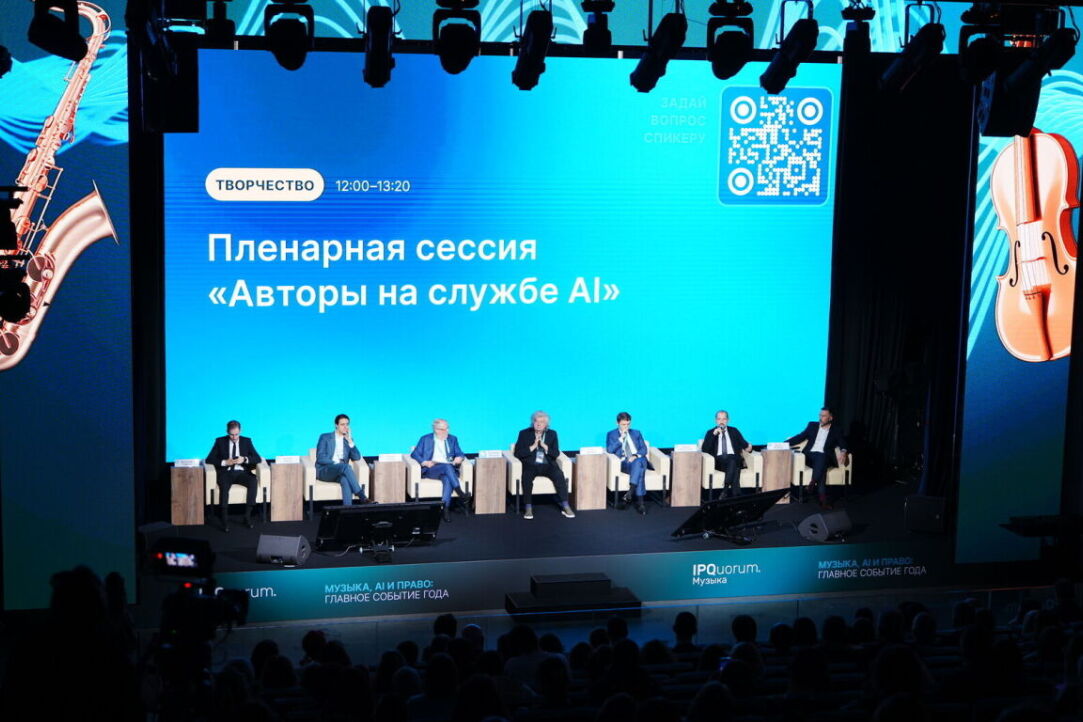
Speaking at the IPQuorum.Music forum on October 15, Leonid Gokhberg, HSE Chief Vice President, and Daniil Kudrin, an expert at the Centre for Industry and Corporate Projects of HSE ISSEK, presented the findings of the first study in Russia on the economic impact of GenAI on creative professions. The analysis shows that creators’ potential losses could reach one trillion roubles by 2030.
The pace of technological innovation is accelerating every year: while it took the telephone 75 years to 'take over the world,' DeepSeek reached 100 million users in just two weeks. Today, GenAI models are rapidly gaining popularity, enabling users to generate text, video, images, and audio. There are now at least 1,000 AI models on the market designed for creative tasks and capable of competing with human creators.
Experts at HSE ISSEK have developed a unique methodology for quantifying the losses faced by authors and copyright holders as a result of the adoption of AI. The study focuses on 12 creative professions that are most vulnerable to GenAI. For the first time, researchers have estimated the share of generative content in different types of creative work and assessed the income decline experienced by 'traditional' creators who do not use neural networks. Notably, the study deliberately excludes the potential positive effects of AI, such as increased productivity and reduced barriers to entry.
The findings indicate that total income losses for members of creative professions could reach 1 trillion roubles by 2030. Programmers and developers, as well as advertising and marketing specialists, are expected to be hit the hardest. Generative models have brought new players into the creative industries, including both institutional actors—such as IT companies, developers, and digital platforms—and individuals, such as amateur creators. The production and distribution of AI-generated content by these new players pose a serious threat to the revenues of writers, translators, journalists, and composers: according to experts, AI penetration in these professions will exceed 25%.

'We live in an era of exponential digital development,' says Leonid Gokhberg, Chief Vice President of HSE University. 'Innovation cannot be stopped, but it is crucial to foster a balanced dialogue between creators, technology companies, and the government. GenAI should not become a threat to creative professions. Rather, it should be viewed as a tool that complements human imagination, not replaces it.'
The researchers emphasise that current AI solutions are still far from fully replacing humans, as generative models are prone to 'hallucinations' and errors, and can pose reputational risks. In practice, AI often serves as an assistant, helping creators with editing, reference selection, translation, and technical problem-solving.
The HSE ISSEK study represents the first step toward a systematic analysis of GenAI’s impact on the intellectual property market and toward developing solutions that balance innovation with the protection of creators’ interests.
A full recording of the plenary session 'Authors in the Service of AI' is available here.

See also:

Physicists Train AI to Optimise Particle Beams in Accelerators
Researchers from the AI and Digital Science Institute at the HSE Faculty of Computer Science and the Budker Institute of Nuclear Physics at the Siberian Branch of the Russian Academy of Sciences have developed RLABC (Reinforcement Learning for Accelerator Beamline Control), a framework that uses reinforcement learning to identify optimal settings for a particle accelerator. In a computer simulation, RLABC optimised the accelerator's parameters to achieve a particle transmission rate of 70%. The study has been published in Computer Physics Communications.
HSE University Students Develop Socially Significant Project in Digital Healthcare
In October 2026, Sechenov University hosted MedITron, a medical innovation hackathon. Over three days, participants were challenged to develop a solution to one of the case studies prepared by leading MedTech organisations. Among the winners was Team Med404, which included two HSE students.
Fall into ML 2026: From Fundamental Research to Discussions on the Future of AI
On October 23–24, HSE University hosted Fall into ML 2026, the fifth conference on machine learning and AI. Over the past five years, the event has grown from a small gathering of researchers into a flagship platform that brings together leading machine learning specialists, early-career researchers, students, and representatives of technology companies. The fifth edition marked a new stage in the development of the conference, with a programme that included discussions with international speakers, presentations of joint research projects, and tutorials on the latest trends in AI.
Master’s Programmes and AI: Shaping the Future of Higher Education
From October 28 to 30, the 17th International Conference on Higher Education, ‘The (Non)Homogeneous Landscape of Higher Education: Institutions, Trajectories, Effects,’ took place at HSE University. Among the key topics discussed at the plenary sessions on the second and third days were the development of master's programmes and the application of AI in the learning process.
‘You Cannot Understand a Country from the Outside—You Have to Live in It, Struggle in It, and Let It Surprise You’
Syed Amir Ali Shah , from Islamabad, Pakistan, enrolled in the Master’s in Information Security and Artificial Intelligence Technologies to study in a modern, international environment with ample opportunities to develop outside the classroom. In his time at HSE University in Moscow, Syed Amir Ali has gained deeper insight into the relationship between information security and AI, presented his research to the university community, and volunteered at a wide range of university events. Read on to find out more in this interview.
The Future of Humanoid Robots in the Home Explored at Foresight Session
On October 23–24, HSE University hosted the landmark fifth Fall into ML 2026 Conference. During the foresight session titled ‘A Humanoid in Your Kitchen: When Will It Happen and What Can Prevent It?’ researchers explored why humanoid robot assistants have not yet become part of our everyday lives, what needs to change for this to happen, and who will be held responsible when such assistants make mistakes.
‘A Reliable Bridge Between a Laboratory Prototype and a Working Service’
The HSE Faculty of Computer Science will complete the development of the third phase of the SmartMLOps system by the end of the year. This enterprise platform simplifies and accelerates the deployment of AI models in production environments. The work is being carried out as part of HSE University’s ‘Multi-Agent Platform of AI Solutions for Industry-Specific Tasks.’ Hadi Saleh, Head of the Unit for Applied Technological Solutions at the AI and Digital Science Institute of the HSE Faculty of Computer Science, explains what makes the new system unique and what challenges it will be able to address.
The Future of Connectivity: 6G Technologies Under Development at HSE University
Sixth-generation (6G) communication will require new devices and technologies, and a development team at HSE University is working on solutions in microelectronics and photonics as part of the university's Strategic Technological Project 'Trusted 6G Communication Systems Technology Suite.' In 2026, the researchers developed models and prototypes of devices, experimentally tested their characteristics, and agreed with industrial partners on formats for collaboration. The HSE News Service spoke with project coordinator Alexander Shurakov, Associate Professor at the School of Electronic Engineering of HSE MIEM, about how these developments can move beyond the laboratory.
AI Helps Predict Industrial Equipment Failures Before Emergencies Arise
The AI and Digital Science Instituteat HSE Faculty of Computer Science (FCS) presented a multi-agent hardware–software system that analyses the electrical parameters of industrial equipment and helps detect signs of malfunction at an early stage. The solution is designed to shift maintenance from repairing equipment after failures occur to predicting its condition and scheduling interventions before an emergency arises. The system was presented at the 4th Professional Conference for the IT and Engineering Community in the Oil and Gas Industry.
HSE University Wins Autonomous Search Tech Contest for LizaAlert Search and Rescue Team
The navigation system, developed by specialists from the Laboratory for Intelligent Unmanned Systems at HSE MIEM, is designed to search for missing people and allows the unmanned vehicle to autonomously execute route missions without satellite navigation. The Autonomous Search competition is notable for its comprehensive verification of actual working technologies. Out of 50 applications submitted, 15 were admitted to the qualification round, and four teams advanced to the finals.