

Technological Breakthrough: Research by AI and Digital Science Institute Recognised at AI Journey 2025

Researchers from the AI and Digital Science Institute (part of the HSE Faculty of Computer Science) presented cutting-edge AI studies, noted for their scientific novelty and practical relevance, at the AI Journey 2025 International Conference. A research project by Maxim Rakhuba, Head of the Laboratory for Matrix and Tensor Methods in Machine Learning, received the AI Leaders 2025 award. Aibek Alanov, Head of the Centre of Deep Learning and Bayesian Methods, was among the finalists.
Maxim Rakhuba received high praise from the scientific community and was awarded the national AI Leaders award for his outstanding contribution to the development of efficient modelling methods and big data processing. His project focuses on designing new approaches to accelerating and reducing the size of machine-learning models through the use of low-dimensional matrices and tensors. These techniques significantly boost the performance of deep-learning algorithms and reduce the resource demands of servers and data centres.
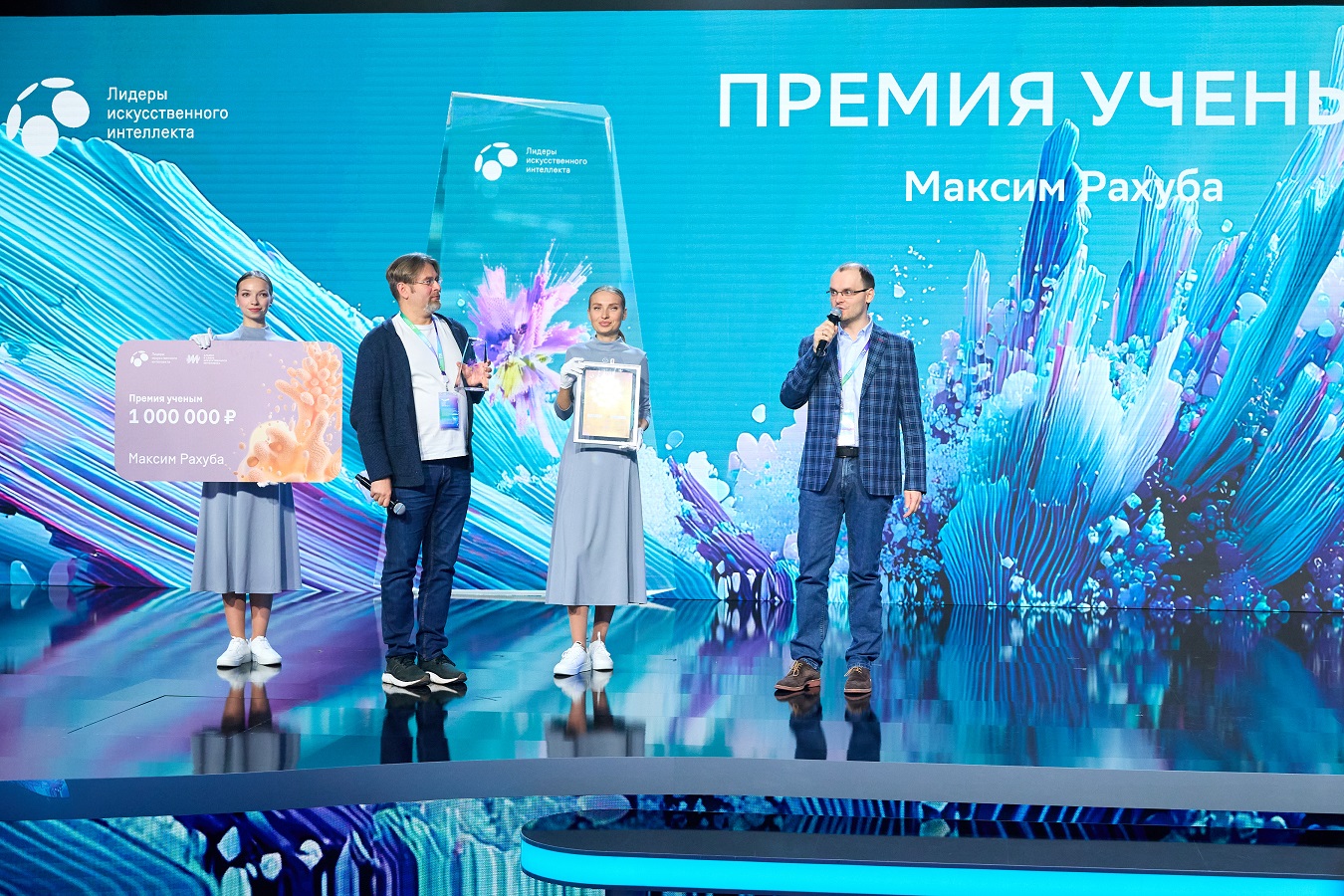
‘The approaches we are developing make it possible, for example, to reduce the number of parameters in modern neural networks, making them more accessible and efficient, which broadens the scope for their application,’ emphasised Maxim Rakhuba.
Aibek Alanov made it to the finals with his project ‘Efficient Control Mechanisms for Image and Audio Generative Models.’ His research focuses on adaptation and personalisation, editing real images without additional training, and improving low-latency speech quality for real-time applications.

As part of the Breakthrough Research and Technology session, Alexey Naumov, Director of the AI and Digital Science Institute, delivered a presentation entitled ‘Estimating Schrödinger Potentials.’ Sergey Samsonov, Head of the International Laboratory of Stochastic Algorithms and High-Dimensional Inference, presented his talk on ‘Training Methods for Generative Flow Networks.’

Vladimir Spokoiny, Academic Supervisor of the HSE Laboratory for Theoretical Foundations of AI Models, presented a study titled ‘Estimation and Inference of Deep Neural Networks.’ His talk addressed some of the most pressing challenges in modern machine learning, including predictive accuracy and the reliability of inference—issues of particular importance given the growing scale and complexity of AI applications.
Peter Lukianchenko, Head of the HSE Laboratory of Artificial Intelligence in Mathematical Finance, shared successful experience of applying AI within the financial services sector during the session ‘Artificial Intelligence in Customer Experience and Personalisation.’ His presentation focused on the development of a multi-agent simulator designed to recreate crisis events in financial markets.
Researchers from the institute also presented a number of important studies during the poster session, including scientific results obtained under a grant from the Third-Wave Artificial Intelligence Centre.
GAS: Improving Discretisation of Diffusion ODEs via Generalised Adversarial Solver.
Authors: Alexander Oganov, Ilya Bykov, Eva Neudachina, Mishan Aliev, Alexandr Tolmachev, Alexandr Sidorov, Alexandr Zuev, Andrey Okhotin, Denis Rakitin, Aibek Alanov.
Revisiting Non-Acyclic GFlowNets in Discrete Environments.
Authors: Nikita Morozov, Yan Maximov, Daniil Tiapkin, Sergey Samsonov.
A System for Automatic Multimodal Analysis of Emotions and Personality Traits Based on Semi-Supervised Cross-Domain Learning.
Authors: Elena Ryumina, Alexander Aksenov, Daria Koryakovskaya, Timur Abdulkadirov, Angelina Egorova, Sergey Fedchin, Alexander Zaburdaev, Dmitry Ryumin.
Evaluation of Tokeniser Adaptation Methods for Russian LLMs.
Authors: Georgy Andryushchenko, Maria Godunova, Vladimir Ivanov, Dmitry Kuzmin, Andrew Parinov, Anna Shchennikova, Elizaveta Zhemchuzhina.
OmicsFUSION: GenAI model for Omics Data.
Authors: Nazar Beknazarov, Artem Bashkatov, Maria Poptsova.
A delegation from the institute also attended other AI Journey 2025 events to support active engagement within the scientific community and to discuss new directions in the development of artificial intelligence technologies.

Anna Kozyreva
‘The participation of representatives from the AI and Digital Science Institute in AI Journey fosters the exchange of scientific ideas with leading experts, helps to establish partnerships, and encourages discussion of future growth areas. The expansion of the international scientific community is particularly valuable and helps to define more clearly the pathways for further progress in AI,’ noted Anna Kozyreva, Head of the institute’s Promotions and Communications Unit.
By maintaining a high level of research activity and continually advancing technological approaches, the HSE AI and Digital Science Institute reaffirms its leading position in the development of artificial intelligence and related scientific fields in Russia.

Georgy Andryushchenko
Nazar Beknazarov
Ilya Bykov
Alexander Zuev
Vladimir Ivanov
Darya Koryakovskaya
Dmitry Kuzmin
Alexander Sidorov
Anna Schennikova
See also:

‘Putting Forward Theories Is the Last Skill at Which We Outperform Machines’
Louis Vervoort, Associate Professor at the HSE Tikhonov Moscow Institute of Electronics and Mathematics (HSE MIEM) and specialist in the philosophy of science and artificial intelligence, spoke to the HSE News Service about what physics and philosophy have in common, why quantum mechanics is incompatible with the theory of relativity, what it means to be a researcher in the age of AI, and why the ability to develop new theories may become humanity’s greatest advantage over machines.
Physicists Train AI to Optimise Particle Beams in Accelerators
Researchers from the AI and Digital Science Institute at the HSE Faculty of Computer Science and the Budker Institute of Nuclear Physics at the Siberian Branch of the Russian Academy of Sciences have developed RLABC (Reinforcement Learning for Accelerator Beamline Control), a framework that uses reinforcement learning to identify optimal settings for a particle accelerator. In a computer simulation, RLABC optimised the accelerator's parameters to achieve a particle transmission rate of 70%. The study has been published in Computer Physics Communications.
HSE Scientists Present Tensor Methods Research at International Conference in China
Researchers from the AI and Digital Science Institute at the HSE Faculty of Computer Science took part in the 3rd Conference–School on Tensor Methods in Mathematics and Artificial Intelligence Computing. The event was held in Shenzhen, China, in late October 2026. One of the institute's research projects received the Best Poster Award, placing among the conference's five best posters.
HSE University Students Develop Socially Significant Project in Digital Healthcare
In October 2026, Sechenov University hosted MedITron, a medical innovation hackathon. Over three days, participants were challenged to develop a solution to one of the case studies prepared by leading MedTech organisations. Among the winners was Team Med404, which included two HSE students.
Fall into ML 2026: From Fundamental Research to Discussions on the Future of AI
On October 23–24, HSE University hosted Fall into ML 2026, the fifth conference on machine learning and AI. Over the past five years, the event has grown from a small gathering of researchers into a flagship platform that brings together leading machine learning specialists, early-career researchers, students, and representatives of technology companies. The fifth edition marked a new stage in the development of the conference, with a programme that included discussions with international speakers, presentations of joint research projects, and tutorials on the latest trends in AI.
Master’s Programmes and AI: Shaping the Future of Higher Education
From October 28 to 30, the 17th International Conference on Higher Education, ‘The (Non)Homogeneous Landscape of Higher Education: Institutions, Trajectories, Effects,’ took place at HSE University. Among the key topics discussed at the plenary sessions on the second and third days were the development of master's programmes and the application of AI in the learning process.
‘You Cannot Understand a Country from the Outside—You Have to Live in It, Struggle in It, and Let It Surprise You’
Syed Amir Ali Shah , from Islamabad, Pakistan, enrolled in the Master’s in Information Security and Artificial Intelligence Technologies to study in a modern, international environment with ample opportunities to develop outside the classroom. In his time at HSE University in Moscow, Syed Amir Ali has gained deeper insight into the relationship between information security and AI, presented his research to the university community, and volunteered at a wide range of university events. Read on to find out more in this interview.
The Future of Humanoid Robots in the Home Explored at Foresight Session
On October 23–24, HSE University hosted the landmark fifth Fall into ML 2026 Conference. During the foresight session titled ‘A Humanoid in Your Kitchen: When Will It Happen and What Can Prevent It?’ researchers explored why humanoid robot assistants have not yet become part of our everyday lives, what needs to change for this to happen, and who will be held responsible when such assistants make mistakes.
AI Users Earn Up to 41.8% More Than Non-Users
Research conducted by economists at HSE University has revealed a significant correlation between the regular use of GenAI in the workplace and higher pay among Russian employees. The study found that individuals who frequently use GenAI in their professional activities earn notably more than those who reject these new tools or resort to them occasionally. The salary premium for highly qualified specialists reaches 41.8%. The article was published in the Voprosy Ekonomiki journal.
AI Robot for Environmental Recognition Tested at HSE University
Engineers and researchers at the HSE Institute for Robotics Systems have successfully run the first tests of an AI-powered environmental recognition model deployed on a robot dog. The robot navigated around the HSE Pokrovka building and Pokrovsky Bulvar, analysing the surrounding environment to identify its location.