

'We Are Now Nearing Practical Application of a Stimulus-Free Brain-Mapping System'

Neural interfaces developed by scientists at HSE University in collaboration with clinicians make it possible to communicate with the brain and decode its signals. The use of such interfaces opens up opportunities to stimulate brain activity, restore and normalise muscle control in patients who have suffered a stroke, heart attack, or other neurological disorders, and support the rehabilitation of individuals with traumatic brain injuries or limb loss. Alexey Ossadtchi, Director of the Centre for Bioelectric Interfaces at the HSE Institute for Cognitive Neuroscience, discusses the centre and its work.
— What is a neural interface, in simple terms?
— A neural interface can be described as a set of approaches that enable direct communication with the brain and with devices that read and decode cortical activity.
Another function of a neural interface is the stimulation of nervous tissue, which enables movement and helps normalise muscle activity.

— There are 12 projects listed on your centre’s website. Which ones would you highlight as the most important?
— Some projects are progressing faster than others. For example, we are now nearing practical application of a stimulus-free brain-mapping system developed in collaboration with the N.I. Pirogov Neurosurgery Centre. This system enables the identification of critical areas, such as those responsible for language, allowing them to be preserved during neurosurgery. We have also developed myographic interfaces that enable amputee patients to control advanced prosthetics, ensuring seamless movement.
Noninvasive localisation of epileptogenic foci is a rapidly advancing area. We collaborate with leading medical institutions—such as the FMBA Federal Centre of Brain Research and Neurotechnologies, the Russian University of Medicine, the A.I. Yevdokimov Moscow State University of Medicine and Dentistry, and the Ministry of Health Federal Centre for Neurosurgery—to map functional areas and identify regions of pathological activity for subsequent surgical removal.
We also explore neurofeedback technologies that help individuals learn to control their own brain activity. We have demonstrated that eliminating any delay between brain response and its visualisation accelerates learning and reduces patient fatigue. The same principle applies to transcranial magnetic stimulation: delivering pulses during the brain’s arousal phase enhances its effectiveness. Accordingly, we have reprogrammed one encephalograph and plan to implement the software on other devices.
The centre also conducts basic research—for example, we study the perception of internal bodily signals, known as interoception, and its relationship to empathy.
— Which diseases or developmental conditions can be alleviated through neurofeedback, allowing individuals to control their own brain activity?
— One specific condition is attention deficit hyperactivity disorder (ADHD). According to existing guidelines, neurofeedback can be used to treat and manage hyperactivity, primarily in children. We are currently developing technologies to extend its use to adults. Neurofeedback can also be effective in treating epilepsy: by controlling the sensorimotor rhythm, it is possible to raise the excitability threshold of neurons and reduce the likelihood of seizures. This method can also be used to enhance cognitive abilities and promote relaxation in healthy individuals.
— Continuing on that topic—can a person who has learned to control their own brain activity influence others? Is there any potential risk to those around them?
— These fears are exaggerated—on the contrary, you’re likely to become a more pleasant member of society. However, this can also be achieved without neurofeedback.
— One area of your work involves the study of meditation. What aspects are you focusing on, and what have you discovered so far?
— We have published two papers in Q1 journals. In the first, we examined how meditation influences brain activity and sympathetic responses by measuring heart rate and analysing heart rate variability in meditators. The study involved two groups practicing Taoist meditation: participants in the first group had prior meditation experience, while those in the second group were novices. We found that novices tended to behave in a similarly unproductive way, while more experienced meditators fell into two subgroups, which we termed 'concentrated' and 'relaxed,' highlighting the importance of an individualised approach to meditation.
In the second study, we explored how meditation can be taught, how to measure different levels of mastery, and how to monitor training progress. One group underwent two months of training, while the second group simply sat on mats and listened to an audiobook. Afterwards, all participants were asked to meditate. In Taoist meditation, we recorded their resting state before training, during meditation, and after practice—both before and after the training period. We observed that brain activity did not change during meditation for any participants, but those who had undergone training showed changes in resting-state activity: their brain’s alpha rhythm altered, and heart rate variability increased. This suggests that both the progress and positive effects of meditation are best monitored during rest.

— Another area attracting attention is interfaces for bionic prostheses with a high degree of freedom. Which body parts are they designed for, and what results have been achieved so far?
— This approach is based on muscle control. While we don't manufacture prosthetics ourselves—it's a large and sophisticated industry—we focus on preparing patients for their use. For example, if a patient has lost an arm and a stump has formed, we attach sensors and a sleeve to it, and create a virtual reality environment where they can control a virtual arm. This allows us to fine-tune parameters like grip strength and bending angle. We then synthesise a control system, which can later be applied to an actual prosthetic limb. Together with Brainstart, we developed a patient training system that has been well received by both doctors and patients. During our visit to the rehabilitation centre in Voronovo, they asked when we would return to continue training them in prosthesis control.
— How important is noninvasive localisation of epileptogenic zones for patients with epilepsy, and how much does it improve treatment outcomes?
— It helps improve the accuracy and safety of surgical procedures. We use MEG, high-density EEG, and structural MRI to identify areas of focal cortical dysplasia, where the cortex changes its shape and functional properties. We often integrate these results with functional mapping to provide surgeons with more precise guidance on resection areas or the optimal placement of stimulating electrodes.
— Could you specify the medical fields where your research has the greatest impact?
— These include neurosurgery, neurorehabilitation, systems for restoring the functions of lost upper limbs through prosthetics, and therapy for cognitive disorders.
— You study the duration of the decision-making process. What characteristics of the human brain and nervous system influence it?
— During task performance, perseverance is linked to the brain’s beta rhythm; however, higher beta activity is associated with increased rigidity. In other words, perseverance often corresponds to a lack of flexibility, as seen in patients with dystonia.
— There is a popular view that the brain often acts almost independently of the person it belongs to. How well-founded is this idea, and what does the centre’s research reveal about it?
— We are developing technologies to visualise brain activity and methods for interacting with the brain, using these tools to assist doctors in treating various neurological disorders. However, the fundamental nature of consciousness lies beyond the scope of our research.
— Which subdivisions of HSE University do you collaborate with?
— Within the Institute for Cognitive Neuroscience, we collaborate with the International Laboratory of Social Neurobiology, the Cognitive Health and Intelligence Centre, and the Centre for Cognition and Decision Making. We also work closely with the Faculty of Computer Science and their doctoral school. As an interdisciplinary department, it is essential for us to maintain a balance between collaborating with colleagues and preserving our independence.
— Which medical universities and research centres have become your partners?
— They include the Sklifosovsky Institute for Emergency Medicine (the famous Sklif), the Federal Centre of Brain Research and Neurotechnologies, the A.L. Polenov Institute of Neurosurgery, the N.I. Pirogov Medical University, the A.I. Yevdokimov University of Medicine and Dentistry, and we have recently begun collaborating with the N.I. Pirogov National Medical and Surgical Centre.
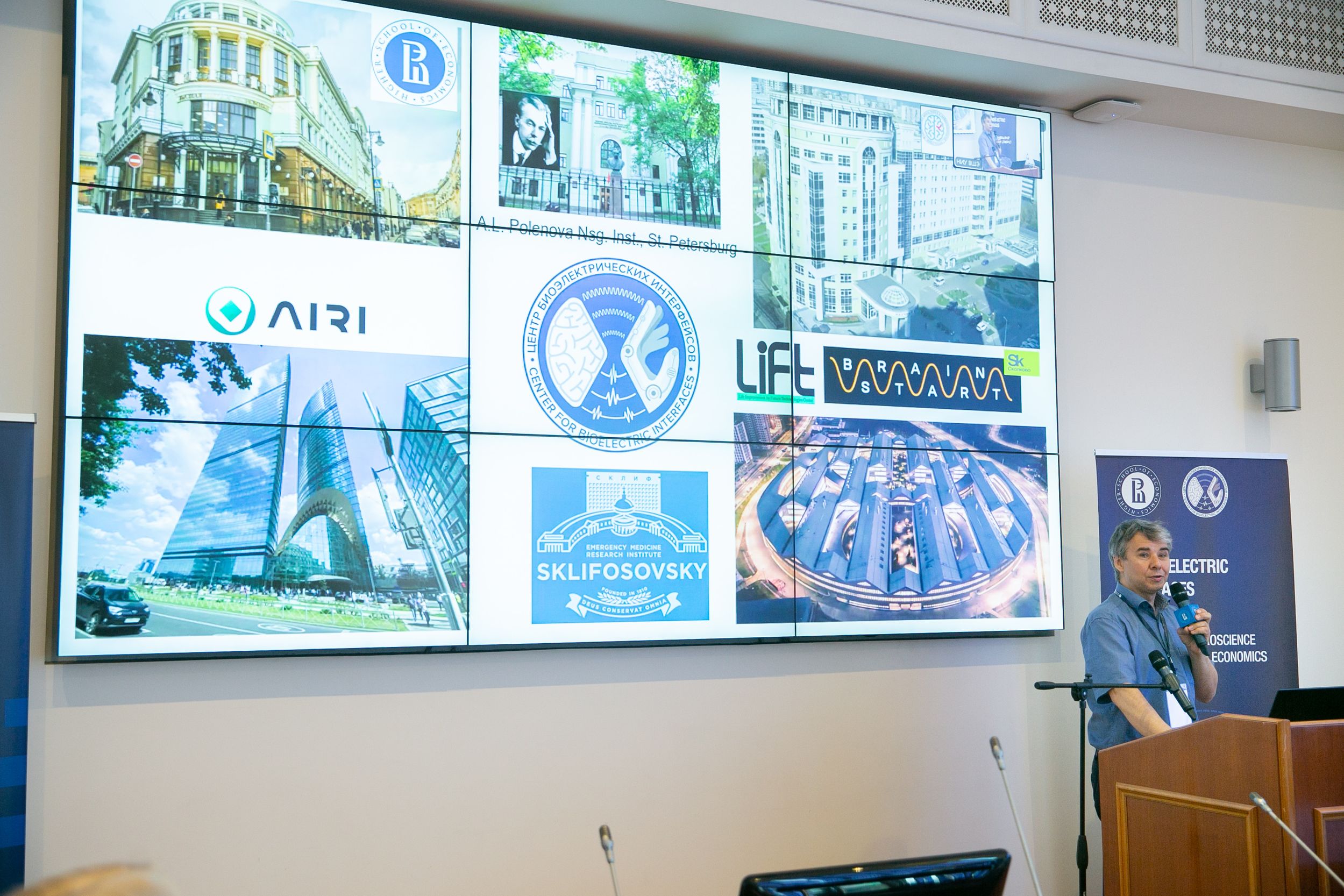
— Please tell us about your mirror laboratory with Samara State Medical University.
— As part of our mirror project, we have transferred the technology for real-time visualisation of brain activity based on EEG recordings to our colleagues. They have now mastered the technology and continue to explore its effective applications in their neurorehabilitation efforts. Our collaboration is ongoing. I recently returned from the BCI Samara conference, where I presented a report on the developments currently underway at the centre.
— How affordable are the prosthetics developed using your technologies?
— These are high-tech products manufactured in small batches, so they are not inexpensive. However, government subsidies make them affordable. This benefits not only patients in need of rehabilitation but also manufacturing companies, which receive sufficient resources to develop and produce more advanced prostheses.
— What is the current status of your international cooperation?
— Our international cooperation is ongoing. At the recent Spring School 'Next-Generation Neurointerfaces: Prospects for Practical Application 2025,' reports were presented by Christoph Guger, CEO of g.tec medical engineering GmbH, Austria, and Elizaveta Okorokova, a graduate of HSE's Master's programme in Cognitive Sciences and Technologies: from Neuron to Cognition who is now a researcher at the University of California, Davis, discussing the development of invasive interfaces for prosthetic control. We also collaborate closely with Guido Nolte, a world-leading expert in MEG data analysis, and with mathematician Rikkert Hindriks, who develops nonlinear methods for analysing brain electrical activity.

See also:

Physicists Train AI to Optimise Particle Beams in Accelerators
Researchers from the AI and Digital Science Institute at the HSE Faculty of Computer Science and the Budker Institute of Nuclear Physics at the Siberian Branch of the Russian Academy of Sciences have developed RLABC (Reinforcement Learning for Accelerator Beamline Control), a framework that uses reinforcement learning to identify optimal settings for a particle accelerator. In a computer simulation, RLABC optimised the accelerator's parameters to achieve a particle transmission rate of 70%. The study has been published in Computer Physics Communications.
'Organ-on-a-Chip Technology Could Eliminate the Need for Animal Testing'
The Laboratory of Molecular Physiology at the HSE Faculty of Biology and Biotechnology investigates how molecular regulators known as microRNAs control gene expression and contribute to the development of diseases, including cancer, viral and inflammatory conditions, and pregnancy complications. At HSE University, researchers develop organ-on-a-chip models: miniature devices containing living cells that mimic the functions of human organs, such as the placenta and intestines. These models help researchers understand how diseases develop and how drugs affect them. HSE News Service spoke with Evgeny Knyazev, Head of the Laboratory.
Fall into ML 2026: From Fundamental Research to Discussions on the Future of AI
On October 23–24, HSE University hosted Fall into ML 2026, the fifth conference on machine learning and AI. Over the past five years, the event has grown from a small gathering of researchers into a flagship platform that brings together leading machine learning specialists, early-career researchers, students, and representatives of technology companies. The fifth edition marked a new stage in the development of the conference, with a programme that included discussions with international speakers, presentations of joint research projects, and tutorials on the latest trends in AI.
Forecasting the Future of Science and Technology
The Laboratory for Science and Technology Studies at the HSE Institute for Statistical Studies and Economics of Knowledge (ISSEK) examines the current state of R&D and analyses emerging trends and their dynamics. This work helps assess the scale of challenges associated with the adoption of new technologies, identify priorities for future research, and inform science and industrial policy. The HSE News Service spoke with Liliana Proskuryakova, Head of the Laboratory, and Alexander Sokolov, Director of the Foresight Centre at ISSEK.
The Future of Humanoid Robots in the Home Explored at Foresight Session
On October 23–24, HSE University hosted the landmark fifth Fall into ML 2026 Conference. During the foresight session titled ‘A Humanoid in Your Kitchen: When Will It Happen and What Can Prevent It?’ researchers explored why humanoid robot assistants have not yet become part of our everyday lives, what needs to change for this to happen, and who will be held responsible when such assistants make mistakes.
‘A Reliable Bridge Between a Laboratory Prototype and a Working Service’
The HSE Faculty of Computer Science will complete the development of the third phase of the SmartMLOps system by the end of the year. This enterprise platform simplifies and accelerates the deployment of AI models in production environments. The work is being carried out as part of HSE University’s ‘Multi-Agent Platform of AI Solutions for Industry-Specific Tasks.’ Hadi Saleh, Head of the Unit for Applied Technological Solutions at the AI and Digital Science Institute of the HSE Faculty of Computer Science, explains what makes the new system unique and what challenges it will be able to address.
The Future of Connectivity: 6G Technologies Under Development at HSE University
Sixth-generation (6G) communication will require new devices and technologies, and a development team at HSE University is working on solutions in microelectronics and photonics as part of the university's Strategic Technological Project 'Trusted 6G Communication Systems Technology Suite.' In 2026, the researchers developed models and prototypes of devices, experimentally tested their characteristics, and agreed with industrial partners on formats for collaboration. The HSE News Service spoke with project coordinator Alexander Shurakov, Associate Professor at the School of Electronic Engineering of HSE MIEM, about how these developments can move beyond the laboratory.
'Our Research Can Be Described as Being at the Forefront of Science'
The International Laboratory of Cluster Geometry at the HSE Faculty of Mathematics focuses on establishing a new scientific discipline that brings together knowledge from different areas of mathematics. The laboratory’s research has attracted considerable interest from both Russian and international colleagues. Its researchers study families of curves and develop methods that are used to investigate the physical microworld. The HSE News Service spoke with the laboratory’s head, Prof. Sergei Lando.
AI Helps Predict Industrial Equipment Failures Before Emergencies Arise
The AI and Digital Science Instituteat HSE Faculty of Computer Science (FCS) presented a multi-agent hardware–software system that analyses the electrical parameters of industrial equipment and helps detect signs of malfunction at an early stage. The solution is designed to shift maintenance from repairing equipment after failures occur to predicting its condition and scheduling interventions before an emergency arises. The system was presented at the 4th Professional Conference for the IT and Engineering Community in the Oil and Gas Industry.
HSE University Wins Autonomous Search Tech Contest for LizaAlert Search and Rescue Team
The navigation system, developed by specialists from the Laboratory for Intelligent Unmanned Systems at HSE MIEM, is designed to search for missing people and allows the unmanned vehicle to autonomously execute route missions without satellite navigation. The Autonomous Search competition is notable for its comprehensive verification of actual working technologies. Out of 50 applications submitted, 15 were admitted to the qualification round, and four teams advanced to the finals.