

Digital Humanities: A God of Many Faces


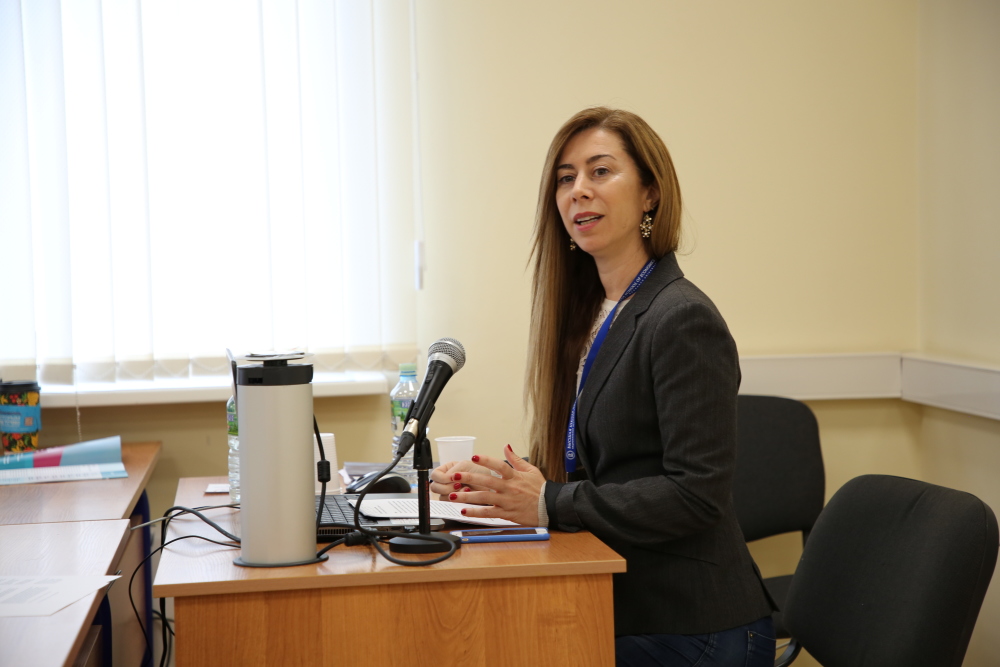


The presentation dealt with the most pressing questions in the field of Digital Humanities: ‘Can we still talk about the so-called Global Digital Humanities or should we focus on a regional or local scale?’, and ‘How does the technological development of a country impact on a scientific field in which digital infrastructures are needed for research and teaching?’
Dr del Rio Riande reflected on Digital Humanities both from a geopolitical and a technocritical perspective by addressing various contexts and conditions of possibility.
What are the Digital Humanities?
Computational methods have been applied in the humanities since the early 1950s. This has only increased over the past decades as the world has become digital. Now, the humanities are being studied in a different way due to the emergence of new possibilities – the availability of electronic texts, the development of methods for these texts’ automatic analysis, new capacities for storage and processing, and new tools for working with data.
There is no exhaustive definition of the digital humanities however Anastasiya Bonch-Osmolovskaya, Associate Professor at HSE’s Faculty of Humanities, explains it as a way of ‘creating interactive maps of correspondence between French enlighteners, building social networks using the letters and journals of the great poets, constructing 3D models of Ancient Rome, and automatically turning Hollywood screenplays into images.’
Digital Humanities as Translation
The field of Digital Humanities is related to naming, and particularly, to naming as an act of translation. Even the term ‘Digital Humanities’ is an English term, coined in an Anglophone linguistic and cultural context. It is now a scientific canon, providing order and structure for what has become a scientific field. However, what does this canon hinder?
According to Dr del Rio Riande, it hinders diversity and multiculturalism. There are very few geopolitical and technocritical approaches outside the Anglophone academies that question and problematize the hegemonic position of the English language inside the field, as well as how to deal with this hegemony in order to build a more real and representative Digital Humanities.
We don’t only translate among languages, but also among cultures. Digital Humanities is nowadays being done in many countries, however this is a process whereby practitioners from all around the world are adopting a certain paradigm and transforming it in their own way according to their specific context. This is also an act of translation, namely, a cultural translation, where the word is recoded, rearticulated and re-contextualised, such that it resembles the former either only somewhat or not at all.
If we don’t stop to consider what is inside the term ‘Digital Humanities’ locally, as opposed to globally, and what methods, academic spaces, infrastructures and encoding are used, as well as who does it and how, it will remain a fully formed western Anglophone project. Consequently, the dominance of the English language and the Anglophone perspective inside and outside the academy will continue to be naturalized. An example of this is the discriminatory indexing performed by web search engines which impacts on what we find when we look for information on the web in a certain language.
Digital Humanities as Technology
The Digital Humanities push researchers in the humanities field to master skills and knowledge that were once completely uncharacteristic– data analysis, data science, text mining, network theory, and geoinformatics, for example.
Unmistakably, software and digital structures are at the core of the digital humanities. They decide how a project is run and how it is published, consulted and preserved. In this sense, software and infrastructure are the ‘medium and the message’, as well as the technical and technological knowledge of the people involved in a project – they guarantee success.
For Gimena del Rio Riande, the question as to how technology intersects with epistemology is key in the Digital Humanities. Technology is always social and interrelated with other institutions. There can also be cultural forms, such as television. The World Wide Web created the false illusion of a natural democratization of knowledge ‘at a click’. However, search engines tend to discriminate everything that is not in English and also tend to work at a local level. There is no such thing as ‘global knowledge’. The web is therefore not neutral and transparent. Rather, it is filled with ideology and massively organizes the circulation of culture.
Digital technologies are often perceived as being neutral, however they are in fact the result of material inequalities that play out among the racial, gender, national and hemispheric lines. Not only are these technologies the result of such inequity, they also reproduce this inequity through their very use which is dependent on the perpetuation of global networks of economic and social disparity and exploitation.
Latin America groups 20 countries that suffer from wealth inequality, the impact of labour-saving technological change and a lack of adaptation to technological advancements. Is it possible to do Digital Humanities in this environment? There is a severe lack of funding, research institutes have obsolete technology and the obvious problems with digital literacy have blurred Digital Humanities landscape in Latin America. This digital divide has rendered it a field where researchers in Latin America are more interested in writing theory about media and open access policies than in carrying out a long-term, funded project. Moreover, the absence of institutional support has helped the growth of self-organized communities of practice, and the feeling that the Digital Humanities is just a kind of experiment, investigated with the aim of writing a paper on it.
Therefore, a critical eye is necessary. Technology needs to be critiqued in order both to know better the artefacts that are part of the Digital Humanities field as well as to improve the different cultural translations of Digital Humanities on a global scale.
Who is This God of Many Faces?
Different cultural translations of the Digital Humanities should not be part of a totalizing strategy which normalizes meaning and invalidates peculiarities which are not only linguistic but also social, cultural, techno-critical and geopolitical. One approach which overcomes the issues raised here might be to extend the cultural systems of the web to one where, taking into account the possibility of simultaneous coexistence of multiple forms of the same text, the web becomes a process of inter-semiotic translation. If we truly hope to understand the possible modes by which we, the digital humanists, might be capable of transforming humanistic research or how this might improve our understanding of digital culture, we should start by addressing the obvious fact of forced homogeneity in the Digital Humanities.

Anastasiya A. Bonch-Osmolovskaya
See also:

HSE Researchers Compile Scientific Database for Studying Children’s Eating Habits
The database created at HSE University can serve as a foundation for studying children’s eating habits. This is outlined in the study ‘The Influence of Age, Gender, and Social-Role Factors on Children’s Compliance with Age-Based Nutritional Norms: An Experimental Study Using the Dish-I-Wish Web Application.’ The work has been carried out as part of the HSE Basic Research Programme and was presented at the XXVI April International Academic Conference named after Evgeny Yasin.
China Bets on Expanding Leading Universities, Postgraduate Education, and STEM Fields
At the XXVI April International Academic Conference named after Evgeny Yasin at HSE University, one of the distinguished speakers was Prof. Liguo Li of the School of Education at Tsinghua University. He spoke about changes in the structure of higher education in China in line with national strategic priorities, including a proposed 1.7–2-fold increase in the number of leading research universities.
Scholar Explains How States Can Build Governance in Era of Mega-Shifts
How can states maintain governability and stability in a world where established rules are rapidly losing their force? Prof. Ali Farazmand of Florida Atlantic University answered this question in a presentation delivered at the XXVI April International Academic Conference named after Evgeny Yasin. The scholar proposed examining the transformation of the global order through the lens of two ‘mega-shifts’—from the rise of global corporate capitalism to the emerging multipolarity of today—and demonstrated why this transition between eras requires fundamentally new approaches to governance.
Supercomputers as Superheroes: How High-Performance Computing Is Saving the World
Modern supercomputers can perform more than a trillion calculations per second. This immense capacity enables researchers to address problems that were previously intractable. At the XXVI April International Academic Conference, Ilias Kotsireas, a professor at Wilfrid Laurier University, spoke about the potential of high-performance computing in fields such as weather and climate modelling, astrophysics, and medicine.
A Time for Flexible Solutions: How China Trains In-Demand Specialists
Building an effective workforce training system requires not only appropriate institutions, but also well-developed intermediary organisations capable of translating policy into practice and connecting different groups of stakeholders, said Dr Po Yang, Professor at Peking University. She was an invited speaker at the XXVI April International Academic Conference named after Evgeny Yasin.
XXVI April International Academic Conference Kicks Off at HSE University
The conference programme covers five research topics: economics; human capital and society; instrumental methods and models; foresight research; and international research. Hundreds of scientists from around the world will take part in the conference.
Applications for Participation in XXVI April International Academic Conference Still Open
Applications can be submitted on the conference website until December 16, 2025. The programme has been developed around five research themes: Economics, Human Capital and Society, Instrumental Methods and Models, Foresight Research, and International Research. The heads of these areas have presented, in video format, the priority topics and sections for which they are expecting submissions.
Applications to Participate in April International Academic Conference Now Open
HSE University is now accepting proposals to present academic reports at the XXVI April International Academic Conference named after Evgeny Yasin. Applications can be submitted until December 16, 2025. The conference events will take place mainly on-site in Moscow from April 14 to 17, 2026.
24 Countries Represented at 25th Yasin International Academic Conference Held by HSE University
The Programme Committee of the 25th Yasin (April) International Academic Conference on Economic and Social Development has summed up the initial results. In 2025, 1,384 people from 24 countries and 29 Russian regions participated in the conference, with 335 of them delivering presentations.
Stuck in the Net: How Much Time Children Spend Online
On average, a schoolchild spends 48 hours a week on studies—equivalent to a six-day working week for an adult. This was highlighted by experts at the round table ‘Domains of Children’s Well-Being Evaluation for Human Potential and Evidence-Based Social Policy Development,’ held as part of the 25th Yasin (April) International Academic Conference.