
The group was formed in July 2019 at the Laboratory for Research in Inflation and Growth of the Expert Institute at HSE University (Moscow). The group performs empirical research on long-term economic growth and productivity. It also researches structural change and cross-sectoral linkages, cross-country comparisons of income and wealth, the micro-foundations of productivity growth, the problems of productivity measurement, and historical statistics.
The major objective of the group is to update and extend the Russia KLEMS database, which has been supported by HSE University since 2007 as a participant of the World KLEMS initiative.
News
As part of the 23rd Yasin Conference, Ksenia Bobyleva presented at session A-5-4 on Measuring Economic Growth. Investment in ICT capital and intangible assets are a significant growth factor in the knowledge economy.
April 23, 2022
A special issue of the journal Review of Income and Wealth has been published, dedicated to the conference “Experiences and Challenges in the Study of Income and Wealth in Eastern Europe and the CIS”. The conference was held in Moscow, at HSE University, together with the International Association for Research on Income and Wealth on September 17–18, 2019
April 22, 2022
The roundtable discussed the issues of growth limitations for the Russian economy, sources of growth in conditions of isolation, import substitution opportunities, reserves for increasing the efficiency in the distribution of resources, and the role of the state in restructuring value chains.
April 22, 2022
Within the framework of the XXIII Yasin International Scientific Conference on Problems of Economic and Social Development, at session A-5-3. Macroeconomic policy and long-term growth, the report "Market defects, intersectoral interactions and industrial policy in the Russian economy" was delivered by Anton Tolokonnikov.
April 22, 2022
The inefficient distribution of resources leads to a lower rate of economic growth and a lower level of social development compared to what can potentially be reached. This is due to distorting taxes and subsidies, and market imperfections. Market imperfections are the costs incurred by economic agents to overcome obstacles related to imperfections of competition, information asymmetry, and barriers to market access. The impact of market imperfections is determined by the structure of intersectoral relations. Market imperfections in the upstream part of production chain (intermediate goods production) bring larger distortions than market imperfections in the downstream part of production chain (closer to final goods). The correlation of the sectoral structure of taxes and subsidies with market imperfections can increase the efficiency of resource allocation in the economy and, thus, increase output and social welfare. The instrument of such improvement is the industrial policy, which contributes to a change in the sectoral structure of net taxes with respect to market imperfections. To what extent do the criteria of the industrial policy used in Russia contribute to a more efficient distribution of resources in the economy? What are the possibilities for improving it? In this article we use approach from Liu (2019) and Input-Output tables for Russia in 2016 to arrange sectors in accordance with the size of the effect of a subsidy of 1 ruble on aggregate output. The highest effect is in supporting sectors, producing productive services, for instance, car and equipment rental services; financial intermediation services; some transport services. It is shown that support for industries with a high proportion of intermediate products in output leads to an increase in aggregate output. Support of sectors with a high employment-to-value-added ratio leads to a decrease in aggregate output.
February 05, 2022

Experts believe that increasing productivity, diversifying the economy, as well as developing human capital and expanding non-resource exports will help boost Russia's economic growth. But the state policy has to be smart. This was discussed at a series of round tables and expert discussions on the topic of productivity at the XXII April International Academic Conference on Economic and Social Development, organised by HSE University and Sberbank.
April 20, 2021
On April 14, at the XXII April Conference, a team under the supervision of Vladimir Gimpelson presented their report, prepared as part of the HCMRC (Human Capital Multidisciplinary Research Center) program.The labor force quality indicator from the Russia KLEMS data set made it possible to assess the contribution of labor force quality to labor productivity growth in the Russian economy, and to compare this contribution with similar indicators for former Soviet republics.The research concludes that Russian human capital is not as productive as it could be. The quality of the labor force does not make a tangible contribution to the growth of labor productivity and an acceleration of growth due to the role of human capital will not occur in the next two to three decades.
April 14, 2021
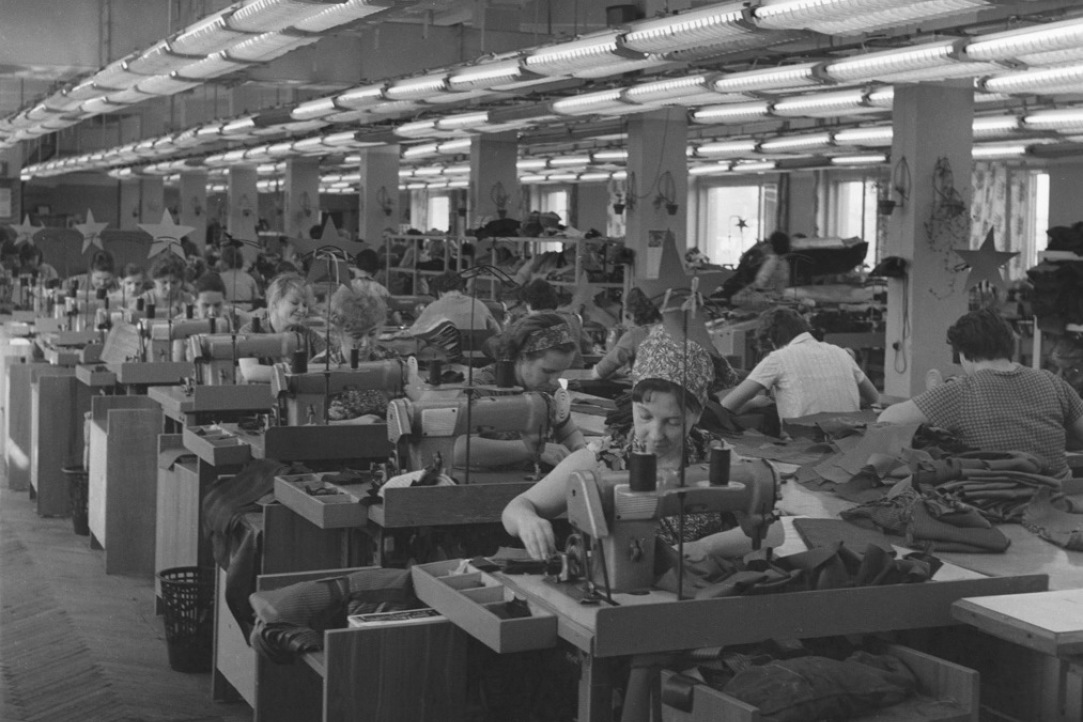
Researchers trying to compare economic data of the USSR and capitalist countries face questions of the comprehensiveness, accessibility, and reliability of data on Soviet economic production and growth. At an online seminar hosted by the HSE University International Centre for the History and Sociology of World War II and its Consequences, Assistant Professor Ilya Voskoboynikov (Faculty of Economic Sciences, HSE University) presented an overview of available approaches to studying the absolute size of the Soviet economy and its growth rates.
January 27, 2021
The 7th issue of “Voprosy Ekonomiki” (Questions of Economics) contains the speeches of the participants of “Long-term economic growth in Russia: prospects for recovery” round table, which took place on April 12 as part of the “April XXI” conference. The publication includes materials by Natalia Akindinova, Marek. Dabrovski, Alexandr Shirov, Dmitry Belousov, Ilya Voskoboynikov and Evsey Gurvich.
July 10, 2020
On May 12 the roundtable was held, chaired by Evsey Gurvich, head of the Economic Expert Group. Topical issues of economic growth were discussed, including prospects after the coronavirus pandemic and forecasts for the short-term and long-term growth rates of the Russian economy. The current budget policy, the experience of recovery after the crises of 1998 and 2008, and sectoral growth drivers, in particular, were considered.
May 22, 2020