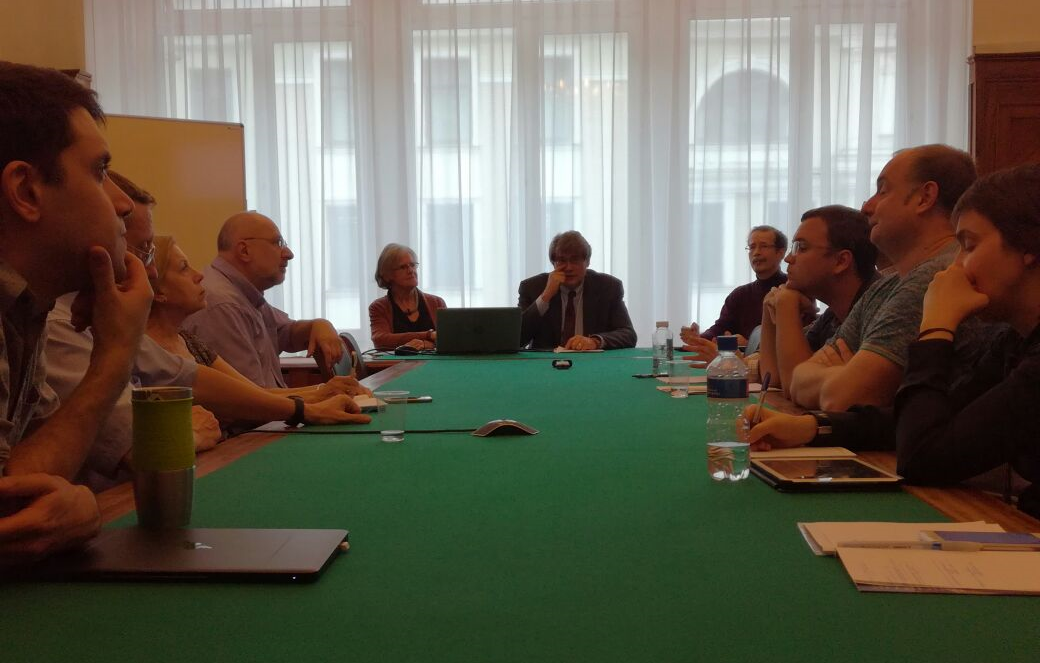
International cooperation in science and innovation is not only able to help solve global issues, such as the battle against climate change, hunger and incurable diseases, but also to overcome political disagreement between countries. The joint international OECD-HSE workshop 'Transnational research and innovation partnerships. Designing international co-operation projects to deliver on economic competitiveness and the grand challenges' addressed the question of how to achieve maximum effectiveness in such cooperation, best practices in organizing research cooperation, and the support tools that the state should provide.
International cooperation in science and innovation is not only able to help solve global issues, such as the battle against climate change, hunger and incurable diseases, but also to overcome political disagreement between countries.
On Wednesday, May 16 the all-Russian seminar "Mathematical methods of decision analysis in economics, finance and politics" was held. D. Frolov gave a lecture on "Annotation of a Document Collection by Finding Thematic Fuzzy Clusters and Parsimoniously Lifting Them in a Domain Taxonomy".
This book offers a comparative analysis of value and identity changes in several post-Soviet countries. In light of the tremendous economic, social and political changes in former communist states, the authors compare the values, attitudes and identities of different generations and cultural groups. Based on extensive empirical data, using quantitative and qualitative methods to study complex social identities, this book examines how intergenerational value and identity changes are linked to socio-economic and political development. Topics include the rise of nationalist sentiments, identity formation of ethnic and religious groups and minorities, youth identity formation and intergenerational value conflicts.
Wolfgang Polt serves as Director of Policies at the Institute for Economic and Innovation Research Policies, Joanneum Research, in Austria. At a special session of the April International Academic Conference on Economic and Social Development hosted by the HSE Institute for Statistical Studies and Economics of Knowledge (ISSEK), he gave a report entitled 'Mission-oriented STI Policies for the Future - What Lessons from the Past?' Following the event, he spoke with the HSE News Service about his impressions of this year’s April Conference, the current state of STI policy globally and in Russia, and future projects he plans to undertake through collaboration with colleagues at HSE.
On April 19 Obukhov A.S. (PhD, senior research fellow at the Center for the Study of Modern Childhood of the Institute of Education of the Higher School of Economics) took part in the "Culture matters" research seminar with the report "Possibilities and limitations of researching modern ritual practices by visual means".
David Schindler became the 5th speaker this year to present his research at the ICSID-CSDSI regular seminar on Diversity and Development. The seminar was held jointly with the seminar “Political Economy” and Economic Development and Growth Research Group on April 17, 2018.
At the round table discussion 'Strategic planning: moving on towards a working model' during the XIX April International Academic Conference on Economic and Social Development members of the Russian Government and representatives of various ministries jointly with HSE researchers considered how efficiently the country does its strategic planning, and which specific tools it uses in the process.