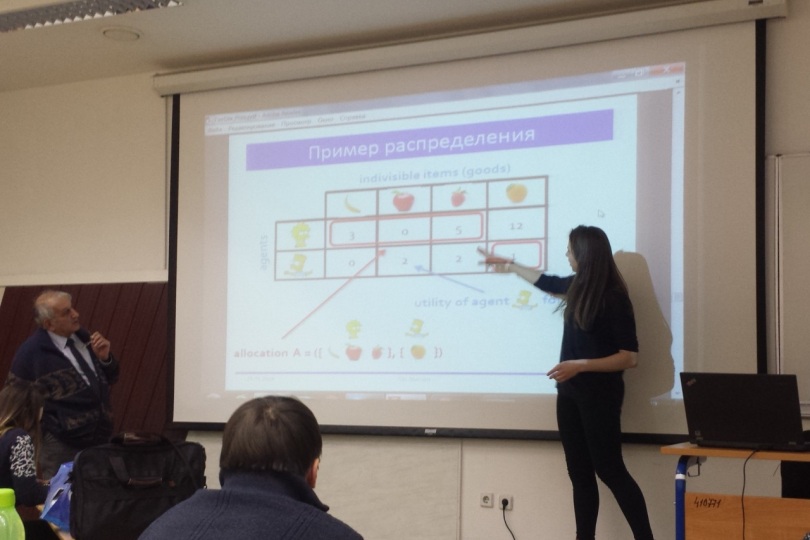
Febrary 1, Stanislav O. Speranski, Scientific Researcher Laboratory of Logical Systems Sobolev Institute of Mathematics, gave a presentation at the session of the seminar of International Laboratory for Intelligent Systems and Structural Analysis.
On January 21, Ivan Ninenko, former associate Director of NGO "Transparency International - Russia", lecturer at Miami University, took part in the "Culture Matters" research seminar with the a report on "How people make moral decisions: experimental methods in studies of dehumanization and prejudice".
January 14, Edgar Demetrio Tovar-García, PhD in Economics, University of Barcelona, Associate Professor of the Department of Public Policy (Faculty of Social Sciences, HSE) took part in the "Culture Matters" research seminar with the report on "Migration background and educational achievements in Russia".
of those who are currently working toward Candidate of Science and Doctor of Science degrees in Russia are younger than 40 years old. The Monitoring of the Labour Market for Highly Qualified R&D Personnel survey was conducted across Russia in September-October 2015 based on a representative sampling. In total, 2,150 people were surveyed.
The latest issue of Foresight and STI Governance (2015, Vol. 9, No. 4) covers long-term socioeconomic challenges for Russia and directions for the Russia’s science and technology cooperation; technological innovations in automotive industry and telemedicine; scenario planning method and the epistemological foundations of music piracy in the digital marketplace.
The latest issue of Foresight and STI Governance (2015, Vol. 9, No. 4) covers long-term socioeconomic challenges for Russia and directions for the Russia’s science and technology cooperation; technological innovations in automotive industry and telemedicine; scenario planning method and the epistemological foundations of music piracy in the digital marketplace.
The latest issue of Foresight and STI Governance (2015, Vol. 9, No. 4) covers long-term socioeconomic challenges for Russia and directions for the Russia’s science and technology cooperation; technological innovations in automotive industry and telemedicine; scenario planning method and the epistemological foundations of music piracy in the digital marketplace.