

HSE University Holds 10th Summer School ‘Eye-tracking in the Lab and Beyond’
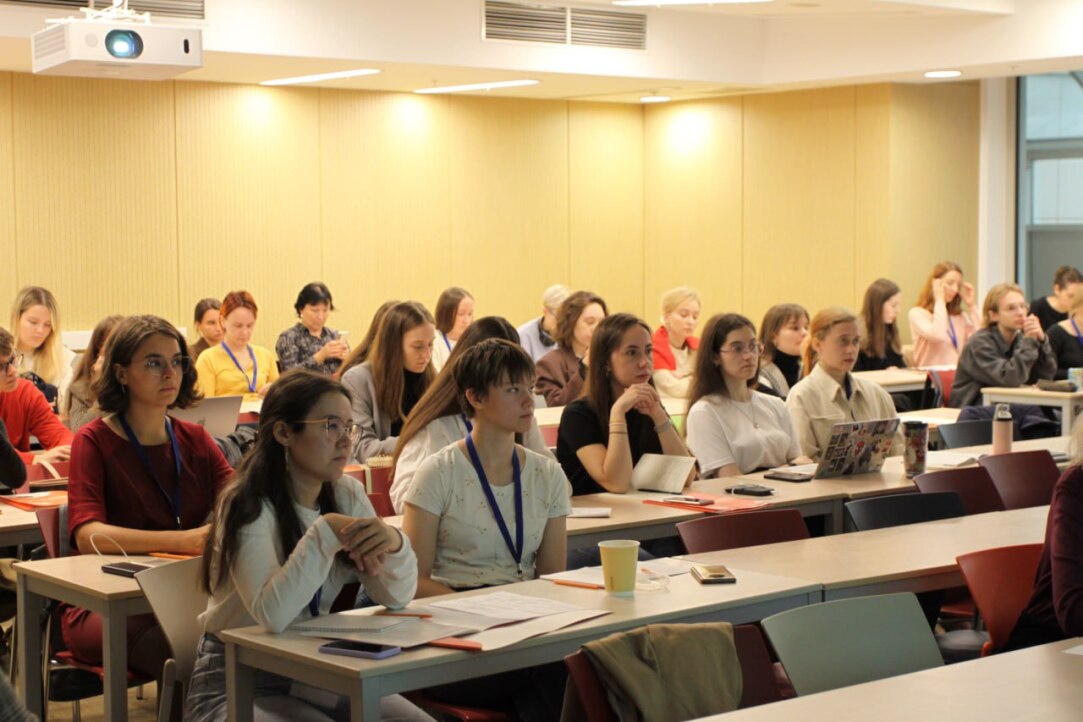
This year, more than 100 students from Russia and abroad took part in the 10th summer neurolinguistic school, ‘Eye-tracking in the Lab and Beyond’. The school is held annually by the HSE Center for Language and Brain. Leading experts spoke about advanced developments and research in the field of video-oculography.
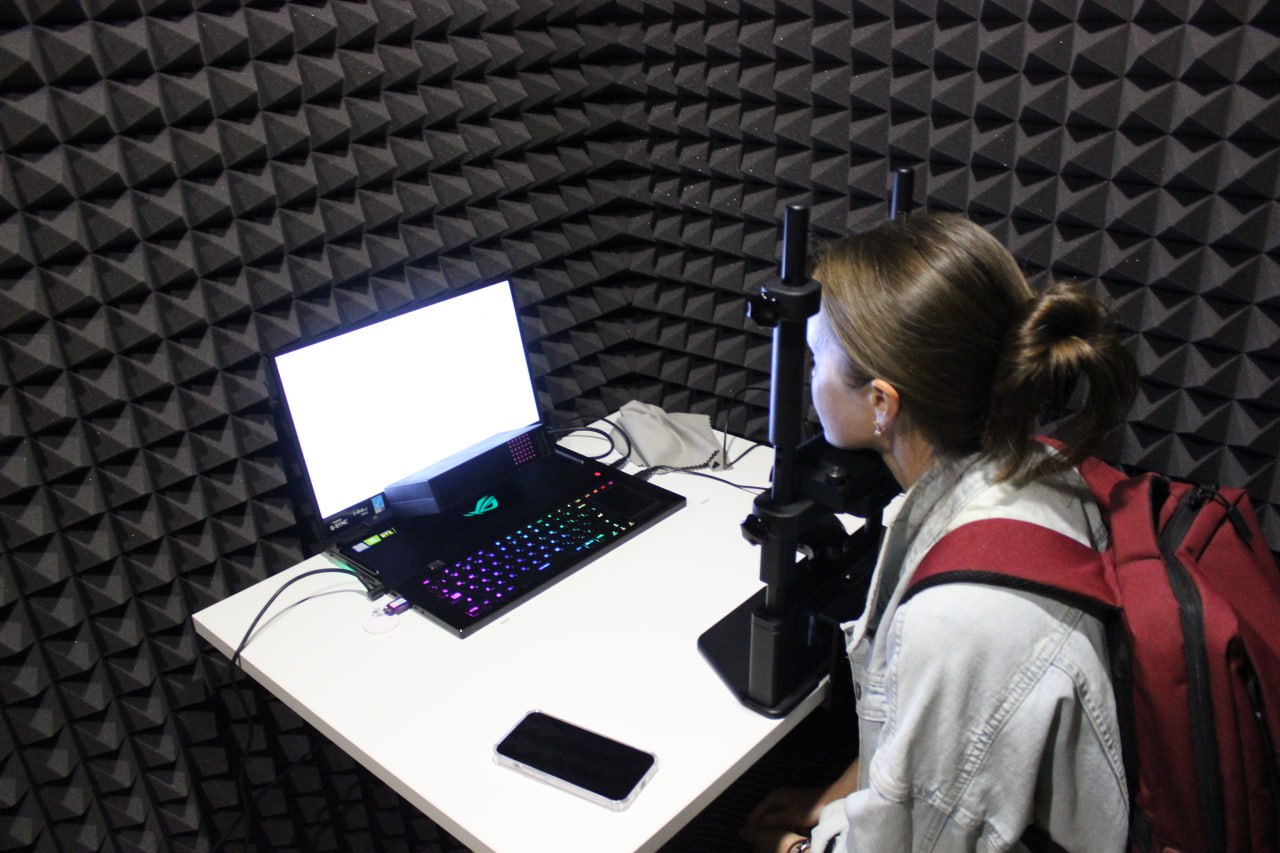
Video-oculography, or eye-tracking, is a modern research method that allows scientists to record eye movements using powerful equipment including special portable glasses equipped with video cameras.
HSE Center for Language and Brain is one of the leading Russian scientific organisations engaged in research within the field of video-oculography. Since opening in 2018, the centre has conducted multiple studies with the participation of children and adults, as well as speakers of rare languages, such as Adyghe and Tuyuk. In addition, the centre’s video-oculographic studies have made a great contribution to the study and development of methods for correcting reading problems in children.
Anastasia Lopukhina, researcher at the University of London, presented an overview of recent studies on eye movement during reading in children. Studies have shown that the transparency of spelling affects the speed at which children learn to read. In addition, Anastasia talked about whether TV subtitles in their native language can help children develop their reading skills faster.
Irina Sekerina, a researcher from New York University, spoke about experiments which register eye movements using a webcam. This new methodology gained particular popularity during the COVID-19 pandemic, because it allows scientists to conduct research and collect data online without using expensive equipment. Despite the fact that the methodology has a number of limitations, its accessibility has great potential for conducting psycholinguistic research.
The report of Svetlana Alekseeva, senior researcher at the Institute for Cognitive Studies of St. Petersburg State University, was devoted to the study of eye movements for testing Cyrillic fonts, including the recently developed Cyrillic LexiaD font adapted for people with dyslexia.
On the second day of the school, Anna Izmalkova, research fellow at HSE Centre for Cognition & Decision Making, spoke about eye movement research in the field of visual searches and problem solving strategies. Based on the analysis of eye movement patterns and mistakes made, researchers can conclude what strategy a person uses when learning new words.
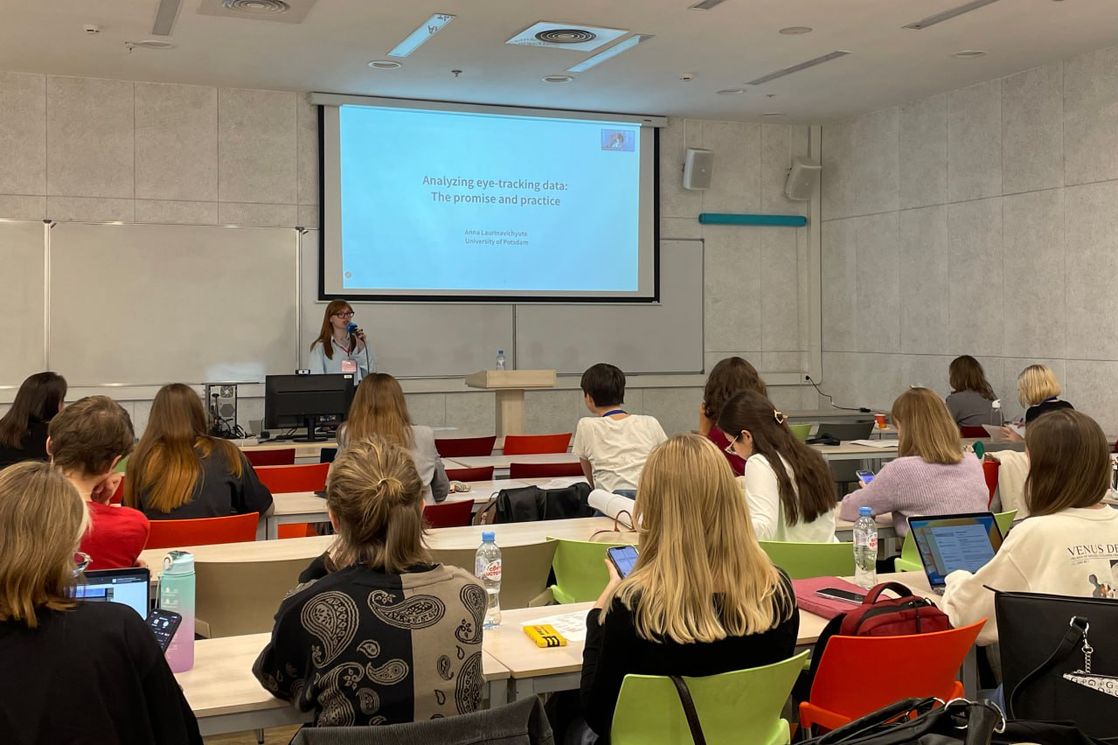
Anna Laurinavichyute, a postdoctoral researcher at the University of Potsdam, presented a report on traditional methods of analysing and processing video-oculographic data, as well as on new, more accurate and complex approaches that will improve the quality of video-oculographic research.
The report of Soroosh Shalileh, research fellow at the Center for Language and Brain, head of the Vision Modelling Laboratory, was devoted to the diagnosis of dyslexia based on machine learning and eye movement analysis. This diagnostic method has an advantage over traditional screening, which may require a lot of time and the involvement of highly qualified specialists, so its use should lower the age at which dyslexia is detected.
Representatives of ‘Neuroiconics’ made a presentation ‘From simple to complex. Modern solutions in the field of video-oculography in science, education, medicine and neuromarketing’ and demonstrated modern video oculographs.
During the school, Anna Izmalkova and Tatiana Ledneva, research assistant at HSE Centre for Cognition & Decision Making, held a workshop on working within the ‘Eye Movement Modeling Example’ paradigm. This approach is widely used to improve the efficiency of knowledge transfer during interaction between an expert and a novice in an educational context.
Elena Gorbunova, Head of HSE Laboratory for Cognitive Psychology of Digital Interface Users, spoke about the use of video-oculography in UX research. This method can be used to determine patterns of user behavior — for example, to determine a strategy for finding information or to identify what exactly the user focuses on while working with a particular interface.

‘It is important for us that the participants of the school were able to learn more about the areas of work of the Center for Language and Brain and talk about their research in the field of video-oculography. The great interest in this area confirms its relevance, and together we will make many more important discoveries,’ said Olga Dragoy, director of the Center for Language and Brain.
The school was held with the support of the HSE Human Capital Multidisciplinary Research Centre.
See also:

Parietal Cortex Influences Risk-Taking Behaviour
Making decisions in situations involving risk and uncertainty is an inherent aspect of our daily lives. Should I obtain luggage insurance for my flight, cross the road when the light is red, or leave my current job for a new opportunity? Researchers at the HSE Institute for Cognitive Neuroscience conducted an experiment to clarify the role the parietal cortex plays in decision-making in the context of risk. They found that suppression of activity in the parietal cortex resulted in subjects being less inclined to take risks. A paper with the study findings has been published in Cerebral Cortex.
Cognitive Reappraisal of Negative Emotions Can Help Manage Stress
Researchers at the HSE International Laboratory of Social Neurobiology assessed the effectiveness of two strategies for regulating emotions: reappraisal and suppression. Having analysed data on the electrical activity of 60 individuals’ brains, the scientists discovered that both approaches put additional strain on the nervous system. It was also found that individuals who are prone to emotional contagion tend to be more effective in using reappraisal and managing negative emotions. The paper has been published in Experimental Brain Research.
Russian Researchers Unveil Mechanism Underlying Language Processing Disruptions in Epilepsy Patients
Researchers at HSE University and the Pirogov National Medical and Surgical Centre have examined alterations induced by epilepsy in the language-related neural network within the brain. Using graph-based analysis, the researchers studied fMRI data from 28 patients and found that in epilepsy, both hemispheres of the brain become activated during language processing and short connections form between the hemispheres, while long connections within one hemisphere are disrupted. The study has been published in Epilepsy&Behavior.
HSE Creates ‘Transfer of Neurocognitive Technologies’ Consortium
HSE, the Pirogov National Medical and Surgical Centre, and the Centre for Speech Pathology and Neurorehabilitation of the Moscow Healthcare Department have signed an agreement on cooperation and the creation of a ‘neuro-consortium’ under the name ‘Transfer of Neurocognitive Technologies’. The new body will boost the development and implementation of advanced solutions in neurotechnology aimed at maintaining and improving people's health. The agreement was signed for five years, and the consortium is open to new participants.
'While it May Sound Futuristic, It Holds Great Promise': Olga Dragoy Shares Her Thoughts on Language Function Restoration and the Future of Neurotechnology
In the spring of 2023, the fifth strategic project of the Priority 2030 programme, 'Human Brain Resilience: Neurocognitive Technologies for Adaptation, Learning, Development and Rehabilitation in a Changing Environment,' was launched at HSE University. The strategic project brings together researchers from all campuses of HSE University. In her interview with the HSE News Service, Olga Dragoy, head of the strategic project and Director of the HSE Centre for Language and Brain, shares an overview of the advanced technologies neuroscientists are creating today, the underlying inspiration driving these efforts, and the operational dynamics of interdisciplinary applied projects.
‘It Was Great to Look at Scientific Achievements through the Eyes of a Journalist, not a Scientist’
HSE University in Nizhny recently hosted the 2nd Autumn Neuro-linguistic School ‘NeuroSciCom: Popularising Language and Brain Studies’ for scientists and students at the HSE Centre for Language and Brain Studies in Nizhny Novgorod. The school was held as part of the 'Human Brain Resilience: Neurocognitive Technologies for Adaptation, Learning, Development and Rehabilitation in a Changing Environment' Strategic Project of the Priority 2030 programme.
The Brain Is a Network of Networks. Scientists Have Found a Way to Unravel Them
A team of researchers from HSE University and the Artificial Intelligence Research Institute (AIRI) have demonstrated the effectiveness of the PSIICOS method they had previously developed for non-invasive mapping the neural networks in the brain based on its electrical activity. Unlike other methods, it does not search for individual neuronal sources to be then combined into networks but instead looks directly for the functional networks of interconnected neuronal populations—and does so swiftly and accurately. The study findings have been published in NeuroImage.
HSE Neuroscientists Use Neural Network to Enhance Neurofeedback Technology
Researchers from HSE University and the Artificial Intelligence Research Institute (AIRI) have successfully lowered the latency between a change in brain activity and the presentation of the corresponding neurofeedback signal by a factor of 50. The results were obtained by employing a neural network trained in low-latency filtering of brain activity signals from diverse individuals. This approach opens up new prospects for the treatment of attention deficit disorder and epilepsy. A paper with the study findings has been published in Journal of Neural Engineering.
Online Rhythmic Transcranial Magnetic Stimulation Can Reveal the Precise Moment When Preferences Shift in the Human Brain
Cognitive dissonance is a complex and multifaceted psychological phenomenon that arises in challenging decision-making scenarios. Multiple regions of the brain participate in its occurrence, yet the neurodynamics of underlying cognitive mechanisms remain a subject of debate. Researchers from the HSE Institute for Cognitive Neuroscience have proposed the use of online transcranial magnetic stimulation applied to participants as they were actively engaged in tasks, to pinpoint the moment of cognitive dissonance resolution. Their findings have been published in a review paper in Frontiers in Human Neuroscience.
Data Analysis and Personalised Medicine: Summer School in Cardiogenetics
The Continuing Professional Development Centre of the HSE Faculty of Computer Science has recently hosted the summer school 'Cardiogenetics: From Sequencing to Constructing a Cardio Panel'. The school programme was co-organised by the Russian Academy of Sciences' Institute of Analytical Instrumentation and Institute of Spectroscopy and the Syntol company.