On March 22, HSE’s School of Psychology organized a talk by Professor Geoffrey Saxe, from Graduate School at UC Berkeley, on Cultural Development of Mathematical Ideas. The talk was based on the results of Prof. Saxe’s expedition to Papua New Guinea where he studied a remote Mountain Ok community. In his interview with HSE News Service Professor Saxe talks about his research.
Prof. Dr Thomas Dohmen from the Institute for Applied Microeconomics, University of Bonn, Germany is to deliver an honorary lecture at the upcoming April Academic Conference at HSE University April 9 – 12. HSE News Service spoke with Dr. Dohmen about his work on the Global Preferences Survey (GPS), an international survey of epic proportions that he helped develop and analyze in order to learn whether individuals differ in terms of economic preferences by country, and more.
Mobile and web-based applications available today allow patients to self-diagnose and self-prescribe treatment. Galina Polynskaya and Margarita Mesropyan have examined to what extent patients and doctors trust such technology.
Legally, the 1917 revolution solved the gender issue in the Russian academic community. The doors to the profession opened for women, but a ‘glass ceiling’ remained. Ekaterina Streltsova and Evgenia Dolgova studied who it affected and why. This study is the first to present a socio-demographic analysis of the female academic community in Moscow and Leningrad during the early Soviet era.
Scholars from HSE University have developed an algorithm that detects emotions in a group of people on a low-quality video. The solution provides a final decision in just one hundredth of a second, which is faster than any other existing algorithms with similar accuracy. The results have been described in the paper ‘Emotion Recognition of a Group of People in Video Analytics Using Deep Off-the-Shelf Image Embeddings.’
During the XX April International Academic Conference on Economic and Social Development, scheduled this year for April 9-12 at the Higher School of Economics, Dr David Garcia of the Complexity Science Hub Vienna and the Medical University of Vienna, Austria will present a report entitled ‘The digital traces of collective emotion’ at a session on ‘The Wellbeing of Children and Youth in the Digital Age.’ Ahead of the conference, Dr Garcia spoke with the HSE News Service about his conference presentation, his research, and plans for ongoing collaboration with HSE colleagues.
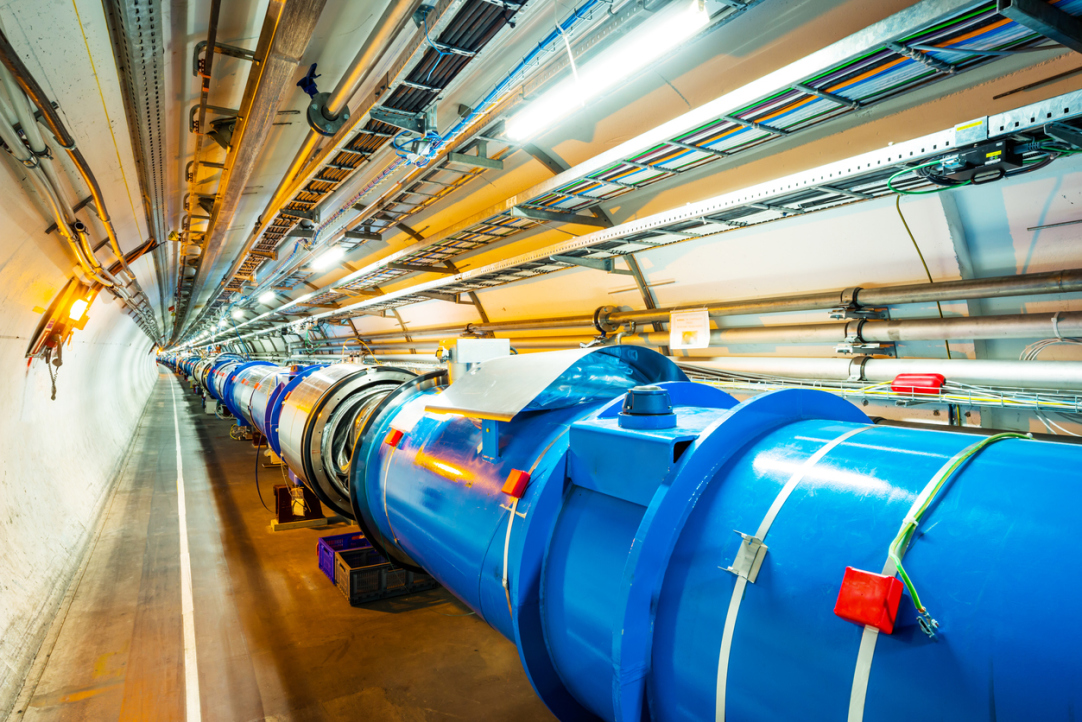
Scientists from HSE University and Yandex have developed a method that accelerates the simulation of processes at the Large Hadron Collider (LHC). The research findings were published in Nuclear Instruments and Physics Research Section A: Accelerators, Spectrometers, Detectors and Associated Equipment.
Anyone moving in a large crowd, absorbed in their phone and yet avoiding collisions, follows certain laws that they themselves create. The movement of individuals as a condition for the movement of masses is the subject of a recent study by Dr. Andrey Korbut.
A public council for the independent evaluation of the quality of education conditions has been created at the Ministry of Education of the Russian Federation. Alexander Milkus, Head of the HSE Laboratory for Educational and Youth Journalism, has been unanimously elected as its chair.
HSE researchers have shown that a child’s phonological abilities (including sensitivity to the sound composition of speech and the ability to identify individual sounds and syllables) are connected with mathematical aptitude in elementary school. However, the relationship between sound speech sensitivity and the development of mathematics varies depending on the socio-economic status of the child’s family.


.jpg "How Equality Started in Research")