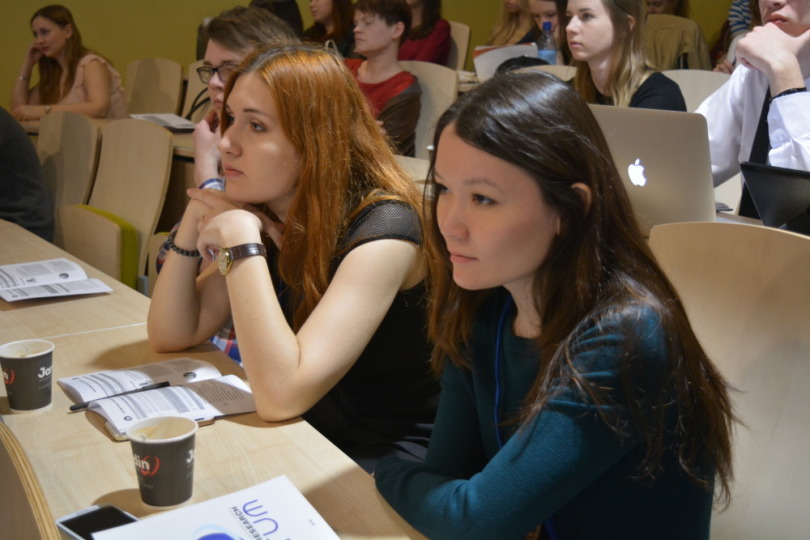
The Higher School of Economics is very serious about students getting involved in undergraduate research. For Russian Science Day, celebrated on February 8, the HSE News Service spoke with three young HSE researchers about their work and learned how the students set goals for themselves, achieve results, and move forward with what some might deem frighteningly ambitious research ideas.
As 2015 drew to a close, a panel of qualified judges was busy deciding on the results of HSE’s Student Research Competition. Out of nearly a thousand submissions in 17 different fields, a jury selected 94 prize recipients, all of which demonstrate how broad and complex the research interests of HSE’s students are.
Students of the Higher School of Economics have developed an app called Chill that allows users to talk to their friends on their portable devices (the Apple Watch and Android Wear) without using text or voice. The application went on the market June 9th and was instantly added to Product Hunt, the world’s largest platform for startups.
On 20th May 2015 Dr Michael Minch, Professor of Philosophy at Utah Valley University, gave an open lecture at HSE Nizhny Novgorod. A specialist with a unique combination of interests ranging from theological ethics to politics, Professor Minch brings together what at first glance appear to be irreconcilable — politics and ethics.
For the first time, students and post-grads are invited to listen in on plenary sessions of the International April Conference. They will be able to find out ‘from the horse’s mouth’ what the world’s top academics, economists, government and public figures think about the current state of Russia’s economy and society.
In choosing a field for further studies, high school students are influenced by their peers, among other factors. For example, a high school student interested in technology among a class of peers who are not so good at physics may perceive it as a competitive advantage, increasing the likelihood of their choice of a technical field for a career, according to Andrey Zakharov , Deputy Head of the International Laboratory for Education Policy Analysis at the HSE's Graduate School of Education, and Elizaveta Chernenko , Research Fellow of the same laboratory.
A voice navigator for the visually impaired, English language learning games, teaching computer programming to children are the results of two days intensive work by young people at Hackathon (forum for developing software), Hack for People at the HSE Centre for Prototype Development. The participants had just 48 hours to formulate the concept for a project, write a strategy to promote and create it or fine-tune a prototype.
From July 5-12, the HSE Innovation and Enterprise Office is hosting a visit by Singapore students. Their programme will include educational, as well as cultural and entertainment activities. Included in the programme is a master class by Professor Desai Narasimhalu, known by many as the sensei of the innovation industry.
With the support of the Korean Fund, HSE’s School of Asian Studies held the Third All-Russian Student Olympiad for the Korean Language on May 12-13. This year, the Olympiad saw the participation of 29 students from 20 Russian universities in Moscow, St. Petersburg and the Far East. Kseniya Andryuschenko, who was one of two students representing the Higher School of Economics’ School of Asian Studies, took third place at the competition.