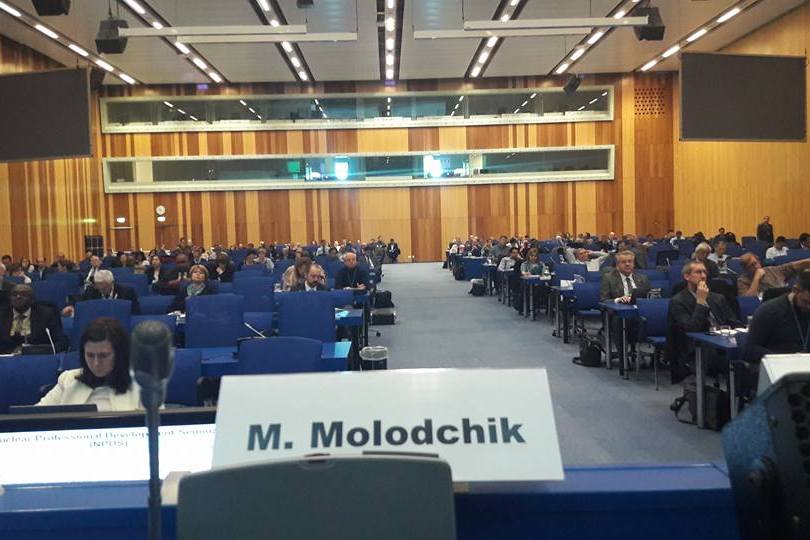
Sophia Paklina has presented the results of the joint research with Mariia Molodchik "Strategic behavior of Russian companies". Authors have constructed the index of human resources and made a clusterization of Russian companies for identifying intensification intellectual resources strategy.
Tag "conferences & seminars"
The 57th Annual Meeting of the Psychonomic Society took place last week in Boston, Massachusetts, USA.
Neurolinguistics laboratory held an open science lecture "Aphasia: speech disorders in brain damage". The lecture was intended for everyone and did not require prior knowledge.
On November 14, the Swiss Green Economy symposium took place in the city of Winterthur which gathered opinion leaders from medium businesses, politics and science. HSE Institute for Statistical Studies and Economics of Knowledge was represented by its deputy director Alexander Sokolov and professor Ozcan Saritas, which was mentioned in the review of forum results by the local newspaper Der Landbote. HSE staff also participated in the seminar in framework of implementation of the cooperation agreement between the Russian Federation and Switzerland.

Discussions at the “Foresight and STI Policy” conference the HSE Institute for Statistical Studies and Economics of Knowledge is hosting for the sixth year in a row, highlight the changes in approaches to studying the current state and expected development trends in the S&T sphere. Major trends of Russian and international Foresight studies include deep integration of their results into science, technology and innovation (STI) policies at all levels, growing number (and complexity) of analytical techniques, and involvement of new actors.
In October, at the invitation of HSE ISSEK Laboratory for Science and Technology Studies, Dr. Holger Schlör, leading researcher at Jülich Research Centre’s (Forschungszentrum Jülich) Institute of Energy and Climate Research (Germany) spoke to HSE students and staff. According to him, Germany (which the OECD calls “green growth laboratory”) is planning to completely switch to green energy by 2050, generating 80% of energy from renewable sources.
