

The World at Your Fingertips
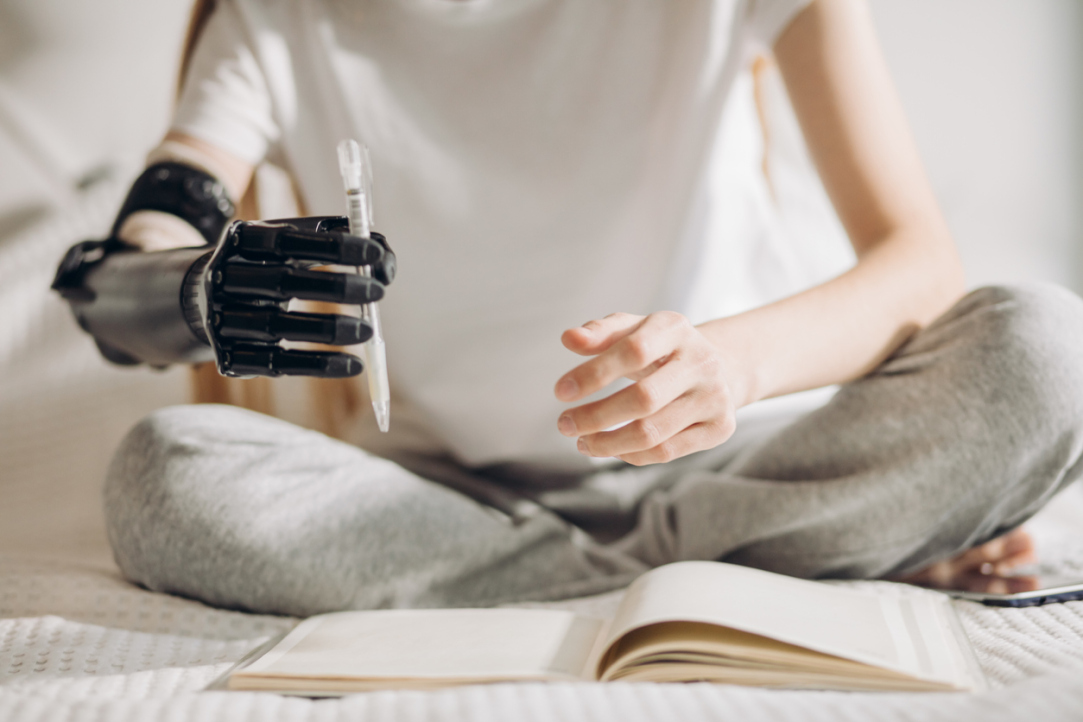
HSE University scientists have created a model for decoding finger movements for next-generation hand prostheses. This will allow users not only to grab objects, but also to gesticulate using the movements of each finger.
The results of the work, which investigates the possibility of accurately restoring finger movements using electromyographic signals from forearm muscles in people with disabilities, were presented at the joint scientific seminar ‘Digital Technologies for Medical Applications’. The event took place as part of the Digital Transformation: Technologies, Effects, Effectiveness strategic project under the Priority 2030 programme. The project was selected as part of the HSE University Research Project Competition for Young Scientists (up to 35 years old) on the topic of digital transformation and the development of digital technologies in 2022.
Igor Agamirzian
‘Today, almost any medical device is a specialised computer,’ said Igor Agamirzian, Director of HSE University’s School of Innovation and Entrepreneurship, as he opened the event.
‘The most important area now is the use of digital technologies to solve the problems faced by people with disabilities, and there is significant progress there,’ he stressed.
Anna Makarova, Research Assistant at HSE University’s Centre for Bioelectric Interfaces, said that present-day prostheses for people who have had hand amputations or were born with hand aplasia are far from ideal. Many modern bioelectric hand prostheses employ a rather primitive control system based on the use of only two large forearm muscles. The prosthesis mechanism converts the electrical signals of alternating muscle tension and relaxation into commands that are typed like binary code in programming. This does not happen intuitively—the user must learn to use the prosthesis, just as they would learn to program using ones and zeros.
Thus, the prosthesis can form one to ten grips, but the movements of each individual finger are not currently utilised on such devices. Studying the possibility of restoring precise movements based on muscle activity is a prerequisite for creating the next generation of prosthesis control systems.
Anna Makarova
‘Recent work has shown that with the use of various methods of machine learning, the movements of individual fingers in healthy people can be restored even through superficial muscle signals. We decided to find out if this is possible in people with amputations,’ the speaker explained.
The HSE University scientists created a model for decoding finger movements and selected the optimal hyperparameters that give the best decoding accuracy on data obtained in an experiment involving healthy subjects. To record EMG activity, they used a wireless 8-channel bracelet and a virtual reality headset. The experimental environment included a virtual environment with the capability to capture and save the coordinates of individual fingers. The subjects were instructed to perform symmetrical movements with both hands, which made it possible to obtain data on the movements performed in the case of amputees undergoing the experiment.
The model was found to be 50% accurate for subjects with a congenital absence of a hand and 71% for subjects who underwent an amputation in adulthood. These are promising results and a good prospect for further research and model improvements, said Anna Makarova.
Anna Makarova
See also:

'While it May Sound Futuristic, It Holds Great Promise': Olga Dragoy Shares Her Thoughts on Language Function Restoration and the Future of Neurotechnology
In the spring of 2023, the fifth strategic project of the Priority 2030 programme, 'Human Brain Resilience: Neurocognitive Technologies for Adaptation, Learning, Development and Rehabilitation in a Changing Environment,' was launched at HSE University. The strategic project brings together researchers from all campuses of HSE University. In her interview with the HSE News Service, Olga Dragoy, head of the strategic project and Director of the HSE Centre for Language and Brain, shares an overview of the advanced technologies neuroscientists are creating today, the underlying inspiration driving these efforts, and the operational dynamics of interdisciplinary applied projects.
‘It Was Great to Look at Scientific Achievements through the Eyes of a Journalist, not a Scientist’
HSE University in Nizhny recently hosted the 2nd Autumn Neuro-linguistic School ‘NeuroSciCom: Popularising Language and Brain Studies’ for scientists and students at the HSE Centre for Language and Brain Studies in Nizhny Novgorod. The school was held as part of the 'Human Brain Resilience: Neurocognitive Technologies for Adaptation, Learning, Development and Rehabilitation in a Changing Environment' Strategic Project of the Priority 2030 programme.
Card Index: 'Success and Self-Sustainability of the Individual in a Changing World'
To achieve success and well-being, a modern person needs to keep up with ongoing social, economic, technological and cultural changes. However, in order to adapt to these, you need to be competent, healthy and active, develop cognitive abilities, acquire new skills and maintain friendships. All of this can expand people’s capabilities, revealing their potential. The HSE's unique multidisciplinary strategic project 'Success and Self-Sustainability of the Individual in a Changing World', which brings together educators, sociologists, psychologists, economists, biologists, physicians and digital technology specialists, helps to solve some of these tasks. Working together, they have managed to create a navigation system to improve human achievements for the benefit of the whole of society.
New Technologies for Preserving Brain Functions: ‘Not Magic, but Normal Engineering’
New methods of brain mapping will make it easier to identify the cortex areas responsible for speech functions and to perform operations on the brain, as well as reduce the likelihood of damage to important areas. In addition, this will allow for more frequent use of non-invasive methods for restoring speech and other functions lost due to injuries and illnesses.
Memory Diagnostics: IT Solutions for Mental Health
High-level technology is becoming an integral part of healthcare, and no field of medicine can work without a computer. HSE University scientists have developed a multilingual tablet application ‘Rey Test’ — the first fully automated and effective tool for diagnosing auditory and verbal memory disorders.
Project Team of ‘Success and Self-Sustainability of the Individual in a Changing World’ Wins Russian Science Foundation Grant
Researchers from HSE University will receive funding from the Russian Science Foundation to study such forms of student employment as freelancing, self-employment, and entrepreneurship, all of which have been actively developing in recent years. The research will shed light on the new opportunities and challenges encountered by students and early-career specialists in the labour market. It will also aid in the development of effective strategies for their successful adaptation and development.
‘We Are Developing Technologies to Support People and Strengthen the Intellect’
HSE News Service spoke to Director of the Institute of Cognitive Neurosciences, Head of the Centre for Cognition and Decision Making at HSE University, Anna Shestakova about the achievements and goals of the new HSE University’s strategic project ‘Human Brain Resilience: Neurocognitive Technologies for Adaptation, Learning, Development, and Rehabilitation in a Changing Environment’.
Leading HSE University Scientists to Receive Grants from Ideas Research Centre for Neuroscience Research
The Ideas Centre for Advanced Interdisciplinary Research has announced the results of its 2023 competition. Five leading neuroscientists will receive grants to open graduate positions for early-career researchers who want to work on solutions to fundamental problems in this area. Three of the competition winners are scientists from HSE University: Matteo Feurra (HSE University in Moscow), Anastasia Kolmogorova (HSE University in St Petersburg), and Sofia Kulikova (HSE University in Perm).
Evgeniy Terentev: ‘The Project Aims to Give People Various Tools for Personal Fulfilment and Betterment’
Every day, new technologies and institutional solutions appear that expand people’s opportunities. Which technologies are effective at this, and which have yet to be created to meet the challenges of the modern era? How do people choose technologies and how can the choice become a conscious one? HSE University’s strategic project Success and Self-Sustainability of the Individual in a Changing World aims to answer these questions and more.
'We Are Seeking to Translate Research into Policy Solutions'
Social Policy for Sustainable Development and Inclusive Economic Growth is one of HSE University's strategic projects. The project is aimed at translating scientific achievements into practical solutions for social and economic policy. HSE researchers and their partners have been actively involved in this work, and the first results have been obtained. In her interview with the HSE News Service, Vice Rector Lilia Ovcharova, Academic Supervisor of the project, spoke about what has been done so far.