

HSE Team Wins International Hackathon with BCI Game


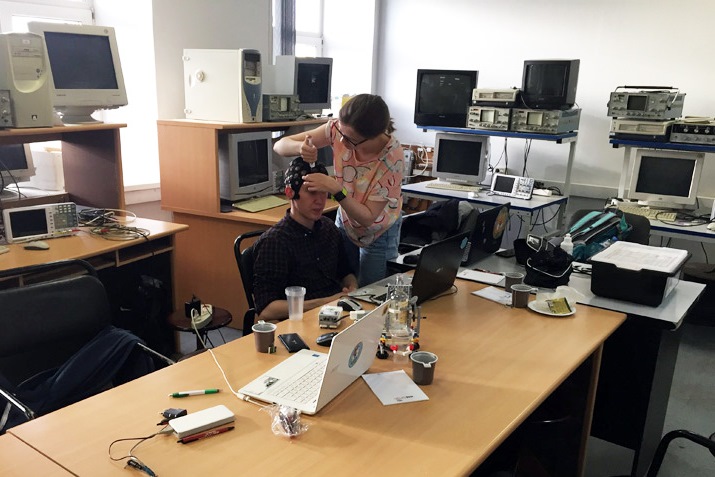

A team of post-graduate students and researchers from the HSE Centre for Cognition & Decision Making have invented a multiplayer BCI game, which is won by the player who best controls a robot with their mind.
The IEEE International Symposium on Video and Audio Signal Processing in the Context of Neurotechnologies took place in St. Petersburg, Russia, on June 26th and 27th and featured a hackathon, also called the IEEE Brain Data Bank Challenge. Representing HSE at the hackathon were Dmitry Altukhov, Nikolay Smetanin, and Alexandra Kuznetsova, all researchers with the HSE Centre for Cognition & Decision Making. The three are also part of a neurovisualization methods group headed by Alexey Ossadtchi.
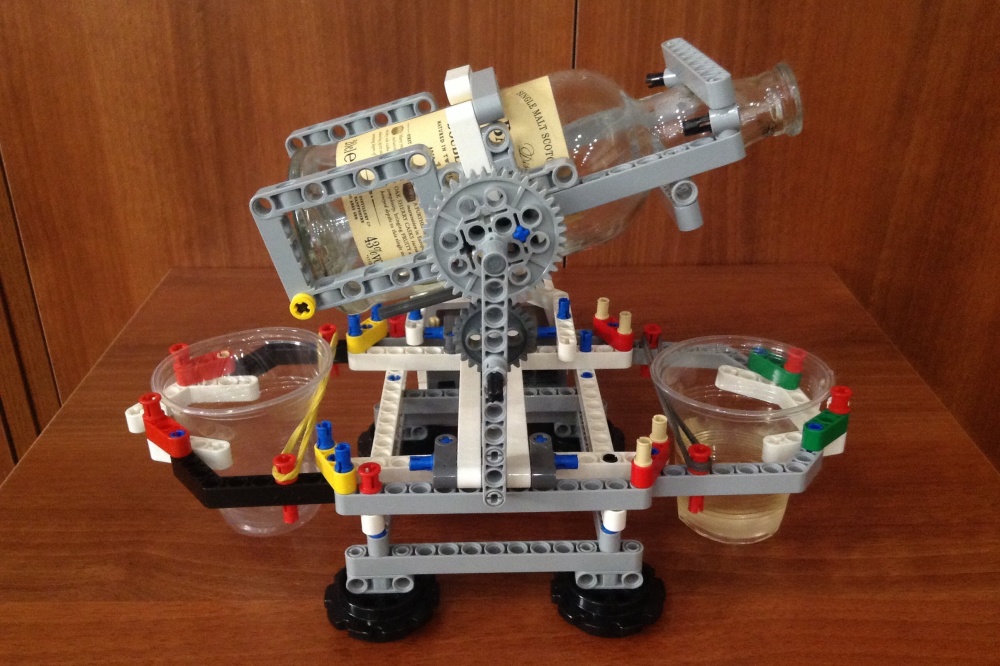
The team developed a game in which two people compete to control a robot that is made from Legos and pours drinks into two glasses. After receiving commands from a player, the robot tilts the bottle over a glass. If the bottle is tipped enough, the drink is poured into the glass. The player’s goal is to pour the entire contents of the bottle into their glass. Players can send the robot three different commands: left, right, or stop.
The commands are given to the robot through a brain-computer interface that recognises imaginary movements of the left or right arm. For example, in order to command the robot to tilt the bottle to the left, the players have to think of themselves moving their left arm. In order to move to the right, the players think of moving their right arm, and in order to stop they just have to relax. The player who best concentrates on the thought-up movements pulls the bottle in their direction with the most strength and, as a result, wins.
HSE’s team placed first and took home the grand prize of $500.

Alexandra Kuznetsova
Despite the fact that the task is presented in the form of a game, multiplayer BCIs open up new areas of research and allow for important applications to be created.
By analysing the process of a game in which users can both compete against and cooperate with one another (by trying to tilt a glass fastest, for instance), we can study mechanisms of social collaboration from a new angle. And from a technical point of view, having several users allows for a larger number of distinct commands to be given and for complex devices to be co-controlled.
In our opinion, the most promising application lies in therapy for those whose motor functions have been impaired as a result of brain damage. As demonstrated in recent studies, using games to rehabilitate patients after a stroke leads to a quicker recovery of motor activity. Further, using a multiplayer BCI for rehabilitation not only requires significant involvement of the patient’s sensorimotor system in carrying out tasks, but it also fosters social collaboration among several patients in the form of a game, thereby positively impacting recovery.
Dmitry Altukhov
Nikolay Smetanin
See also:

HSE University–Nizhny Novgorod Students Win GORKYCODE City Hackathon
This was the second hackathon organised by the Analytical Centre of Nizhny Novgorod and the city’s Digital Transformation Department. Eighteen student teams from the city's major higher education institutions participated, spending 52 hours developing innovative, AI-powered digital products designed to benefit Nizhny Novgorod and its residents.
Scientists Uncover Why Consumers Are Reluctant to Pay for Sugar-Free Products
Researchers at the HSE Institute for Cognitive Neuroscience have investigated how 'sugar-free' labelling affects consumers’ willingness to pay for such products. It was found that the label has little impact on the products’ appeal due to a trade-off between sweetness and healthiness: on the one hand, the label can deter consumers by implying an inferior taste, while on the other, it signals potential health benefits. The study findings have been published in Frontiers in Nutrition.
Internal Clock: How Heart Rate and Emotions Shape Our Perception of Time
Our perception of time depends on heart rate—this is the conclusion reached by neuroscientists at HSE University. In their experiment, volunteers watched short videos designed to evoke specific emotions and estimated each video's duration, while researchers recorded their heart activity using ECG. The study found that the slower a participant's heart rate, the shorter they perceived the video to be—especially when watching unpleasant content. The study has been published in Frontiers in Psychology.
Scientists Develop New Method to Detect Motor Disorders Using 3D Objects
Researchers at HSE University have developed a new methodological approach to studying motor planning and execution. By using 3D-printed objects and an infrared tracking system, they demonstrated that the brain initiates the planning process even before movement begins. This approach may eventually aid in the assessment and treatment of patients with neurodegenerative diseases such as Parkinson’s. The paper has been published in Frontiers in Human Neuroscience.
HSE Scientists Test New Method to Investigate Mechanisms of New Word Acquisition
Researchers at the HSE Centre for Language and Brain were among the first to use transcranial alternating current stimulation to investigate whether it can influence the acquisition of new words. Although the authors of the experiment have not yet found a link between brain stimulation and word acquisition, they believe that adjusting the stimulation parameters may yield different results in the future. The study has been published in Language, Cognition and Neuroscience.
‘We Managed to Outperform Teams of 15–20 IT Specialists’
On June 5, 2025, the top projects were presented as part of the Digital Solutions Marathon hackathon in a case study on forecasting and evaluating lost sales. First place went to a joint team of students from the HSE Faculty of Computer Science and the National University of Science and Technology MISIS, consisting of six students.
When Thoughts Become Movement: How Brain–Computer Interfaces Are Transforming Medicine and Daily Life
At the dawn of the 21st century, humans are increasingly becoming not just observers, but active participants in the technological revolution. Among the breakthroughs with the potential to change the lives of millions, brain–computer interfaces (BCIs)—systems that connect the brain to external devices—hold a special place. These technologies were the focal point of the spring International School ‘A New Generation of Neurointerfaces,’ which took place at HSE University.
How the Brain Responds to Prices: Scientists Discover Neural Marker for Price Perception
Russian scientists have discovered how the brain makes purchasing decisions. Using electroencephalography (EEG) and magnetoencephalography (MEG), researchers found that the brain responds almost instantly when a product's price deviates from expectations. This response engages brain regions involved in evaluating rewards and learning from past decisions. Thus, perceiving a product's value is not merely a conscious choice but also a function of automatic cognitive mechanisms. The results have been published in Frontiers in Human Neuroscience.
Electrical Brain Stimulation Helps Memorise New Words
A team of researchers at HSE University, in collaboration with scientists from Russian and foreign universities, has investigated the impact of electrical brain stimulation on learning new words. The experiment shows that direct current stimulation of language centres—Broca's and Wernicke's areas—can improve and speed up the memorisation of new words. The findings have been published in Neurobiology of Learning and Memory.
HSE Researchers Discover Simple and Reliable Way to Understand How People Perceive Taste
A team of scientists from the HSE Centre for Cognition & Decision Making has studied how food flavours affect brain activity, facial muscles, and emotions. Using near-infrared spectroscopy (fNIRS), they demonstrated that pleasant food activates brain areas associated with positive emotions, while neutral food stimulates regions linked to negative emotions and avoidance. This approach offers a simpler way to predict the market success of products and study eating disorders. The study was published in the journal Food Quality and Preference.