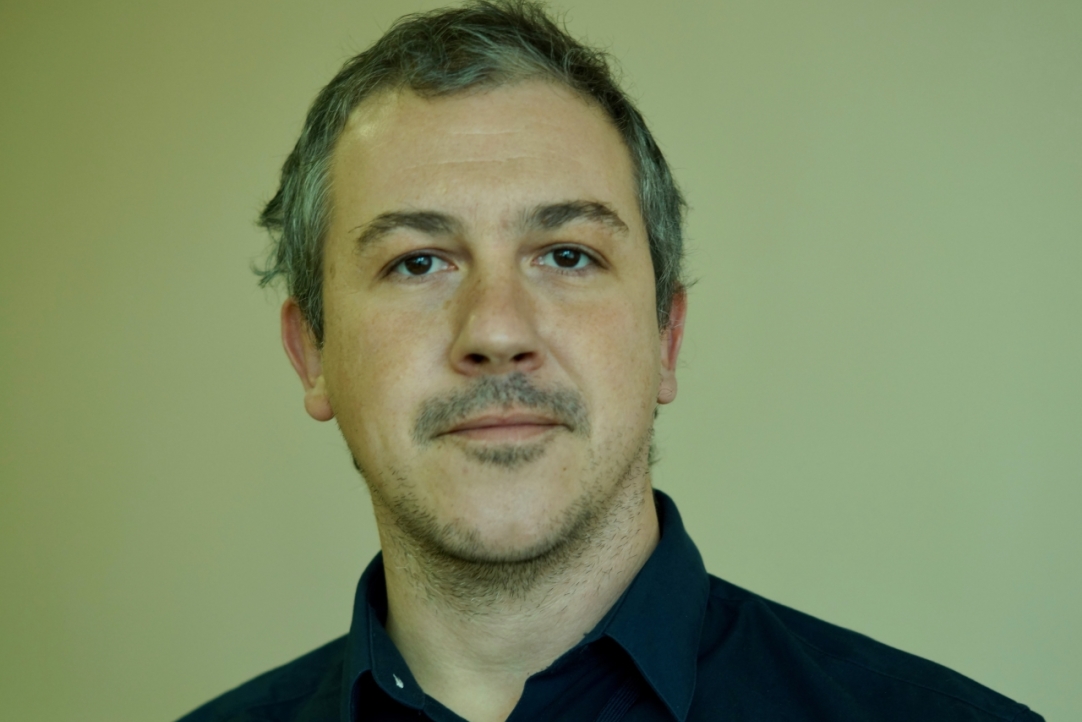
Since last September, Matthew Mangold has been a Postdoctoral Research Fellow in the School of Philology at the Higher School of Economics in Moscow. After completing a PhD in Comparative Literature at Rutgers University in 2017, he joined HSE to conduct research on the intersection between Russian literature and the medical arts, in particular environmental medicine and psychology.
Samsung-HSE Laboratory will develop mechanisms of Bayesian inference in modern neural networks, which will solve a number of problems in deep learning. The laboratory team will be made up of the members of the Bayesian Methods Research Group — one of the strongest scientific groups in Russia in the field of machine learning and Bayesian inference. It will be headed by a professor of the Higher School of Economics Dmitry Vetrov.
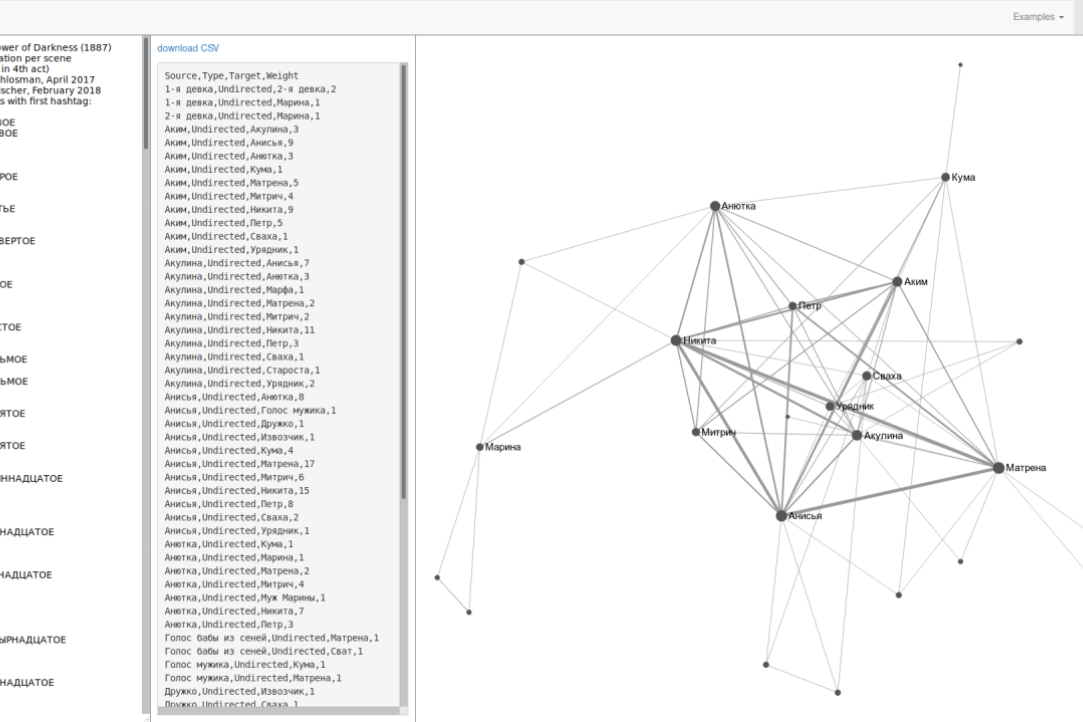
The Easy Linavis web-service allows users to quickly transform a text or any other type of data into a graph, as well as study it by using a social network analysis. You don’t need any special programming skills to use this service.
After receiving her PhD in Psychology from the University of the Basque Country, Beatriz Martín-Luengo arrived in Moscow in 2015 to join the Centre for Cognition & Decision Making at HSE as a Research Fellow. Since then, she has pursued research interests that focus on the ecological study of human memory (i.e., variables that affect our recollection) and metamemory, which is the introspective knowledge of one's own memory capabilities (and strategies that can aid memory) and the processes involved in memory self-monitoring.
Researchers at the Higher School of Economics (HSE University) have revealed that Russian companies need to invest in the development of intellectual resources in order to maximize the benefits from partners in developed countries. Results of the study have been published in the journal, Knowledge Management Research & Practice.
The HSE Center for Language and Brain studies a broad range of topics related to the connection between the brain and language. For Svetlana Malyutina, Deputy Head, and Mariya Khudyakova, Junior Research Fellow, particularly interesting areas of focus include the breakdown of language processing after brain damage (e.g., stroke, neurosurgery, epilepsy) and language acquisition in children.
The recipients of the annual Web of Science Awards are the most influential scientists, scientific organizations and publications of the year. The Moscow Mathematical Journal has made it into the top quartile in the subject area of mathematics and was announced by jury members to be the most influential Russian scientific journal of 2017.
Researchers from the HSE Laboratory of Theoretical Computer Science have won a competition organized by the Russian Foundation for Basic Research (RFBR) and the Royal Society of London for Improving Natural Knowledge.
Alberto Acerbi, a cognitive/evolutionary anthropologist at TU Eindhoven, explains the notion of cultural evolution and highlights its potential for Digital Humanities.
Mathematicians at HSE have successfully demonstrated the use of a Japanese model which detects seismic activity in predicting currency risks. The research results have been published in an article entitled 'Hawkes Processes for Forecasting Currency Crashes: Evidence from Russia'.