Russia is ranked 10th in the world according to publication activity by scientists in the natural sciences. China and the USA top this ranking. Russia is among the top 5 countries in some fields of the natural sciences, while in others, by contrast, it makes a low contribution to world science. Historically, these results come from the disciplinary structure of the Russian science. In total, 3.7% of publications in these areas in international scientific journals were written with the participation of Russian scientists in 2015–2017.
We are glad to announce the International Conference on "Algorithmic Aspects of Social Choice and Auction Design" which will be held on August 09-10, 2018
On 10 July, the Global Innovation Index 2018 was published. In the new ranking, Russia holds the 46th place out of 126, while Moscow made it into the top 30 of the world’s most innovative cities. In his Rusbase column Evgeniy Kutsenko, head of the HSE ISSEK Russian Cluster Observatory, commented on the factors which have contributed to the capital city’s impressive success.
On 10 July, the Global Innovation Index 2018 was published. In the new ranking, Russia holds the 46 th place out of 126, while Moscow made it into the top 30 of the world’s most innovative cities. In his Rusbase column Evgeniy Kutsenko, head of the HSE ISSEK Russian Cluster Observatory, commented on the factors which have contributed to the capital city’s impressive success.
'National Report on Innovation in Russia' is published, for the third year in a row prepared by the Russian Venture Company (RVC), the RF Ministry of Economic Development, and the RF Government’s Expert Council. Experts from the HSE Institute for Statistical Studies and Economics of Knowledge also contributed to producing the report. They suggested a number of advanced research methodologies and new indicators for measuring innovation development in the country. The indicator panel applied in the new report comprises 108 positions.
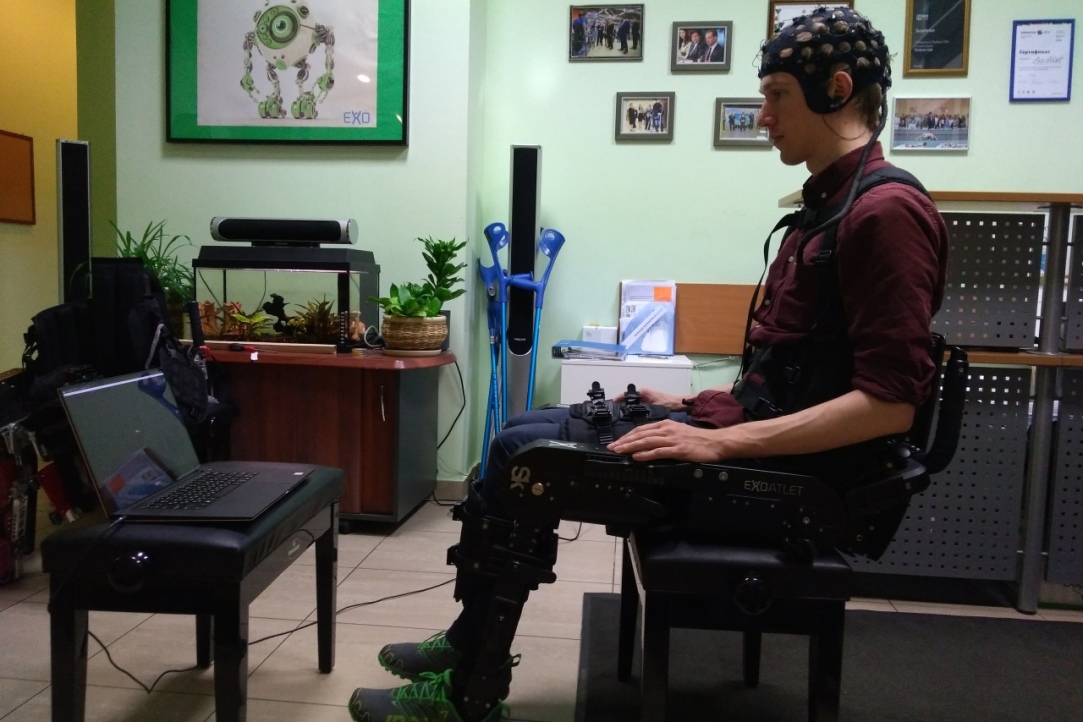
Center for bioelectric interfaces launches the joint project with the ExoAtlet company to develop a brain-computer interface for the rehabilitation of patients with locomotor disorders of the lower limbs. More effective complex therapy will be possible as a result of combining the medical exoskeleton (ExoAtlet, https://www.exoatlet.com/ru) with the recording of the patient's electroencephalogram (EEG). Using an exoskeleton a patient will perform one locomotion cycle, if she can concentrate on the imaginary leg movement, which can be detected as the desynchronization of the patient's motor rhythm on EEG.
The development of a magnetic encephalograph of a new generation on the basis of a compact highly sensitive magnetometric sensor will allow the non-invasive recording of electrical activity of the human brain and heart with previously inaccessible spatial and temporal accuracy. The new technology for measuring superweak magnetic fields, which does not require the use of cryogenic equipment, will significantly reduce the cost of the device, make it accessible to a wide range of clinical and research institutions, and provide superiority in the tasks of diagnosing neurological and cardiac disorders, as well as in cognitive studies.
Members of the Linguistic Convergence Laboratory and School of Linguistics won RSF grant "Research conducted by scientific groups under the supervision of young scholars" for their common project.