EN

Tag "research projects"

‘Why Data Analysis Is Art’: HSE University–St Petersburg Hosts International School on Statistics

‘Why Data Analysis Is Art’: HSE University–St Petersburg Hosts International School on Statistics
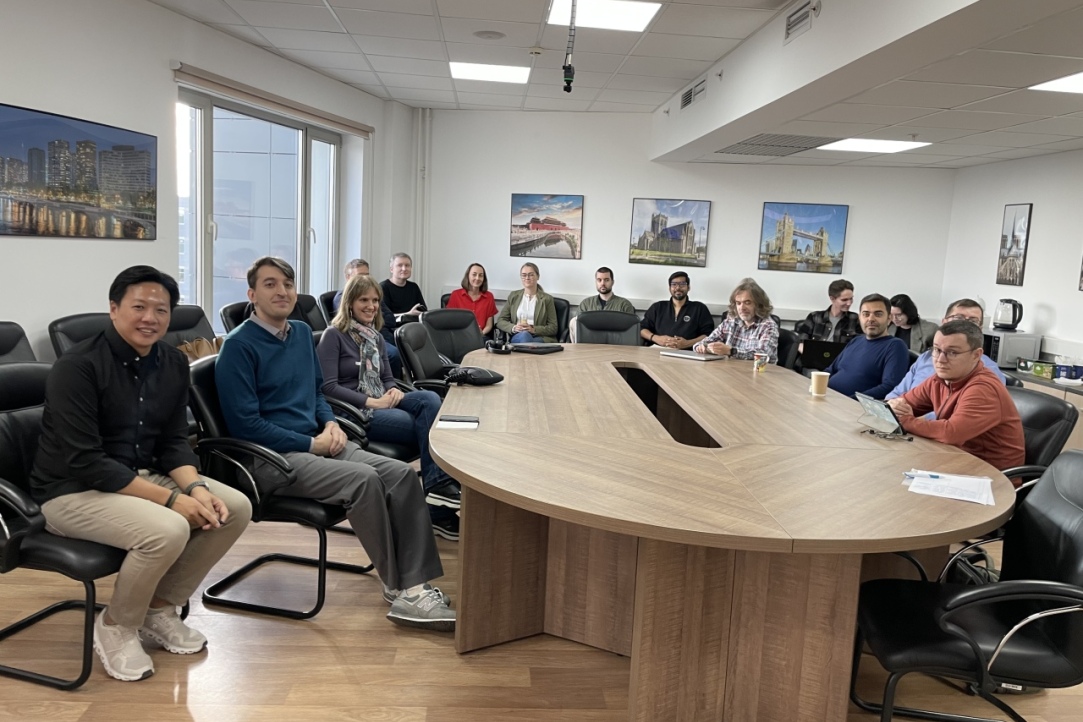
Why do statistical methods sometimes yield unexpected results? How does the creative approach help to process data in complex linguistic research? Is there 'a magic button' to analyse the results? The answers to these and other questions were the topic of the three-day autumn school 'Statistics in Psycho- and Neurolinguistics.'

‘Our Task Is to Promote and Popularise Native Languages’

‘Our Task Is to Promote and Popularise Native Languages’
The Centre for the Study of Native Languages at Dagestan State University (DSU) is actively engaged in researching the many languages spoken by the peoples of Dagestan. The republic has 14 official state languages, many of which have their own dialects and varieties. Scholars from Dagestan plan to adopt corpus-based methods of linguistic research used at HSE University and intend to collaborate with HSE’s Linguistic Convergence Laboratory. The HSE News Service spoke with the centre’s Director, Prof. Marina Gasanova, who is currently undertaking a research placement at HSE University.

How Colour Affects Pricing: Why Art Collectors Pay More for Blue

How Colour Affects Pricing: Why Art Collectors Pay More for Blue
Economists from HSE University, St Petersburg State University, and the University of Florida have found which colours in abstract paintings increase their market value. An analysis of thousands of canvases sold at auctions revealed that buyers place a higher value on blue and favour bright, saturated palettes, while showing less appreciation for traditional colour schemes. The article has been published in Information Systems Frontiers.

Applications to Participate in April International Academic Conference Now Open

Applications to Participate in April International Academic Conference Now Open
HSE University is now accepting proposals to present academic reports at the XXVI April International Academic Conference named after Evgeny Yasin. Applications can be submitted until December 16, 2025. The conference events will take place mainly on-site in Moscow from April 14 to 17, 2026.

'We Explore Areas Where Much Remains Unknown'

'We Explore Areas Where Much Remains Unknown'
Computational methods for analysing ancient and modern genomes make it possible to study the formation of genetic diversity in populations, reconstruct their history of mixing and migration, and trace the development of environmental adaptations. The HSE International Laboratory of Statistical and Computational Genomics applies mathematical methods and genetic data to address a wide range of issues across fields such as anthropology, epidemiology, and criminology. The HSE News Service spoke with the laboratory head, Vladimir Shchur, about its work.

A Space for Economic Experimentation: LEEF Organises Workshop for Early-Career Researchers

A Space for Economic Experimentation: LEEF Organises Workshop for Early-Career Researchers
In early September 2025, the renewed Laboratory for Experimental Economics and Finance (LEEF) held its first workshop for early-career researchers. Its main distinguishing feature was that every presentation was based on the results of laboratory economic experiments. In particular, the speakers discussed what people consider a fair deal, how best to motivate employees, and how genes influence the willingness to cooperate and help others. All interested students and postgraduates were invited to collaborate with the laboratory.

Internal Clock: How Heart Rate and Emotions Shape Our Perception of Time

Internal Clock: How Heart Rate and Emotions Shape Our Perception of Time
Our perception of time depends on heart rate—this is the conclusion reached by neuroscientists at HSE University. In their experiment, volunteers watched short videos designed to evoke specific emotions and estimated each video's duration, while researchers recorded their heart activity using ECG. The study found that the slower a participant's heart rate, the shorter they perceived the video to be—especially when watching unpleasant content. The study has been published in Frontiers in Psychology.

Environmental Regulation in Russia and India

Environmental Regulation in Russia and India
In Schola’s latest instalment showcasing the winners of the International Academic Cooperation of HSE University competition, Aleksei Sorbale speaks about the project ‘Regional and Inter-Regional Associations in Norm-Building and Norm-Control in the Area of Environmental Regulation in Russia and India,’ carried out jointly with a research team from India’s University of Petroleum and Energy Studies (UPES).

Generation Z's Digital Revolt: HSE Examines a Million Messages from Nepali Social Media

Generation Z's Digital Revolt: HSE Examines a Million Messages from Nepali Social Media
In September 2025, young people in Nepal took to the streets, armed not with party slogans but with online chats. Researchers at HSE analysed a million messages on a Discord server to understand the mechanics of youth protest. Experts discussed why the protesters identified themselves as Generation Z and what lessons can be drawn from this experience.

Scientists Identify Personality Traits That Help Schoolchildren Succeed Academically

Scientists Identify Personality Traits That Help Schoolchildren Succeed Academically
Economists from HSE University and the Southern Federal University have found that personality traits such as conscientiousness and open-mindedness help schoolchildren improve their academic performance. The study, conducted across seven countries, was the first large-scale international analysis of the impact of character traits on the academic achievement of 10 and 15-year-olds. The findings have been published in the International Journal of Educational Research.