

HSE and China’s Top Universities to Launch Large-Scale Research and Education Projects

As part of the official visit of Russian President Vladimir Putin to the People’s Republic of China, the HSE delegation led by Rector Nikita Anisimov concluded new cooperation agreements with major Chinese universities. The agreements are designed to expand bilateral partnerships in education, science, and cultural exchange.
During the visit, the HSE University delegation met with the leadership of Tsinghua University, Peking University, and Beijing University of Technology, China’s top scientific and educational centres.

HSE Rector Nikita Anisimov
‘The strong overcome obstacles, and the wise overcome the entire journey. Cooperation with leading Chinese universities not only opens up new horizons in scientific research and knowledge exchange for Russian universities but also reinforces our position in the international educational space, serving as a key component of humanitarian cooperation between the Russian Federation and the People’s Republic of China. Together with our Chinese partners, today we took another important step towards mutual progress and prosperity.’
During the negotiations with our Chinese partners, two key agreements were signed. The first agreement with Tsinghua University focuses on the development of joint projects in the field of biology, ranging from molecular and computational neuroscience to AI-assisted big data analysis. This includes the formation of research groups, preparation of research publications, organization of internships for undergraduates and doctoral students, as well as holding of scientific and educational events. HSE doctoral students will have the opportunity to take internships at Tsinghua, while undergraduates will gain access to new academic mobility formats. The two universities also plan to launch dual degree programmes.
The academic exchange agreement signed with Peking University provides for an annual exchange of undergraduate and doctoral students. This document stipulates the procedures for selecting and assisting participants, their accommodation, administrative and visa support, and academic integration at the host institution. The agreement was published on the Kremlin website as one of the documents signed following the talks between the leaders of Russia and China.
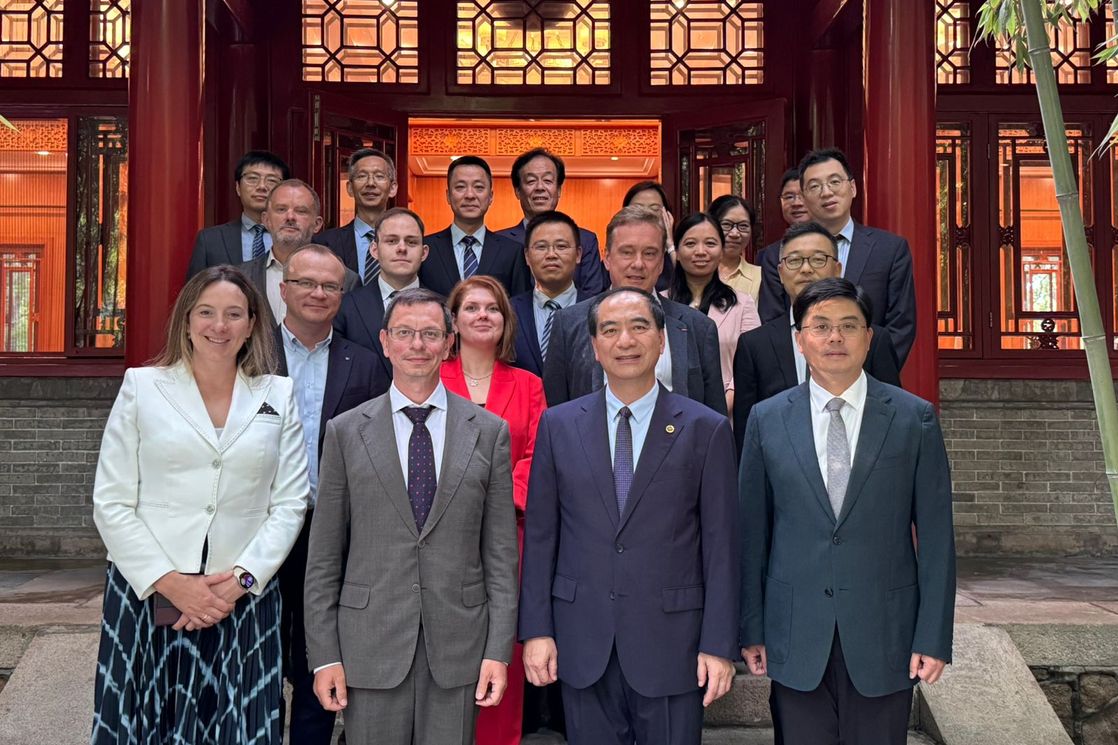
In addition, during their visit, HSE representatives held separate meetings with Peking University units—in particular, with the School of Physics and the School of Management. They discussed the prospects for launching joint educational programmes, developing research initiatives, and participating in international grant competitions. The meetings were attended by HSE Vice Rector Victoria Panova, HSE MIEM Vice Rector and Director Dmitry Kovalenko, HSE MIEM Professor Andrey Vasenko, Dean of the HSE Faculty of Computer Science Ivan Arzhantsev, and Dean of the HSE Faculty of World Economy and International Affairs Anastasia Likhacheva.
The development of humanitarian cooperation and cultural exchange was among the key topics discussed at all the venues. The parties expressed interest in expanding programmes for learning Chinese in Russia and Russian in China, supporting youth initiatives and deepening academic dialogue between university communities.
HSE representatives also met with the university’s students and graduates studying or working in China. During their informal conversation, they shared experiences of participating in academic mobility programmes, talked about their professional plans, and discussed opportunities for future joint projects.

See also:

Researchers Use iFORA to Map the Future of Industry 4.0
HSE University presented the capabilities of iFORA, an intelligent big data analysis system, at Kazan Digital Week 2026. An overview of technological opportunities and potential threats associated with Industry 4.0 was delivered by Konstantin Vishnevskiy, Director of the Centre for Strategic Analysis and Big Data at HSE ISSEK.
‘Now More Than Ever, We Need a Place Where We Can Listen to and Understand Each Other’
In early November 2026, HSE University hosted HSE Unity Fest, a major student festival. The programme featured three days of concerts and a fair, film screenings, workshops, lectures, and guided tours. For the first time, Unity Fest also included an international football tournament. Participants also visited the Kochevnik Ethnopark, Patriot Park, and Sergiyev Posad.
HSE Opens Middle East Office and Signs Agreement with UAE’s No. 1 University
HSE University has opened an official representative office in Abu Dhabi. It will focus on developing educational, scientific, and cultural initiatives in the Middle East and will serve as a representative office not only for HSE University but also for Russian education as a whole, providing a platform open to universities, research centres, and the business community.
Physicists Train AI to Optimise Particle Beams in Accelerators
Researchers from the AI and Digital Science Institute at the HSE Faculty of Computer Science and the Budker Institute of Nuclear Physics at the Siberian Branch of the Russian Academy of Sciences have developed RLABC (Reinforcement Learning for Accelerator Beamline Control), a framework that uses reinforcement learning to identify optimal settings for a particle accelerator. In a computer simulation, RLABC optimised the accelerator's parameters to achieve a particle transmission rate of 70%. The study has been published in Computer Physics Communications.
HSE Scientists Present Tensor Methods Research at International Conference in China
Researchers from the AI and Digital Science Institute at the HSE Faculty of Computer Science took part in the 3rd Conference–School on Tensor Methods in Mathematics and Artificial Intelligence Computing. The event was held in Shenzhen, China, in late October 2026. One of the institute's research projects received the Best Poster Award, placing among the conference's five best posters.
Fall into ML 2026: From Fundamental Research to Discussions on the Future of AI
On October 23–24, HSE University hosted Fall into ML 2026, the fifth conference on machine learning and AI. Over the past five years, the event has grown from a small gathering of researchers into a flagship platform that brings together leading machine learning specialists, early-career researchers, students, and representatives of technology companies. The fifth edition marked a new stage in the development of the conference, with a programme that included discussions with international speakers, presentations of joint research projects, and tutorials on the latest trends in AI.
Moscow Hosts Closing Ceremony of the First-Ever International Space Games
Teams of young people and students from eight countries—China, India, Kazakhstan, Kyrgyzstan, Mexico, Pakistan, Uzbekistan, and Russia—successfully completed the main mission of the International Space Games (ISG): ensuring the sustainable functioning of an autonomous settlement on another planet. The Games’ unique format, which dispenses with traditional competition aimed at securing victory for a single country, has proved its effectiveness. HSE University is the project operator.
HSE University and China National Academy of Educational Sciences Expand Cooperation
On October 12, 2026, a delegation from the China National Academy of Educational Sciences (CNAES), led by its President, Li Yongzhi, visited HSE University. At a meeting with HSE President Nikita Anisimov, the two sides reviewed the results of their long-standing partnership and discussed prospects for joint research.
Generational Shifts: HSE University Discusses Sequencing of Life Events in Russia and China
On October 23, 2026, HSE University hosted the second Russian–Chinese academic seminar on changing life trajectories and the sequencing of key events in the transition to adulthood in Russia and China. The event was organised by the HSE Institute for Social Policy and the Faculty of World Economy and International Affairs, in cooperation with the Institute of Population Research at Peking University (China).
The Future of Humanoid Robots in the Home Explored at Foresight Session
On October 23–24, HSE University hosted the landmark fifth Fall into ML 2026 Conference. During the foresight session titled ‘A Humanoid in Your Kitchen: When Will It Happen and What Can Prevent It?’ researchers explored why humanoid robot assistants have not yet become part of our everyday lives, what needs to change for this to happen, and who will be held responsible when such assistants make mistakes.