

'Math in Moscow Programme Was Absolutely Incredible'
Jonathan Gerhard from James Madison University spent one semester studying in Math in Moscow programme run jointly by HSE, Moscow Center for Continuous Mathematical Education, and Independent University of Moscow. During his time in Russia Jonathan took intensive maths courses, studied the Russian language and traveled to several Russian cities.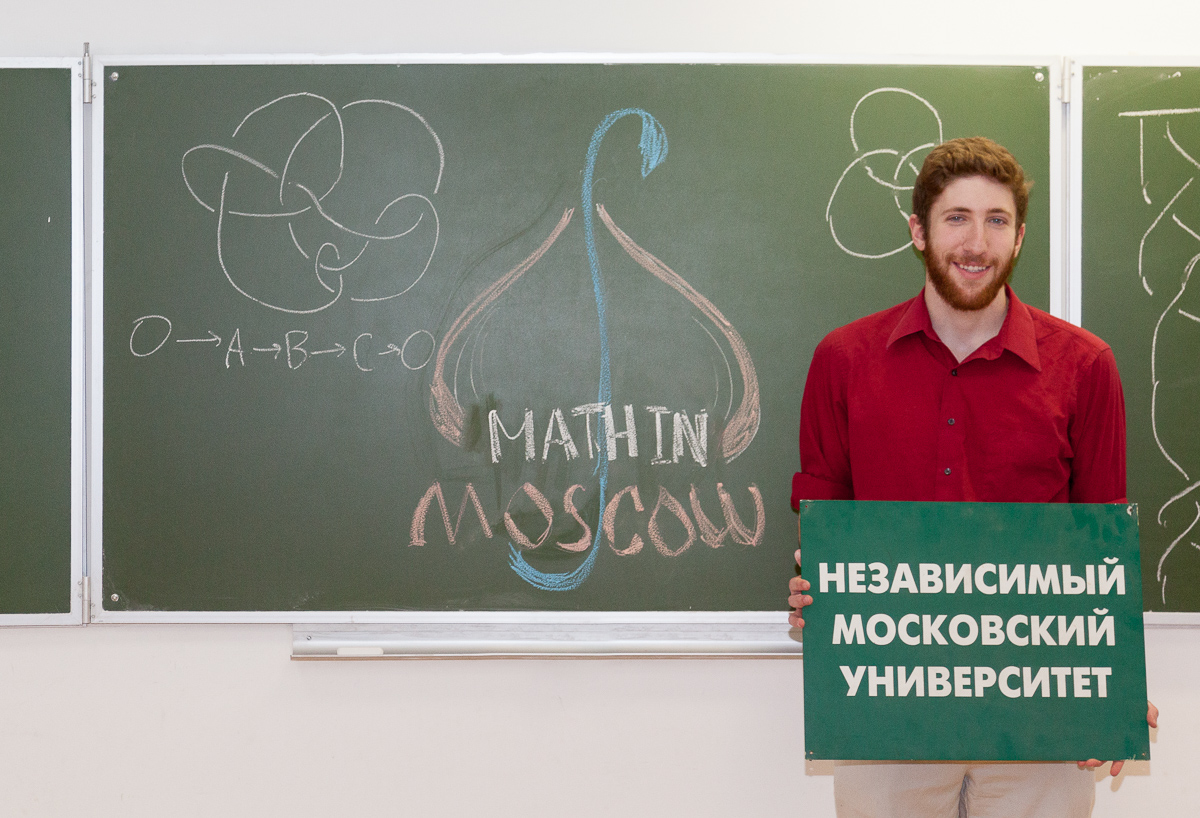
I think the programme was fantastic. To forgo the mathematics for a second, my experience in Russia was phenomenal. The level 2 and 3 Russian courses were taught by a fantastic, helpful, and enthusiastic professor (Dasha), who really helped me see the logic in the Russian language. By the end of the semester, I felt like I could actually come up with new sentences and phrases. Additionally, she would speak quickly to us (which I think was good for learning), but it became very evident that she was being very careful with what she was saying so that we could understand most of it, and explained words we didn't know before we even had to tell her we didn't know them!
In regards to the Russian language and culture, being in the capital of Russia was the best possible learning opportunity. People on the street don't slow down or avoid slang. Of course, everyone I met there was very receptive that I was a foreigner and would try to converse with me, but hearing the way they say things and seeing how they do things was immensely helpful in trying to adapt to Russian life for those four months.
Additionally, there were many friendly people around the dorms: people working at the food stands, grocery stores, or the hair cuttery that was a minute away; they were all incredibly nice. Having a comfortable home environment, as well as having a metro card to explore the city (there was so much to see! And much I learned I missed...but I'll save that for next time!), made for a very enjoyable stay in Moscow.
We also went on a few excursions: I personally went to both the Vladimir/Suzdal and Saint Petersburg trips. Again, these were incredible! The Saint Petersburg trip was very interesting, as we saw many royal palaces, museums (the famous Hermitage, and more), and other notable spots, as well as just exploring the city ourselves each night! The trip to Vladimir/Suzdal, rightly led by our guide named Vladimir, was so much fun! Our guide was hilarious, and made the trip immensely enjoyable. Seeing the old Russian towns of Vladimir and Suzdal with him was so much fun and very educational. The Russian architecture was absolutely beautiful! (That statement applies not only to those towns but to essentially every Russian monument/building/church we saw).
Finally, the math. It was incredible. It became very obvious that these classes would not be a walk in the park. We had incredibly intelligent professors whose own research was in the topic they were teaching. I took Algebraic Topology, Commutative and Homological Algebra, and Algebraic Geometry. The commutative algebra and algebraic geometry worked with eachother very well, and the homological algebra and algebraic topology had a beautiful interplay. These classes were incredibly hard, and yet after putting in a week's worth of work every week, I feel like I've really internalized the material.
Though I enjoyed every class massively, I absolutely fell in love with Algebraic Topology. This course was taught by Dr. Alexei Gorinov, whose homeworks were inspiring. We began solving the homeworks by working a problem at a time, but as the weeks went on, we discovered beautiful interplay between the questions. One thing we did two questions back help here, and that combined with the last question gives us the next result! It read like a novel. In that class, I feel I not only learned the material, but I learned the intuition and I gained a thinking process. I hope to go to graduate school to study Algebraic Topology.
Overall, I thought the programme was absolutely incredible. I will be strongly encouraging other students at James Madison University to participate in this programme.
Applications for Spring 2017 semester are accepted until September 30, 2016.
See also:

Immortal Cells and Mathematics Reveal Mechanism behind Coronavirus Infection
A mathematical model has helped describe the course of infection caused by two variants of coronavirus: Omicron and Delta, and explain the differences between them. It appears that the cell entry rate is lower for Omicron, allowing infected cells ample time to alert neighbouring cells of the threat and trigger the activation of their innate immune response. In the future, the developed model could be employed to investigate any other variant of COVID-19, potentially leading to effective strategies for combating new hazardous strains, such as Pirola and JN.1. The findings from the study conducted with the participation of HSE researchers have been published in PeerJ.
Mathematicians Reveal the Mechanism behind Neuron Synchronisation: Hyperchaos
Scientists of the International Laboratory of Dynamic Systems and Applications at HSE Campus in Nizhny Novgorod have described a rare case of synchronisation in a system of chemically coupled neuron models. The study findings enable a mathematical description of atypical brain functioning modes, including those associated with neurodegenerative diseases. The study has been published in Regular and Chaotic Dynamics.
‘The Joy of Science Lies in the Euphoria of Learning’
For Elena Nozdrinova, mathematics is her life's work and a realm where she discovers universal order and harmony. In her interview with the HSE Young Scientists project, she speaks about dynamical systems, the Nizhny Novgorod scientific school, and favourite pastimes that help her grow.
HSE Scientists Unveil New Findings Regarding Stability of Communication Systems
Researchers from the International Laboratory of Dynamical Systems and Applications at the HSE Campus in Nizhny Novgorod have discovered that the use of systems with hyperbolic solenoid attractors and repellers can lead to issues in the transmission of communication signals. The findings of this study have been published in Results in Mathematics. The research was financed by a substantial grant from the Russian Government as part of the 'Science and Universities' National Project and a further grant from the Russian Science Foundation.
Monsters of the Deep: HSE Scientists Have Compiled a Catalogue of Rogue Waves
Rogue waves, or killer waves, are abnormally high and deadly waves that can emerge unpredictably in open seas and along shorelines. They pose an imminent deadly threat to everyone from colossal liners and pleasure yachts to seafarers and vacationers. Scientists from the HSE campus in Nizhny Novgorod Efim Pelinovsky and Ekaterina Didenkulova have assembled a catalogue of such phenomena that occurred in the World Ocean from 2011 to 2018, identifying the areas where they are frequently documented and inflict the most substantial damage.
Students of Engineering and Mathematics School Present First Project Results
Students of the Engineering and Mathematics School (EMS) launched by HSE University and VK in October 2022 held a Demo Day to showcase the first results of their product- and research-based IT projects. Work on the projects has been conducted under the supervision of experts from the university and mentors from VK.
‘I Prefer Work to Most Types of Pastime’
Ivan Arzhantsev has headed up the Faculty of Computer Science since it was established in 2014. He has never been a specialist in Computer Science – all his life he’s been engaged in mathematics. On his 50th birthday, he shared with HSE Life how this has helped him to lead the best HSE faculty.
HSE University Students Win Prizes at the International Mathematics Competition for University Students
The 29th International Mathematics Competition for University Students (IMC 2022) took place in early August in a mixed format in Blagoevgrad (Bulgaria) and online. Eight students of the HSE Faculty of Computer Science and the HSE Faculty of Mathematics won prizes at the competition.
‘HSE University Was a Gateway into the Wider World of Science’
Fernanda Florido-Calvo came to HSE University in Nizhny Novgorod from Chile to study mathematics. While on her two-year Master of Science in Mathematics programme, she wrote her master’s thesis and presented it at the All-Russia Contest of Diploma Thesis of Russian Mathematicians 2021, where she won two awards with full marks. Fernanda spoke to the HSE News Service about her passion for mathematics and the paths that lead to HSE University.
HSE University Researchers to Speak at the International Congress of Mathematicians
The speakers of the International Congress of Mathematicians, a key global mathematics event held every four years by the International Mathematical Union, have been announced. The next ICM will take place in St. Petersburg, Russia, in July 2022. Five researchers from the HSE Faculty of Mathematics will present their papers at the congress.