

Former HSE Exchange Student Returns as Post-Doc in Linguistics
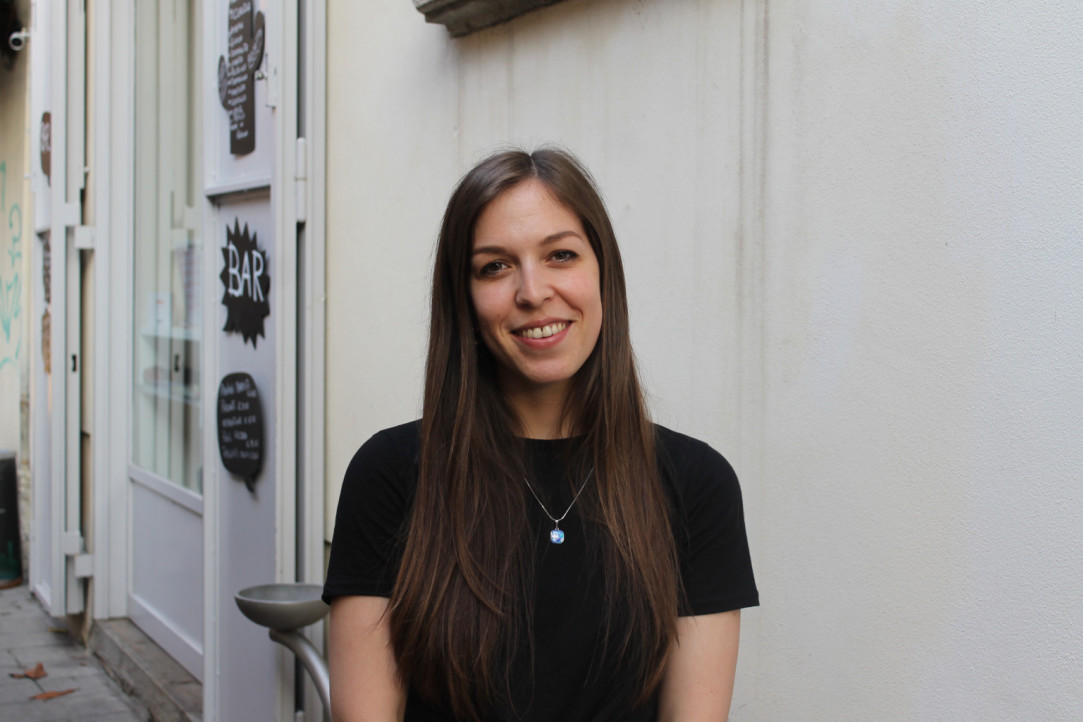
Originally from Pavia, Italy, Chiara Naccarato developed an interest in Russian early on in her studies, completing her undergraduate and master’s degrees in Russian Language and Linguistics at the University of Milan. She recently joined HSE as a postdoctoral researcher in the Linguistic Convergence Laboratory after completing her PhD studies in Linguistic Sciences at the Universities of Pavia and Bergamo.
‘During the years of my PhD, I spent a six-month and two three-month periods at HSE as an exchange student’, she recalls. ‘These study periods gave me the opportunity to meet and work with brilliant professors from the HSE School of Linguistics, from whom I have learnt a lot and whose contribution to shaping my PhD research has been fundamental. When I heard about the opportunity of working here, I was very enthusiastic about the idea of coming back to this extremely stimulating workplace’.
Chiara’s dissertation, entitled ‘Compound agent nouns in Russian: A comparison of rival word-formation constructions’, is on a subject she plans to continue researching at HSE. She is also currently interested in contact phenomena characterizing non-standard varieties of Russian.
‘At the Linguistic Convergence Laboratory, I have the chance to cooperate with the best experts in this field’, she notes. ‘At the moment, I am taking part in a research project regarding contact-induced word-order variations in Daghestanian Russian’.
Having made numerous trips to Moscow over the past five years, Chiara is nevertheless fascinated by the city and the ways in which it continues to evolve. ‘I have currently been in Moscow for eight months, but I have been here many times for short and long periods. Moscow is an endlessly-changing city, which offers infinite possibilities of every kind and never makes you feel bored’.
Chiara hopes that in 5-10 years she will still be working in academia. ‘Being a researcher and teacher is extremely fulfilling and stimulating’, she exclaims. ‘I would not change that for anything!’
Chiara’s recommended reading and viewing list on Russia:
Novels:
- Nikolai Gogol, Dead Souls (1835)
- Leo Tolstoy, War and Peace (1863-1869)
- Yevgeny Zamyatin, We (1919-1921)
- Mikhail Bulgakov, The Master and Margarita (1929-1940)
Non-fiction:
- Tiziano Terzani, Goodnight, Mr. Lenin: A Journey Through the End of the Soviet Empire (1992)
- Gian Piero Piretto, Il radioso avvenire. Mitologie culturali sovietiche (2001) (Radiant Future: Soviet Cultural Myths) – Not available in English translation
- Gian Piero Piretto, Gli occhi di Stalin. La cultura visuale sovietica nell'era staliniana (2010) (Stalin’s Eyes: Soviet Visual Culture in the Stalin Era) – Not available in English translation
- Serena Vitale, A Mosca, a Mosca! (2010) (To Moscow, To Moscow!) – Not available in English translation
Films:
- Walking the Streets of Moscow (1963)
- The Irony of Fate (1975)
- Domestic Circumstances (1978)
- Office Romance (1977)
- Moscow Does Not Believe in Tears (1979)
- The Inner Circle (1991)
- Burnt by the Sun (1994)
Anna Chernyakhovskaya, specially for HSE News service
See also:

Twenty vs Ten: HSE Researcher Examines Origins of Numeral System in Lezgic Languages
It is commonly believed that the Lezgic languages spoken in Dagestan and Azerbaijan originally used a vigesimal numeral system, with the decimal system emerging later. However, a recent analysis of numerals in various dialects, conducted by linguist Maksim Melenchenko from HSE University, suggests that the opposite may be true: the decimal system was used originally, with the vigesimal system developing later. The study has been published in Folia Linguistica.
‘Learning Japanese Is a Long-Distance Race’
How can one master kanji, even with the help of sports, and why is Japanese Studies considered the pinnacle of Asian Studies? In this interview dedicated to the Japanese language, Vasilii Shchepkin and Olga Klimova discuss specific features of the language, the reasons for and experiences of learning it, as well as translation practices.
Linguists from Around the World Discuss Current Academic Issues at First Eurasian Congress
HSE University partnered with the First Eurasian Congress of Linguists dedicated to the 300th anniversary of the Russian Academy of Sciences (RAS). The congress served as a platform for discussing relevant issues in linguistics related to all language groups of Eurasia and other regions worldwide. Approximately 200 researchers from 46 foreign countries and 300 Russian linguists from 50 regions of Russia participated in the event.
'Back in School, I Decided That I Would No Longer Suppress My Feelings'
Polina Makarova initially planned to pursue a career in programming but soon shifted her focus to theoretical linguistics. In this interview with the HSE Young Scientists project, she discusses her research on grammatical agreement in the names of professions, the importance of emotional intelligence, and the benefits of keeping an eublepharid, or leopard gecko, as a pet.
'Language Surrounds Us at All Times'
The most likely place to find Anton Buzanov is at the HSE building on Staraya Basmannaya Ulitsa, where the researcher spends nearly all his time. In his interview with the HSE Young Scientists project, he recounts his experience of leading a field expedition to Sami communities, shares his affection for teenage television shows, and observes that engaging solely in activities that bring joy can prevent burnout.
HSE University-Developed Linguatest System Launched in Nizhny Novgorod
Linguatest, Russia’s first foreign-language certification system, has been launched in the Nizhny Novgorod region. The system was developed by specialists from HSE University in cooperation with the National Accreditation Agency and the Prosveshchenie group of companies, who are providing certification and publishing support for the project. Nizhny Novgorod is the first city after Moscow to offer testing under the system.
'The Applied Linguistics Programme Allowed Me to Try Something I Was Interested in While Continuing What I Am Passionate About'
Austin Garrett-Sites, from the US, is a master's student of the Applied Linguistics and Text Analytics programme in Nizhny Novgorod. Students from around the world to come to Russia to get a European education in English with viable employment prospects. Austin spoke about his impressions after the first year of study and his favourite places in Nizhny Novgorod.
What’s It Like to Work as a Computer Linguist
The IT industry is rapidly developing and incorporating new professions. Zoya Mazunina and Arina Mosyagina, linguists with Seldon and graduates of the HSE University Fundamental and Applied Linguistics programme, met with university applicants to talk about the computer linguist profession, issues of automatic language processing, and how linguists use the knowledge they gain at HSE University.
Towards Finding Practical Solutions to Socially Significant Healthcare Problems
The Centre for Language and Brain in Nizhny Novgorod started operations in September 2020. Today, it is comprised of a team of linguists - teachers and students - who are researching the relations between speech and parts of the brain. The Director of the Centre, Natalya E. Gronskaya, spoke to the HSE Look about how the neuro-linguistic laboratory appeared in Nizhny Novgorod, as well as current tasks and prospects the Centre can offer the students and the region.
Predicting Grammatical Properties of Words Helps Us Read Faster
Psycholinguists from the HSE Centre for Language and Brain found that when reading, people are not only able to predict specific words, but also words’ grammatical properties, which helps them to read faster. Researchers have also discovered that predictability of words and grammatical features can be successfully modelled with the use of neural networks. The study was published in the journal PLOS ONE.