

Faculty of Mathematics Alumnus about Alma Mater and Doctoral Studies at Leiden University
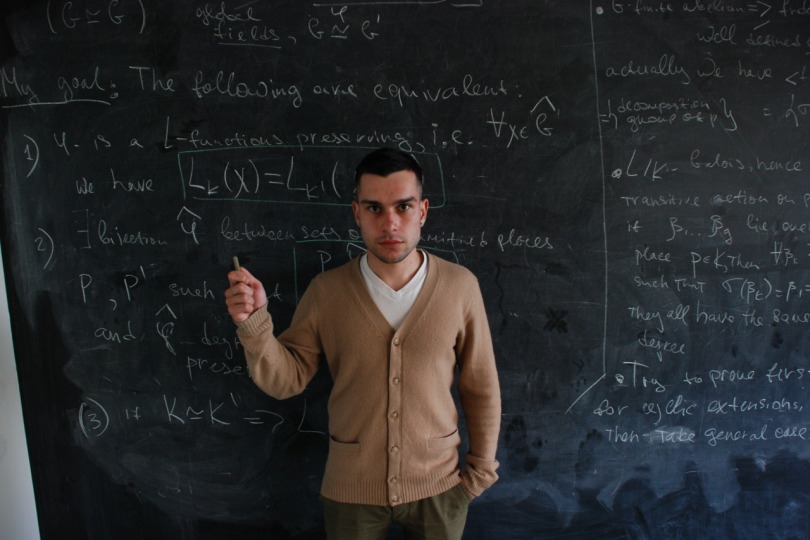
Pavel Solomatin is one of the first wave of graduates from the HSE Faculty of Mathematics. He successfully graduated from the undergraduate and master’s programmes, and then enrolled in the Leiden University doctoral programme, where he is currently studying number theory under the academic supervision of Bart de Smit.
— Why did you decide to apply for the HSE Faculty of Mathematics?
— Honestly, I don’t have a clear answer to this question. I’d known since secondary school that I wanted to study mathematics, but when I was applying for university in 2008, the HSE Faculty of Mathematics was only just being formed. We were the first students of the faculty. Of course, that meant that none of the applicants had any information about how and what we would be taught at the faculty. Moreover, none of my friends knew about HSE at all seven years ago. That’s why my choice is mere serendipity. I simply passed all the examinations, saw my name on the lists, and brought my documents to the admissions committee.
— Did your studies at HSE influence your life choices? What was the most memorable thing during your studies?
— Yes, definitely. If there had been no Faculty of Mathematics in my life, I wouldn’t be here talking about mathematics. Most of my classmates at school easily entered the technical departments of leading Russian universities. Seven of my classmates enrolled in Moscow State University. Unfortunately, almost none of them still want to be academics. At the same time, five students from school 179 enrolled in the Faculty of Mathematics at HSE that same year. Three of them graduated from the faculty, and all of them are still deeply involved in mathematics today.
— Which lecturers do you still remember today?
— I remember everyone who taught me. I remember those who taught me during the first years of study with particular warmness, including S.M. Lvovsky, Yu.M. Burman, G.L. Rybnikov, O.V. Schwarzman, and many others.
— Where did you continue your education after the undergraduate programme? What fields of mathematics are the most interesting for you? When did you decide that this is what you are interested in?
— After my undergraduate course, I continued on the Faculty of Mathematics master’s programme. I’m interested in various fields of mathematics, but number theory is my main area of interest. I realized I wanted to study arithmetic during my first years of university studies, thanks to my academic supervisor, Alexey Zykin, who I worked closely with from when he started working at the faculty in 2009 until my departure.
— What requirements did the Leiden University demand for doctoral applicants? What knowledge and skills were useful for you in the doctoral programme and what were you lacking?
— The requirements were standard for most Western doctoral programmes: knowledge of the subject and the desire to study. Formally, this means a big batch of documents that includes a CV, recommendations from professors, grade records, language certificates, various research papers, and so on. I had to pass a couple of interviews in the process of admission. Speaking about the knowledge and skills that I was lacking, it’s difficult to say. It seems that I didn’t have any particular problems as regards to this.
— Could you tell us more about your university and the research topic on which you are working?
— I’m studying at Leiden University. Leiden is a small city in the Netherlands located right between The Hague and Amsterdam. The university has a rich history: it was founded in 1575. The problem I am working on is related to L functions in various representations of absolute Galois group of global fields. Speaking more simply, my problem is an arithmetic analogue of the following classical geometry problem: is it possible to hear the form of a drum? Or more formally, is it possible to recreate a surface if you know the spectrum of the Laplace operator on it?
— How are your studies going? Is it different from studying at HSE?
— I’m working on my problem most of the time. Leiden turned out to be a good place for those interested in number theory. More than half the people at the department are involved in arithmetic, so if you have a question regarding arithmetic, you always can find an expert who can help you understand the issue quickly. Comparing Western and the Russian schools, I would say that each of them has their own advantages, but for different levels of education. HSE’s undergraduate programme provides a very good foundation, which is, in my view, much more substantial than at most Western universities. On the other hand, Moscow lacks good doctoral schools (in broader sense) in many areas of mathematics. I think that it will be difficult for HSE alone to fix this situation radically.
— Do you see your classmates often?
— I regularly see some of my friends, although I see some of them more rarely than I would like to. About 10 of my classmates went to study and work overseas, mostly to the U.S. Many of them left Moscow to return to their hometowns. And I myself don’t spend much time in Moscow these days.
— Do you have any leisure time, apart from your studies? What do you do?
— There is just about enough leisure time, but I can’t say there is plenty of it. I try to keep fit. Sport helps to release the mental stress accumulated during the day.
— What advice would you give to future generations of HSE mathematicians, today’s students?
— Study only for yourself. Not for grades, bursaries, or approval from teachers or parents. All these things don’t matter. Set your own goals and try to find solutions to them, try to find something that really engages you. Most importantly, it should be interesting for you. Otherwise, mathematical studies will turn your life into unbearable torture.
— Do you regret choosing this field of work?
— I think you can’t regret it: you are either into science, or not.
— Do you have the main goal in life? What are your future plans?
— It’s early to talk about it. First, I have to write my thesis, and only then think about future plans.
See also:

HSE University Wins Seven Medals at International Mathematics Competition for University Students
HSE students were among the winners of the International Mathematics Competition for University Students (IMC), which was held in August in Bulgaria. The medallists are students of the HSE Faculty of Computer Science (FCS) programme in Applied Mathematics and Information Science and the Faculty of Mathematics programme in Mathematics.
‘Our Result Was Recognised Not Only Within the Project Defence but Also on International Scale’
This year, the European AI Conference (ECAI 2025) accepted an article titled ‘Multi-Agent Path Finding for Large Agents is Intractable’ by Artem Agafonov, a second-year student of the Applied Mathematics and Information Science Bachelor’s programme at HSE University’s Faculty of Computer Science. The work was co-authored by Konstantin Yakovlev, Head of the Joint Department with Intelligent Technologies of System Analysis and Management at the Federal Research Centre ‘Informatics and Management’ of the RAS and Associate Professor at the Faculty of Applied Sciences. In the interview, Artem Agafonov explained how he came up with the idea for the article and how he was able to present it at an A-level conference.
'Today, Human Existence Without Mathematics Is Difficult; Tomorrow, It Will Be Simply Impossible'
Mathematicians around the world share a common language and continue to collaborate despite the challenges of recent years. The hub of mathematical networking has been shifting to China, where scientists from various countries meet at conferences and other academic events. Partnerships with leading Chinese universities offer promising opportunities to strengthen existing ties and forge new ones. In this interview with the HSE News Service, Valery Gritsenko, Head of the HSE International Laboratory for Mirror Symmetry and Automorphic Forms, discusses this and other topics, including what AI is and why the state should engage with mathematicians.
HSE Scores Best Results among Russian Universities at International Olympiad in Uzbekistan
At the Third Al-Khorezmi International Mathematical Olympiad (AKHIMO), held at Urgench State University in Uzbekistan, students from HSE University's Faculty of Computer Science scored best results among participants from Russian universities. The olympiad also featured contestants from Brazil, the USA, China, India, South Korea, Malaysia, Japan, Vietnam, Serbia, Kyrgyzstan, Kazakhstan, Tajikistan, Turkey, Turkmenistan, and Uzbekistan.
Russian Scientists Assess Dangers of Internal Waves During Underwater Volcanic Eruptions
Mathematicians at HSE University in Nizhny Novgorod and the A.V. Gaponov-Grekhov Institute of Applied Physics of the Russian Academy of Sciences studied internal waves generated in the ocean after the explosive eruption of an underwater volcano. The researchers calculated how the waves vary depending on ocean depth and the radius of the explosion source. It turns out that the strongest wave in the first group does not arrive immediately, but after a significant delay. This data can help predict the consequences of eruptions and enable advance preparation for potential threats. The article has been published in Natural Hazards. The research was carried out with support from the Russian Science Foundation (link in Russian).
'The Six Handshakes Rule Applies to Social Media'
Ivan Samoylenko specialises in graph theory; in his third year of university, he developed an idea that later became the foundation of a highly cited academic article. In this interview with the HSE Young Scientists project, he speaks about the Watts-Strogatz small-world model, being a performer in the Bolshoi Children's Choir, and making the choice between science and industry.
‘HSE Is a Very Good Place: Intelligent Students, a Strong Teaching Staff’
Since March 2025, the HSE Faculty of Mathematics has welcomed a leading Russian mathematician, Doctor of Physical and Mathematical Sciences, Honorary Professor at the University of Edinburgh, National Professor of China, and recipient of the Lyapunov Prize—Sergey Kuksin. In an interview with the HSE News Service, he spoke about the role of the individual in mathematics, KAM theory, and why analysis is so relevant today.
Scientists Disprove Bunkbed Conjecture
Mathematicians from Russia, including two HSE graduates, have disproven a well-known mathematical conjecture that, despite lacking solid proof, had been considered valid for 40 years. The ‘Bunkbed Conjecture’ belongs to percolation theory—a branch of mathematics that studies the formation of connected structures in independent environments.
'Our Mathematics Is for Far-Reaching Minds'
Anna Presnova focuses on automatic control theory, a branch of science that addresses global problems. In this interview with the HSE Young Scientists project, she talks about her aspiration to achieve practical results, the energy she gains from teaching, and why she would be interested to meet with Alexandr Lyapunov, founder of stability theory.
'It Was a Great Learning Experience for the New Generation of Mathematicians'
From November 5 to 9, 2024, HSE University hosted a five-day conference on algebraic geometry and mathematical physics, organised jointly with the Beijing Institute of Mathematical Sciences and Applications. Over 30 mathematicians from the world's leading universities, including early-career scientists, participated in the event.