

'HSE Students Are not Content with Knowing Things — They Immediately Want to Solve Linguistic Problems'
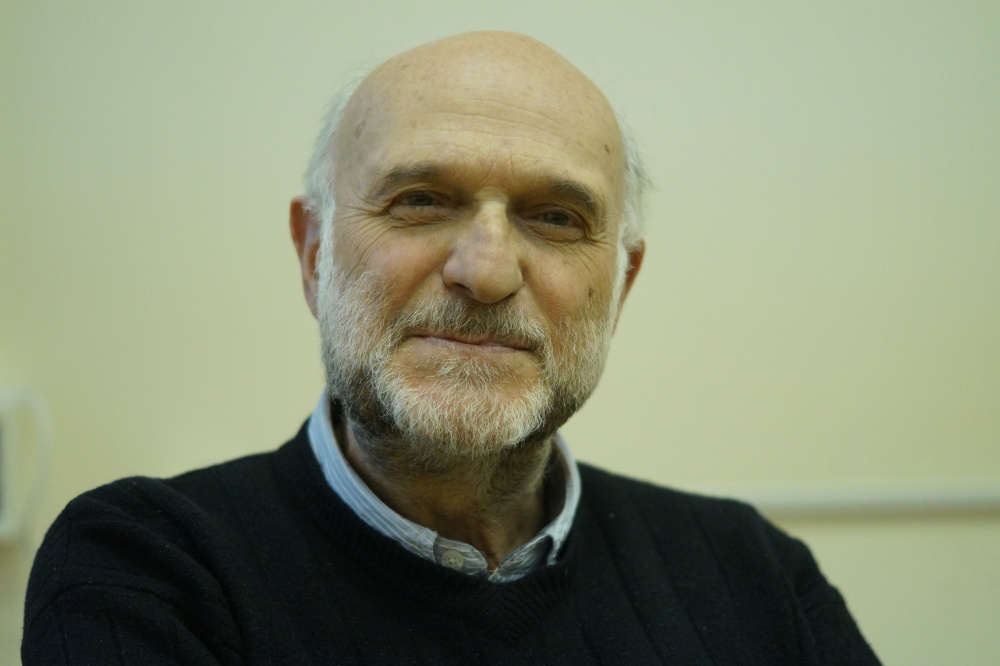
Guglielmo Cinque is a professor of linguistics at the University of Venice and one of the most well-known European generativists. Recently he paid a week-long visit the HSE School of Linguistics, and now shares his impressions of our students and staff, as well as of this year's weather in Moscow.
— Is it your first visit to Russia? How do you like it here? It is not the best weather, of course.
— Well, the weather is not your fault. Yes, it is my first visit to Russia, I have never been here before. But I knew the works of some researchers here at HSE. And I think it is one of the leading centres for typological linguistics. It is also a well-known centre for specialists in Caucasian languages, perhaps the best one. And as I just discovered, for Finno-Ugric languages as well. Also, yesterday I was told about a new project about Chukchi language…
— Yes, our School of linguistics organized an expedition to Chukotka last summer.
— This is something we miss in Italy. We have dialects to study, and they are very different. In the South I cannot understand a word! But in Russia you have the advantage to study many different families of languages. So I was very curious about coming here and getting to know these researchers.
— Who were the people from HSE that you knew before coming here? If you mention typology, then it must be Ekaterina Rakhilina, right?
— Yes, and also, Yury Lander, Michael Daniel… And then I discovered, that researchers at HSE not only work on typology, but also on formal syntax, like Anna Volkova, and formal semantics. This is unusual, because other centres of linguistic typology tend to be not as open. You do not see people working on formal syntax and semantics close to people working on linguistic typology. And this is something that attracts me particularly. I thought it could be interesting to see different perspectives to typological concerns, which I also try to follow. I am not a typologist, but I try to have a comparative syntax that takes into account various languages.
— I certainly noticed this typological scope in your lectures. Speaking of which: for our not-so-hardcore-linguist readers could you maybe outline your research in a nutshell?
— The name that characterizes the work I, and many other people in Italy, do is cartographic project. We work in the framework of generative grammar, and it is also compatible with the later developments of Chomsky’s minimalist programme, though it might also appear to be maximalists at the same time. We are trying to come up with precise, detailed, fine-grained structures for the sentence and for each phrase that composes the sentence ‑ VP, NP, AP and so on.
— Is this what you call the ‘God’s truth’ linguistics?
— Well, it is actually more of a methodological or scientific approach that differs from standard typology. I am not saying about all of the typologists. I cited Kholodovich, the founder of the Leningrad typology school in the 60-es, and his idea is that there is a universal syntax underlying the syntax… That is almost a Chomskian position!
So the ‘God’s truth’ position is, I think, the position that modern science takes. You’re trying to discover what is outside. In this case it is language, and faculty of language. And in a sense it is a bet, that such a thing, such a universal structure exists.
Of course, you could say ‘I do not believe there is any structure’. But then you are bound to be less exigent, less demanding about the facts. You take them at face value. If there is a difference, you are not trying to unify, not trying to generalize and see, how things relate.
— Coming back to your course, are you happy with the feedback that you got from the students and from the staff?
— Yes, I was very impressed by the reaction of the students. Of course, the teachers did not surprise me; I expected them to be very knowledgeable. But the students put some very interesting questions, very much to the point. And I was also impressed later during individual appointments. What impressed me is that they were immediately taken to the research level. They had to solve some empirical problems of some languages. At many appointments students presented some syntactic or morphosyntactic problems that they were trying to solve. And I am not only talking about PhD students — there were 3-rd year bachelor students and first year master’s. This is unusual. They dive into scientific problems directly. Some of them came with an abstract that they were planning to send or had already sent. It means they are stimulated to take a challenge.
— And from what you saw, could you give an assessment of the linguistic background of the students?
— The ones I talked with seem to be knowledgeable in typological methodology and the way of working with it. Others were also knowledgeable in formal syntax. It is not a homogeneous group of students, of course. Some are more typologically-oriented, some others more interested in formal syntax. But in general I was quite impressed by the fact that they are not content with knowing things — they immediately wanted to solve linguistic problems with the knowledge they reach. And this is a good way of checking your knowledge: trying to solve problems and seeing how far you can get. You can see what you miss, what you have to read more and understand more.
— Speaking about you personally, did you take out something valuable from these individual meetings? Maybe some interesting ideas or some data from the languages you did not encounter before.
— Yes, sure, both of the two. I found a couple of languages that I did not know about which seem to provide evidence for a certain word order I was interested in. And of course I had a chance to discuss linguistic problems with Yuri Lander, Michael Daniel, Anna Volkova, and Natalia Zevakhina. Unfortunately, professor Ekaterina Rakhilina was away, so we could only exchange a few things, but I know her work on lexical typology.
— And now for less scholarly questions. I know it is not the best kind of weather, but did you manage to do something for leisure here in Moscow?
— Despite the weather and the rain I managed to visit Kremlin and the museum of Russian impressionism, to see the Moscow Metro, which is quite amazing, the center and so on… I got the idea of Moscow, which is very heterogeneous architecturally, and this is very nice.
See also:

'Language Surrounds Us at All Times'
The most likely place to find Anton Buzanov is at the HSE building on Staraya Basmannaya Ulitsa, where the researcher spends nearly all his time. In his interview with the HSE Young Scientists project, he recounts his experience of leading a field expedition to Sami communities, shares his affection for teenage television shows, and observes that engaging solely in activities that bring joy can prevent burnout.
HSE University-Developed Linguatest System Launched in Nizhny Novgorod
Linguatest, Russia’s first foreign-language certification system, has been launched in the Nizhny Novgorod region. The system was developed by specialists from HSE University in cooperation with the National Accreditation Agency and the Prosveshchenie group of companies, who are providing certification and publishing support for the project. Nizhny Novgorod is the first city after Moscow to offer testing under the system.
'The Applied Linguistics Programme Allowed Me to Try Something I Was Interested in While Continuing What I Am Passionate About'
Austin Garrett-Sites, from the US, is a master's student of the Applied Linguistics and Text Analytics programme in Nizhny Novgorod. Students from around the world to come to Russia to get a European education in English with viable employment prospects. Austin spoke about his impressions after the first year of study and his favourite places in Nizhny Novgorod.
What’s It Like to Work as a Computer Linguist
The IT industry is rapidly developing and incorporating new professions. Zoya Mazunina and Arina Mosyagina, linguists with Seldon and graduates of the HSE University Fundamental and Applied Linguistics programme, met with university applicants to talk about the computer linguist profession, issues of automatic language processing, and how linguists use the knowledge they gain at HSE University.
Towards Finding Practical Solutions to Socially Significant Healthcare Problems
The Centre for Language and Brain in Nizhny Novgorod started operations in September 2020. Today, it is comprised of a team of linguists - teachers and students - who are researching the relations between speech and parts of the brain. The Director of the Centre, Natalya E. Gronskaya, spoke to the HSE Look about how the neuro-linguistic laboratory appeared in Nizhny Novgorod, as well as current tasks and prospects the Centre can offer the students and the region.
Predicting Grammatical Properties of Words Helps Us Read Faster
Psycholinguists from the HSE Centre for Language and Brain found that when reading, people are not only able to predict specific words, but also words’ grammatical properties, which helps them to read faster. Researchers have also discovered that predictability of words and grammatical features can be successfully modelled with the use of neural networks. The study was published in the journal PLOS ONE.
Weaving Languages Together: Why Megacities Need to Preserve Multilingualism
Moscow, like any modern big city, attracts migrants from different regions and countries. Some of them speak very little or no Russian. Their adaptation and successful integration depend in part on how fast they can learn Russian and in part on whether the city makes an effort to accommodate other languages. According to linguist Mira Bergelson, this latter factor is particularly important if the city is to benefit from immigration.
‘Reading’ with Aphasia Is Easier than ‘Running’
Neurolinguists from HSE University have confirmed experimentally that for people with aphasia, it is easier to retrieve verbs describing situations with several participants (such as ‘someone is doing something’), although such verbs give rise to more grammar difficulties. The results of the study have been published in Aphasiology.
‘We Have Not Yet Fully Understood How Languages Work, and We Are Already Losing 90% of Their Diversity’
Why might a grandmother and her grandson not understand each other? Why would linguists want to go to Dagestan? Is it possible to save the less commonly spoken languages of small nations and Russian dialects? Nina Dobrushina, Head of the Linguistic Convergence Laboratory answered these questions in an interview with HSE News Service.
Former HSE Exchange Student Returns as Post-Doc in Linguistics
Originally from Pavia, Italy, Chiara Naccarato developed an interest in Russian early on in her studies, completing her undergraduate and master’s degrees in Russian Language and Linguistics at the University of Milan. She recently joined HSE as a postdoctoral researcher in the Linguistic Convergence Laboratory after completing her PhD studies in Linguistic Sciences at the Universities of Pavia and Bergamo.