

‘We Need Solutions That Will Allow Russian Business not to Look to Offshore Companies, but to Gain Profitability in Russia’
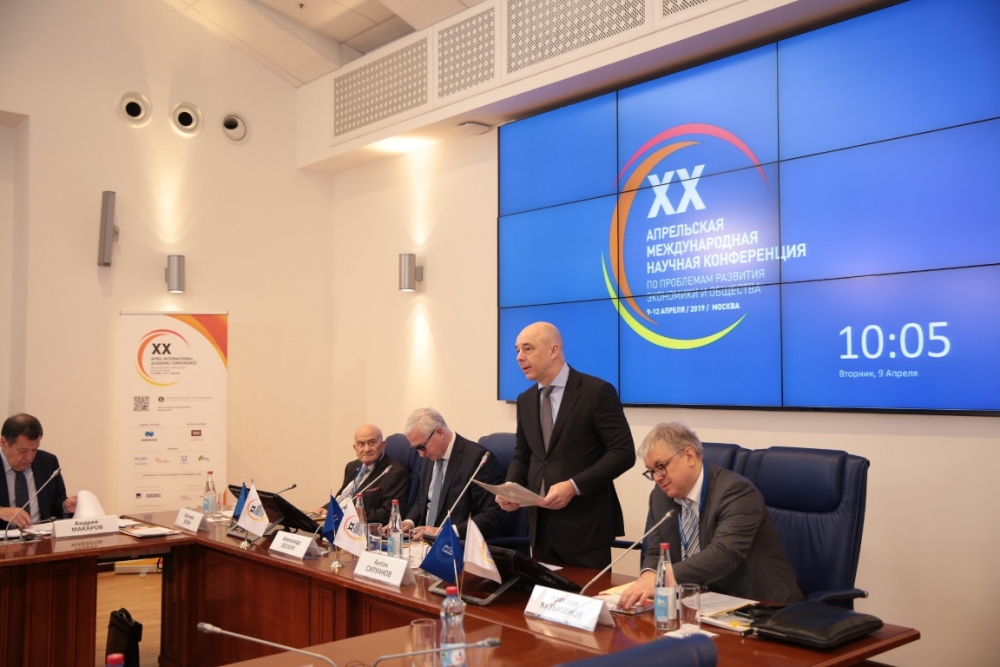


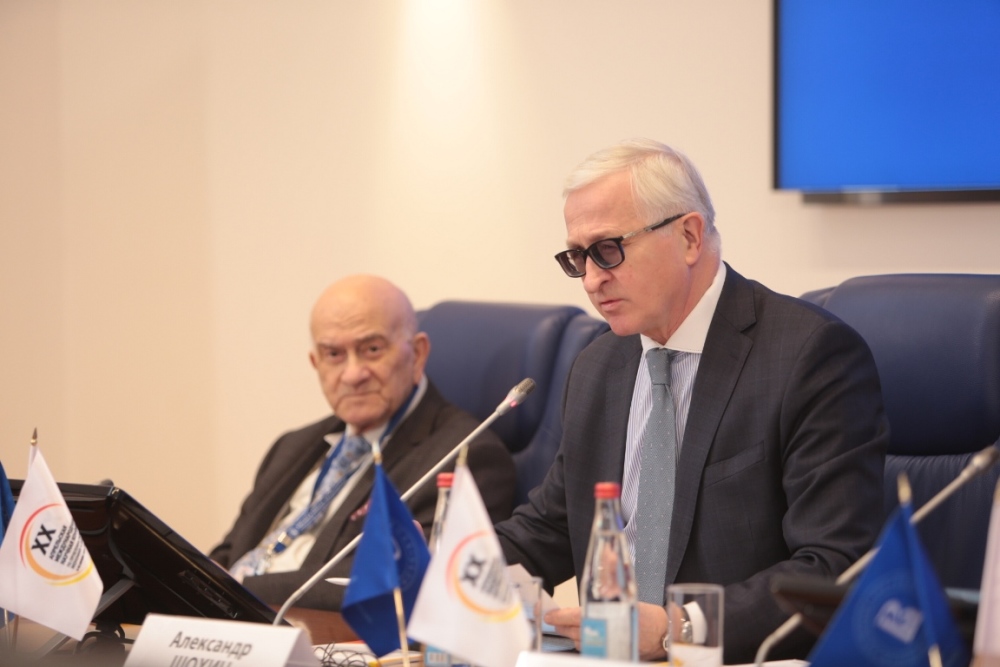


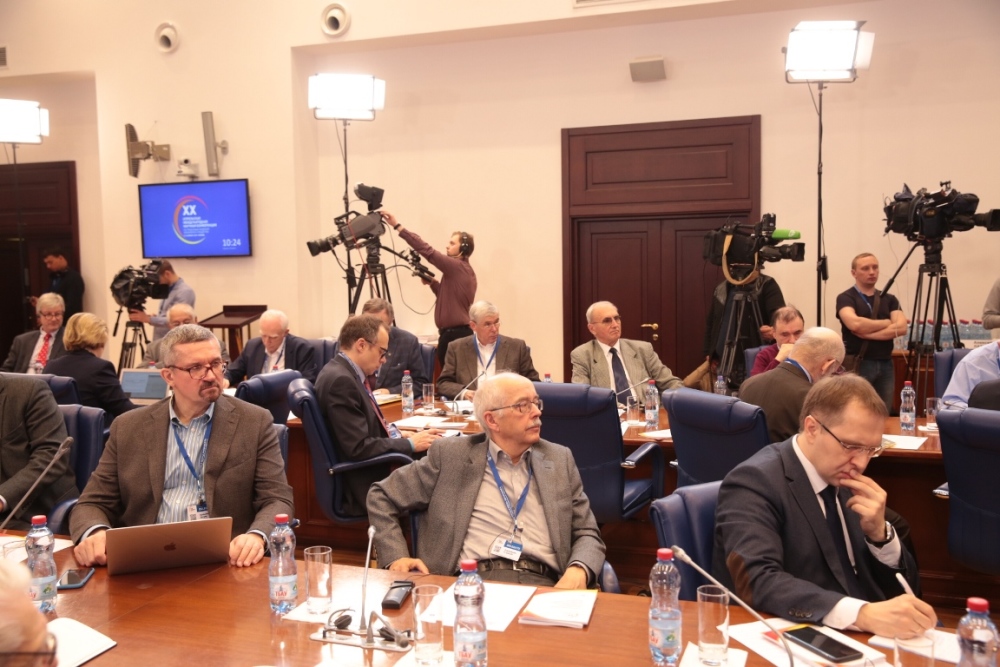
HSE’s XX April International Conference opened with a plenary session devoted to Russian economic development and fiscal policy. Mr. Anton Siluanov, Russia’s First Deputy Prime Minister and Minister of Finance, discussed the solutions proposed by the Russian government to stimulate economic growth and business development.
Economic Stability and Political Predictability
According to the minister, in recent years the Russian government has managed to lay the foundation for further reforms and structural changes. Macroeconomic imbalances have been eliminated, and budgetary resilience to external conditions and impact factors (such as oil prices and sanctions restrictions) has improved. Regional finances have strengthened—debt levels of Russian provinces have not only ceased to increase, but have even begun to decrease. All this made it possible for Russia in 2018 to maintain an economic growth rate of 2%—not high, Siluanov admitted, but surpassing the country’s average rates over the past 10 years.
Balancing the budget at the primary level is now possible at a price of $45 per barrel. The Minister noted that the budget surplus in 2018 was 2.6%, and reserves were formed.
Unlike other countries with developing economies, Russia did not increase its debts, but pursued a balanced budget policy
Russia’s national goals, as outlined by President Putin, stipulate growth rates not lower than international ones, as well as Russia's entry into the top five largest world economies. ‘That is not an easy task,’ says Mr. Siluanov. One of the ways we can achieve this goal are national projects, so a resource base has been formed in order to finance them. Regional governments are also involved in this endeavor.
For high growth rates, investments of at least 25% of Russia’s GDP are necessary (investments currently make up 21%). According the minister, this amount should not consist of only or mostly budgetary funds: ‘We are working with business in order to reduce the risks of investing and create incentives for it.’
The government is also focused on ensuring the stability and predictability of budgetary and fiscal policies (for the next six years there will be no major changes in the tax system). Another task is leveling the field of competition for different business entities. Siluanov agreed: the criticism that preference is given to state-owned companies is fair. At the same time, as the state improves administration procedures, it is closing tax loopholes, and this benefits certain companies.
In terms of reducing administrative burdens and eliminating obstacles, we have already had some success, the minister says: the time it takes to start a business is decreasing, customs procedures have been simplified (in part thanks to the introduction of electronic forms). Russia has risen from below the top hundred countries to within the top thirty in the international ‘Doing Business’ ranking.
In the future, regulatory measures (including those of a technical nature) that may adversely affect business development must be implemented with a delay of two years, so that businesses can prepare for them.



Opportunity for Domestic Investment
‘We are taking measures to encourage the return of business to our jurisdiction,’ the minister says. Russia will continue to provide capital amnesty. Two special administrative districts have been established that have essentially the same status as those foreign zones where the capital used to go.
Siluanov stressed the need for business to participate in the realization of large investment projects. It is necessary to negotiate with large and medium-sized businesses in order to transform resources that are in the economy (such as business’ profits) into concrete projects. A governmental and entrepreneurial working group has been formed, which eliminates administrative restrictions that affect business. Two bills have been prepared: a new version of special investment contracts and a law encouraging investment in the Russian economy.
‘We are taking a path of long money development,’ says Siluanov. ‘Legislation of the voluntary pension savings system is a tool for both raising pensions and long-term investments.’ Such resources, according to the minister, are especially important in cases when restrictions are imposed on attracting funds from foreign jurisdictions.
Industrial measures developed by the government include subsidies and tax incentives, especially in the field of petrochemical chemistry, which will be actively developed and will contribute to economic growth.
Siluanov also noted national projects on infrastructure development, digitalization (which will facilitate business operations and make the economy more transparent), labor productivity and the development of small and medium-sized businesses.
Plans for 2019 include loans to small and medium-sized businesses that are ten times bigger than last year’s, which amounted to 80 billion rubles
Another task, without the achievement of which it is impossible to improve Russia’s competitiveness and economic growth is to increase its exports. ‘Within six years, we need to almost double the volume of non-primary exports,’ the minister says. Companies working in this endeavor will receive state support.
At the request of the business sector, the Russian government is preparing to liberalize currency legislation in terms of currency earnings returns and the elimination of vestiges of the Soviet era, during which this was criminalized. In general, by 2021, a reevaluation of currency laws should be complete and outdated measures that were implemented a decade ago and hinder businesses today will be eliminated.
‘These measures are our responses to the current limitations and challenges, and they will encourage Russian business not to look to the West and offshore companies,’ Siluanov asserts, ‘but to work in Russia and gain high profitability.’
See also:

Applications for Participation in XXVI April International Academic Conference Still Open
Applications can be submitted on the conference website until December 16, 2025. The programme has been developed around five research themes: Economics, Human Capital and Society, Instrumental Methods and Models, Foresight Research, and International Research. The heads of these areas have presented, in video format, the priority topics and sections for which they are expecting submissions.
Applications to Participate in April International Academic Conference Now Open
HSE University is now accepting proposals to present academic reports at the XXVI April International Academic Conference named after Evgeny Yasin. Applications can be submitted until December 16, 2025. The conference events will take place mainly on-site in Moscow from April 14 to 17, 2026.
24 Countries Represented at 25th Yasin International Academic Conference Held by HSE University
The Programme Committee of the 25th Yasin (April) International Academic Conference on Economic and Social Development has summed up the initial results. In 2025, 1,384 people from 24 countries and 29 Russian regions participated in the conference, with 335 of them delivering presentations.
Stuck in the Net: How Much Time Children Spend Online
On average, a schoolchild spends 48 hours a week on studies—equivalent to a six-day working week for an adult. This was highlighted by experts at the round table ‘Domains of Children’s Well-Being Evaluation for Human Potential and Evidence-Based Social Policy Development,’ held as part of the 25th Yasin (April) International Academic Conference.
Russian and Chinese Scholars Share Experience of Transformation of Doctoral Education
The Russian and Chinese postgraduate education systems originally borrowed their institutional frameworks from the Soviet Union. However, in the 21st century, they have evolved along different paths. While key performance indicators for postgraduate programmes in Russia are declining, China is seeing a rapid increase in the number of postgraduate students. These contrasting trajectories and the reforms undertaken in each country in recent decades were the focus of a roundtable discussion held as part of the 25th Yasin (April) International Academic Conference.
Nobel Laureate Proposes Solution to Markov Equilibrium Problem
In dynamic games, a Markov equilibrium involves strategies that guide players' behaviour based on the current state of the game, rather than its entire history. This approach is effective when players have access to complete information. But when uncertainty arises in the game—for instance, when players are unsure of who they are dealing with—this approach can become problematic. Eric Maskin, Nobel Laureate in Economics and Professor at Harvard University, addressed this issue in a paper presented at the XXV Yasin (April) International Academic Conference on Economic and Social Development held at HSE University from April 15 to 18, 2025.
‘The World Is Becoming More Complex and Less Predictable’: What Scientists Say about the Future
The future is now more difficult for researchers to forecast, and events that are hard to predict are playing an increasingly significant role. But there is good news too: scientists are confident that humanity will adapt to any changes. This was the focus of discussion at the International Symposium ‘Foresight in a Rapidly Changing World,’ which took place as part of the 25th Yasin (April) International Academic Conference.
Fragmentation and Bloc Formation: How the Global Economy is Changing
Sergey Dubinin, former head of the Bank of Russia and Professor of Finance and Credit at the Faculty of Economics at Moscow State University, has delivered an honorary address at the XXV Yasin (April) International Academic Conference. He spoke about the transformation of the global monetary and financial system, as well as the Russian economy.
More Children, More Happiness: HSE Experts Study Impact of Number of Children on Russians' Assessment of Happiness
Russians with children feel happier than those without children. At the same time, the number of children influences the assessment of happiness: the more children Russians have, the happier they feel. These conclusions were outlined inthe report ‘More Children, More Happiness: The Impact of the Number of Children on Russians’ Assessment of Happiness,’ presented at the XXV Yasin (April) International Academic Conference on Economic and Social Development, held on April 15–18 at HSE University. The study was conducted by Elena Churilova, Senior Research Fellow, and Dmitry Jdanov, Chief Research Fellowat HSE International Laboratory for Population and Health.
HSE Expands Cooperation with Gulf Countries
HSE University and the Centre for International Policy Research (Qatar) have agreed to collaborate in the field of social sciences, with plans for joint research, academic exchanges, and regular expert engagement. The agreement was signed during the roundtable ‘State Capacity and State Resilience in the Global South,’ held as part of the 25th Yasin (April) International Academic Conference at HSE University.