

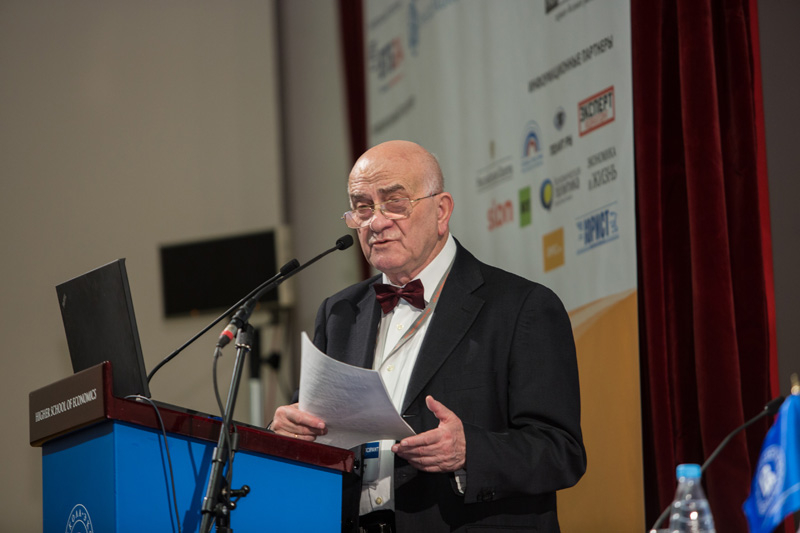
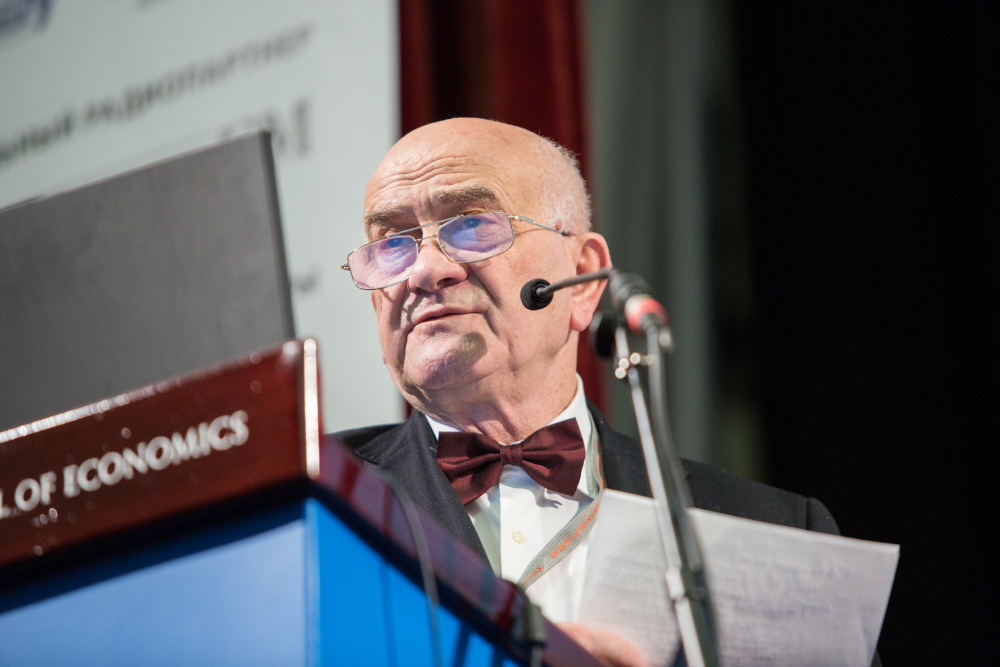
HSE Academic Supervisor, Professor Evgeniy Yasin, opened the XIV HSE April International Academic Conference on Economic and Social Development.
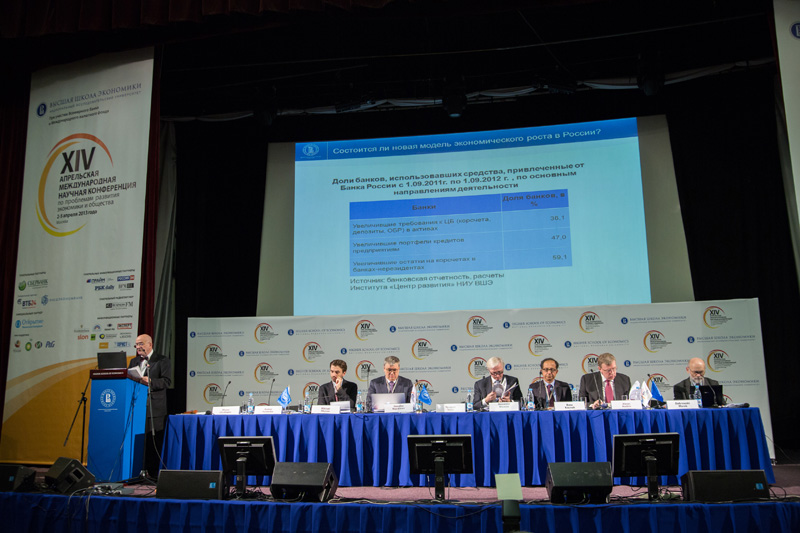
The XIV HSE April International Academic Conference on Economic and Social Development started in Moscow on April 2, 2013. HSE Academic Supervisor Evgeniy Yasin addressed the first plenary session on the Global Economic Crisis and the Russian Economy.
 |
| Evgeniy Yasin |
'The global economy is going through a prolonged crisis', reminded Evgeniy Yasin. 'This is due to the fact that the world is undergoing tectonic shifts, and we do not yet quite understand their nature … In my opinion, developed countries are faced with a technological barrier, and economic growth rates are now largely determined by the dynamics of innovation, rather than by extraction of cheap mineral resources. Better productivity driven by innovation is the main source of economic growth today; turning on the printing press and printing some more money for the economy will no longer work'.
Developing countries, according to Evgeniy Yasin, 'may be in a better position now'. They are enjoying a temporary advantage by adopting a 'catch-up development' mode through 'yesterday's innovation' and the use of cheap labor.
Russia is between these two poles. 'We have no competitive advantages besides natural resources', noted Evgeny Yasin. Labour in Russia is more expensive than in developing countries, while technology lags behind that of developed countries.
Before the 2008-2009 crisis, Russia showed higher rates of economic growth than the world average (7.5% in 2003-2007), but there was a sharp decline during the crisis, and the post-crisis recovery is comparable to the global average. The situation is exacerbated by 'the increasingly negative dynamics of private investment'. At the same time, increased military and security spending exceeds the growth of spending on education and health care, i.e. investment in human capital.
'We are not likely to see fast growth rates in the world economy, and oil prices will remain high, but it will not have the same effect on the Russian economy as before the crisis', Evgeniy Yasin believes. 'That is why we need a new economic growth model'.
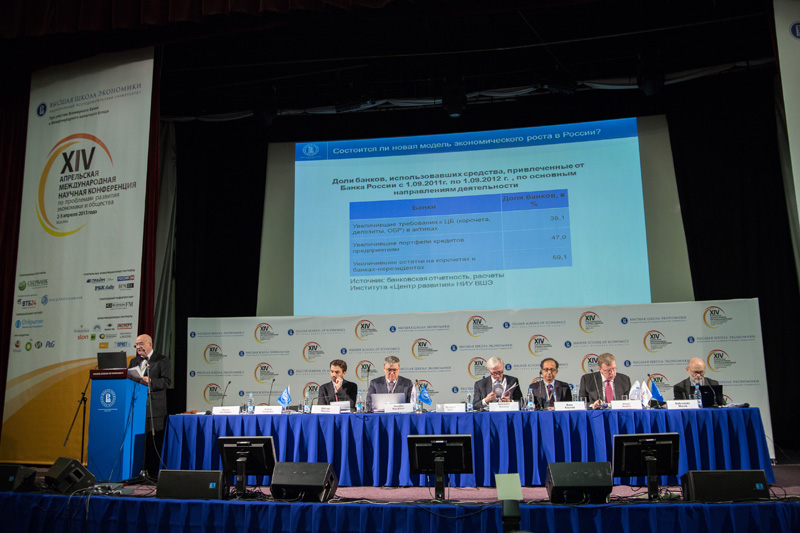 |
| First plenary session on ‘The Global Economic Crisis and the Russian Economy’ |
For this latter scenario to be implemented, five basic conditions need to be met: to establish the rule of law, fostering the independence of courts; to reshape the relationships between business and the law enforcement and judicial agencies; to reform local government, expanding its authority, and to restore true federalism; to encourage private investment (especially in the pension system and health care); and to promote democracy.
The authors of the report believe that 'new Russian business' and 'the new bureaucracy' are the driving forces capable of making the above a reality. In previous years, business and bureaucracy were often in conflict, business won the first round, in the 1990s, and bureaucracy took revenge after 2003, but the new generation of business owners and bureaucrats are prepared to cooperate, and various business associations will play an important role in this dialogue.
And finally, civil society is the third player charged with an important role in shaping the new economic growth model. Of particular importance is mutual trust, without which attracting private investment in the economy and social institutions will be extremely difficult. Evgeniy Yasin feels certain that increasing household incomes will not lead to an inflationary surge and will be balanced by a flow of private investment into pension and social security funds.
The World Bank's Chief Economist and Senior Vice President Kaushik Basuand prominent Polish economist Marek Dabrowski also addressed the plenary, speaking about the causes of the global financial crisis and the prospects for recovery. The chairman of the Committee for Civic Initiatives and former Finance Minister Alexei Kudrin commented on the government's monetary policies and criticized the government's projection for Russia's development to 2030.
Oleg Seregin, HSE News Service
Photo: Nikita Benzoruk
See also:

25th Yasin (April) International Academic Conference Now Accepting Proposals
Reports on new research results will be presented and discussed as part of the conference’s sections. These reports will be selected based on reviews of proposals. As always, the conference programme features expert discussions of the most pressing economic, social, internal and external issues in the format of roundtables and associated events.
Academic Council: HSE University’s Contribution to Achieving National Goals and Development Priorities to Increase
HSE University’s Development Programme until 2030 will be improved in order to increase the university’s contribution to achieving national goals and implementing the priorities of the country’s scientific and technological development. This decision was made by the university’s Academic Council on April 26. The meeting also addressed the principles for the development of HSE University’s external communications, one of which is the creation of a high-quality information field around the university.
Keeping Up with the Neighbours: Envy as a Driver of Economic Growth
Classical economic theory assumes that economic agents are entirely self-interested and rational in their pursuit of material well-being, and that they are not affected by external factors. As a result, externalities are not considered in any way when constructing economic models. Nevertheless, some sociologists argue for a revision of modern economic theory to incorporate the ethical dimensions of economic agents' behaviour. Kirill Borissov, Professor of the Faculty of Economics at the European University in St Petersburg, spoke at the XXIV Yasin (April) International Academic Conference and shared his observations from creating his own economic model incorporating the factor of envy.
Structural Transformation and Drivers of Sustainable Growth in Russian Economy Discussed at HSE University
The Russian economy has demonstrated high resilience to unprecedented external pressure and has managed to largely adapt to new conditions. As early as this year, it can go from recession to growth. The issue of where to find drivers and resources for this was discussed at a plenary session titled ‘Russian Economy under Sanctions: From Adaptation to Sustainable Growth’ at the XXIV Yasin (April) International Academic Conference held at HSE University as part of the Decade of Science and Technology. Minister of Economic Development of the Russian Federation Maksim Reshetnikov took part in the discussion.
‘People Want to Receive Only Useful Content’
Experts say that interest in news has sharply increased among the Russian audience. At the same time, part of the audience deliberately avoids it. What kind of content is in demand and will people continue to watch TV? These and other issues were discussed at the plenary session ‘ Info-hygiene and Information Elitism: How to Consume Media Properly’ at the XXIV Yasin (April) International Academic Conference.
'The Emerging Trends in Africa Will Shape the World Order, and We Need to Be Prepared for That'
Africa has the potential to become a new economic giant. Today, African countries are interested in comprehensive cooperation and strengthening their positions in the global arena, and they look forward to receiving assistance from Russia and China in developing their technology, economy, and social sphere. Effective engagement with Africa requires training a greater number of professional African studies specialists. The XXIV Yasin (April) International Academic Conference at HSE University featured a plenary session on 'Africa in a Changing World'.
Learning a Foreign Language Can Delay the Onset of Dementia
Dementia, a debilitating form of cognitive impairment, can be preventable. According to Professor Jubin Abutalebi of the University Vita Salute San Raffaele, Italy, and the Arctic University of Tromsoe, Norway, the easiest way to prevent cognitive decline after the age of 60 is to learn and practice foreign languages – the more languages, the better, suggests Professor Abutalebi in his presentation 'Preventing dementia through bilingualism' at the XXIV Yasin (April) International Academic Conference.
‘The BRICS Strategic Partnership Offers the World Creative, Unifying, Forward-Looking Initiatives’
Today, BRICS has become an influential factor in modern international relations and is perceived as one of the pillars of a more just world order. This association is not based on one party’s dominance, but instead, is built on a sound balance of interests. The role of the association was discussed by the participants of the plenary session ‘BRICS Development Strategy: Equal Opportunities in an Unequal World’at the XXIV Yasin (April) International Academic Conference.
Sanctions Create New Opportunities for Russian Companies
Like any crisis, the sanctions of 2022, besides problems, have created new opportunities for Russian companies. This is the conclusion that HSE University’s experts have come to. Their study results are presented in the report ‘Adaptation of Russian Industrial Companies to Sanctions: First Steps and Expectations’, prepared by HSE University for the XXIV Yasin (April) International Academic Conference.
Search Query: How to Study Migration with Google Trends
Experts have calculated that the number of international students in Russia has grown six times over the last decade, and researchers say that many of those who are studying today would like to stay in the country. This, alongside issues such as why Google Trends are worth looking into, were covered at the HSE XXIV Yasin International Academic Conference on Economic and Social Development section on demography and labour markets.