

Structural Transformation and Drivers of Sustainable Growth in Russian Economy Discussed at HSE University
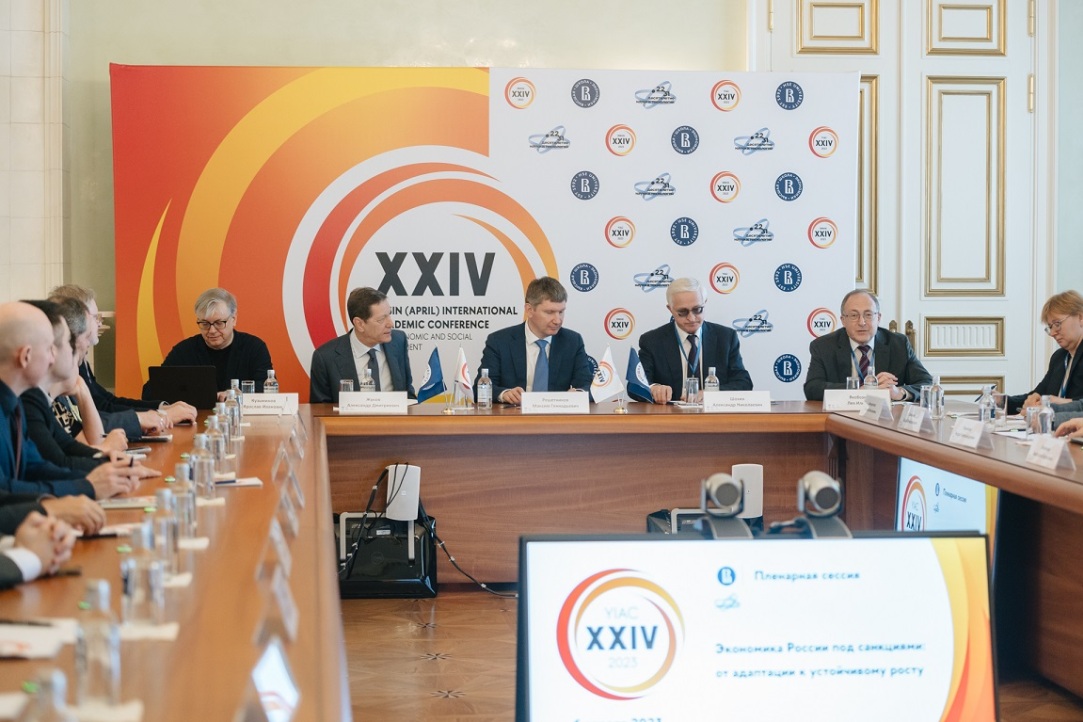
The Russian economy has demonstrated high resilience to unprecedented external pressure and has managed to largely adapt to new conditions. As early as this year, it can go from recession to growth. The issue of where to find drivers and resources for this was discussed at a plenary session titled ‘Russian Economy under Sanctions: From Adaptation to Sustainable Growth’ at the XXIV Yasin (April) International Academic Conference held at HSE University as part of the Decade of Science and Technology. Minister of Economic Development of the Russian Federation Maksim Reshetnikov took part in the discussion.
The minister emphasised that it is already clear that the Russian economy will show growth in 2023. ‘The main driver is domestic demand. The first component of this is consumer demand,’ he said.
Investment is another point of growth. ‘Last year, fairly strong investment growth was recorded, and this year it remains in the plus zone,’ the minister continued. In this regard, he emphasised the importance of investment structure quality so that investment produces long-term economic growth, as well as the development of the financial sector, the capital market, and the banking sector, which should provide an investment resource even in the face of a reduction in enterprises’ own resources.

‘We are solving this problem by expanding the guarantees of Vnesheconombank (VEB) and various programmes in which the state helps businesses invest amid conditions of capital shortage. Based on this model, economic processes will be built in the near future, and, of course, this will affect the structure of the economy,’ Maksim Reshetnikov said.
The economic contribution of export—another component of GDP—reached its peak in 2022, and a decline is expected in the coming years, the minister stated. ‘The objectives of reorienting export and supporting non-commodity, non-energy export will remain on the agenda and will be a very important driver of economic development,’ he stressed.
According to Maksim Reshetnikov, in general, the structure of the economy has become more flexible and stable. ‘The plasticity of our economy is based on the adaptability of private business. All our efforts have been aimed at removing potential barriers and allowing businesses to do their job. This calculation proved to be right,’ he added.
He cited investment in industry and support for R&D as priorities in the current environment ‘in order to take risks, cover some losses, and most importantly, ensure a stable public contract,’ he explained.
He drew attention to the fact that in recent years, the government has built a comprehensive toolkit to support enterprises. For example, VEB guarantees involve the transfer of risks to the state on key projects. In some cases, this covers 50%, 70%, and even 90% of the risks.
As part of Project Finance Factory, the interest rate risks of borrowers are hedged through subsidies from the Russian government. ‘That is, when loan rates jump up, the business gets rates of 7–8%. We compensated 20 billion rubles last year to smooth out these peaks for the economy,’ he recalled.
Another mechanism, IPPAs (Investment Protection and Promotion Agreements), guarantee immutable conditions for the implementation of investment projects, as well as the reimbursement of infrastructure costs through taxes, the minister continued.
‘We also have a mechanism in place to subsidise interest rates even below the average market level for priority projects,’ Maksim Reshetnikov said. In line with the priorities set by the government, the Bank of Russia will lower the risk level requirements for financing banks, and the volume of this indulgence will reach 10 trillion rubles. ‘This is a quarter of all funding for the real sector of the economy, technological and industrial projects,’ he noted.
‘The state has never taken on such a volume of risks and has never performed the function of the last resort investor to that extent,’ he concluded.
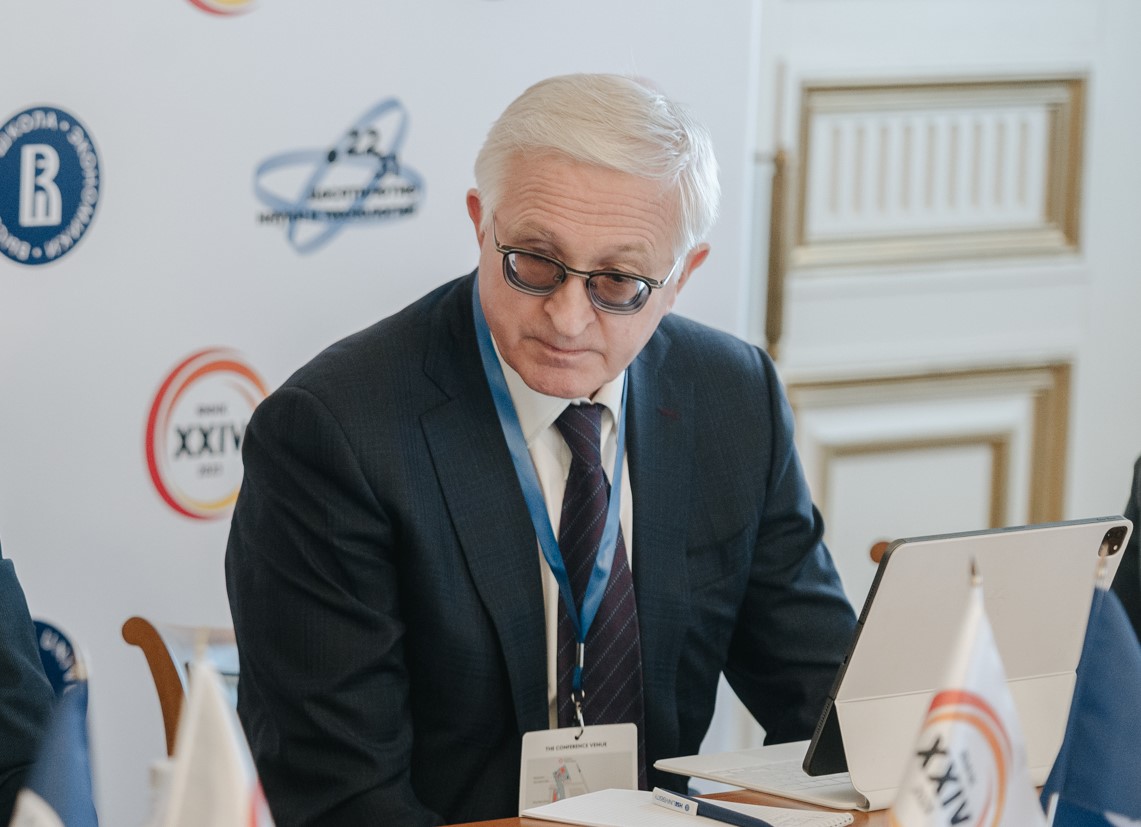
Alexander Shokhin, Head of the Russian Union of Industrialists and Entrepreneurs, President of HSE University, agreed that domestic demand is becoming the main source of growth. In his opinion, the government’s task in the current conditions is to stimulate private initiative and expand the boundaries of economic freedom. ‘We need to reduce excess pressure on business,’ he stressed. In addition, it is necessary to stimulate and create conditions for the return of companies to the Russian jurisdiction; the Russian Union of Industrialists and Entrepreneurs has a package of proposals in this area. ‘Business is ready to return home,’ said Alexander Shokhin.
The role of business in adapting to new conditions was also analysed by HSE University Academic Supervisor Yaroslav Kuzminov. ‘A year ago, we assumed that the shifts in the economy would be much more radical, but it has turned out to be more resilient than we thought,’ he admitted. Contrary to fears, the manufacturing sector is becoming more complex, not simpler, as domestic companies replace high-tech Western products that have left the market. However, not everything can be quickly replaced, so the task of finding foreign suppliers remains relevant. Yaroslav Kuzminov also named domestic demand as the main driver of growth and expressed the opinion that in the coming years, the task of increasing the share of labour in the distribution of social products will become urgent. He added that after the initial adaptation period (2022–2025), it will be necessary to think about a targeted policy to increase labour incomes and the share of labour in GDP. Some measures are being taken now, such as raising the minimum wage, but this is not enough. It is clear that today, all market players—entrepreneurs and the state—are wary of outpacing wage growth out of a fear of harming competitiveness. But the HSE Academic Supervisor believes that the increase in production will soon come up against the trap of low incomes among the population.

Large investment projects, says Yaroslav Kuzminov, will have a declining macroeconomic effect, so it is advisable to focus them on the formation of new transport and logistics infrastructure. Alexander Shokhin agreed with this, but added that such investments should also take into account the very high volatility of international trade in recent years.
‘Investment is the main driver of growth,’ Alexander Zhukov, First Deputy Chairman of the State Duma of the Russian Federation, said in support of the speakers. ‘We see that today’s Russia has opportunities for investment,’ he added. The Vice Speaker believes that a reasonable balance has been found between the interests of the state and business; the task of the government and other authorities is to improve the investment climate.

The discussion participants paid considerable attention to the role of private initiative and strengthening of the market basis of the Russian economy. ‘An important advantage of the Russian economy today is the readiness of business to work in conditions of high uncertainty and constant change in the environment and regulation. This was formed back in the 1990s,’ Yaroslav Kuzminov emphasised. Small and medium-sized businesses should have strong incentives to continue their activities. In particular, the government plans to form special tools to ensure the ‘growth’ of small businesses into medium-sized ones, as well as medium-sized businesses into large ones, Maksim Reshetnikov said.
Alexander Zhukov stressed that ‘it was the market structure of the economy and free, independent business decisions that allowed Russia to get through the first year of unprecedented economic sanctions from the West with minimal losses.’ The Vice Speaker characterised the arguments ‘calling for nationalisation and command economy’ irresponsible, recalling the experience of the Soviet Union’s collapse precisely because of the extreme inefficiency of the ‘Gosplan’ methods of making economic decisions. In conclusion, Alexander Zhukov emphasised that it is necessary to continue supporting business and giving it the opportunity to develop: ‘Now we need to reconsider the decisions that limit the development of business.’
See also:

Applications for Participation in XXVI April International Academic Conference Still Open
Applications can be submitted on the conference website until December 16, 2025. The programme has been developed around five research themes: Economics, Human Capital and Society, Instrumental Methods and Models, Foresight Research, and International Research. The heads of these areas have presented, in video format, the priority topics and sections for which they are expecting submissions.
Applications to Participate in April International Academic Conference Now Open
HSE University is now accepting proposals to present academic reports at the XXVI April International Academic Conference named after Evgeny Yasin. Applications can be submitted until December 16, 2025. The conference events will take place mainly on-site in Moscow from April 14 to 17, 2026.
24 Countries Represented at 25th Yasin International Academic Conference Held by HSE University
The Programme Committee of the 25th Yasin (April) International Academic Conference on Economic and Social Development has summed up the initial results. In 2025, 1,384 people from 24 countries and 29 Russian regions participated in the conference, with 335 of them delivering presentations.
Stuck in the Net: How Much Time Children Spend Online
On average, a schoolchild spends 48 hours a week on studies—equivalent to a six-day working week for an adult. This was highlighted by experts at the round table ‘Domains of Children’s Well-Being Evaluation for Human Potential and Evidence-Based Social Policy Development,’ held as part of the 25th Yasin (April) International Academic Conference.
Russian and Chinese Scholars Share Experience of Transformation of Doctoral Education
The Russian and Chinese postgraduate education systems originally borrowed their institutional frameworks from the Soviet Union. However, in the 21st century, they have evolved along different paths. While key performance indicators for postgraduate programmes in Russia are declining, China is seeing a rapid increase in the number of postgraduate students. These contrasting trajectories and the reforms undertaken in each country in recent decades were the focus of a roundtable discussion held as part of the 25th Yasin (April) International Academic Conference.
Nobel Laureate Proposes Solution to Markov Equilibrium Problem
In dynamic games, a Markov equilibrium involves strategies that guide players' behaviour based on the current state of the game, rather than its entire history. This approach is effective when players have access to complete information. But when uncertainty arises in the game—for instance, when players are unsure of who they are dealing with—this approach can become problematic. Eric Maskin, Nobel Laureate in Economics and Professor at Harvard University, addressed this issue in a paper presented at the XXV Yasin (April) International Academic Conference on Economic and Social Development held at HSE University from April 15 to 18, 2025.
‘The World Is Becoming More Complex and Less Predictable’: What Scientists Say about the Future
The future is now more difficult for researchers to forecast, and events that are hard to predict are playing an increasingly significant role. But there is good news too: scientists are confident that humanity will adapt to any changes. This was the focus of discussion at the International Symposium ‘Foresight in a Rapidly Changing World,’ which took place as part of the 25th Yasin (April) International Academic Conference.
Fragmentation and Bloc Formation: How the Global Economy is Changing
Sergey Dubinin, former head of the Bank of Russia and Professor of Finance and Credit at the Faculty of Economics at Moscow State University, has delivered an honorary address at the XXV Yasin (April) International Academic Conference. He spoke about the transformation of the global monetary and financial system, as well as the Russian economy.
More Children, More Happiness: HSE Experts Study Impact of Number of Children on Russians' Assessment of Happiness
Russians with children feel happier than those without children. At the same time, the number of children influences the assessment of happiness: the more children Russians have, the happier they feel. These conclusions were outlined inthe report ‘More Children, More Happiness: The Impact of the Number of Children on Russians’ Assessment of Happiness,’ presented at the XXV Yasin (April) International Academic Conference on Economic and Social Development, held on April 15–18 at HSE University. The study was conducted by Elena Churilova, Senior Research Fellow, and Dmitry Jdanov, Chief Research Fellowat HSE International Laboratory for Population and Health.
HSE Expands Cooperation with Gulf Countries
HSE University and the Centre for International Policy Research (Qatar) have agreed to collaborate in the field of social sciences, with plans for joint research, academic exchanges, and regular expert engagement. The agreement was signed during the roundtable ‘State Capacity and State Resilience in the Global South,’ held as part of the 25th Yasin (April) International Academic Conference at HSE University.