

Artificial Intelligence Tested by Kant Philosophy
.jpg "Artificial Intelligence Tested by Kant Philosophy")
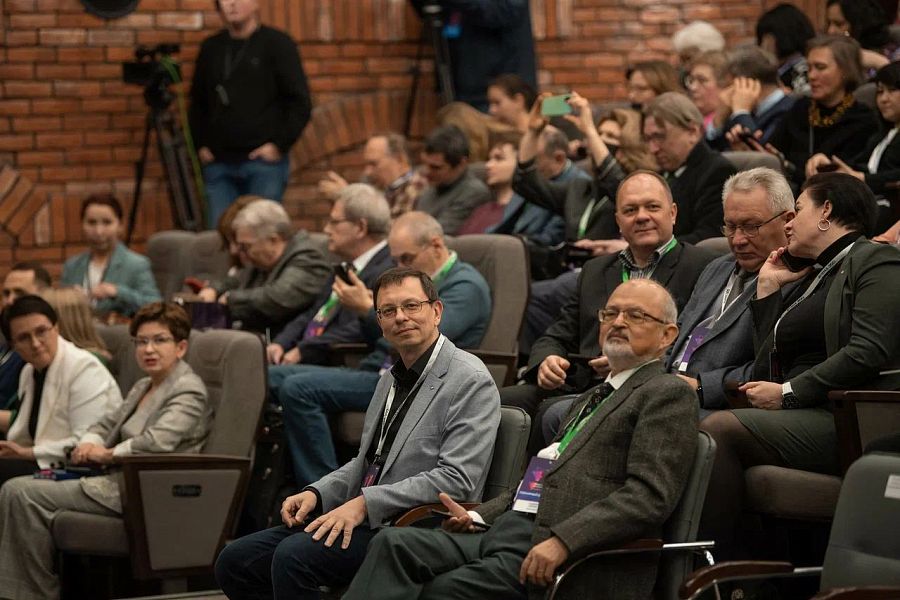
The Baltic Federal University (Kaliningrad) recently hosted an International Congress entitled ‘The World Concept of Philosophy’ in honour of the 300th anniversary of the birth of the philosopher and thinker Immanuel Kant. The event brought together about 500 scientists and experts from 23 countries. HSE Rector Nikita Anisimov took part in the opening plenary session of the congress titled ‘Critique of Artificial Intelligence: Being and Cognition in the Context of Artificial Intelligence Development.’
Opening the congress, Deputy Prime Minister Dmitry Chernyshenko read a welcome message from Russian President Vladimir Putin. The head of state emphasised that the initiative to widely celebrate the anniversary date received active support both in Russia and abroad. ‘I hope that the anniversary celebrations will be instrumental in preserving Immanuel Kant’s rich intellectual and humanistic legacy and encourage the further study of his works, which became a veritable breakthrough in their time.’

Dmitry Chernyshenko emphasised that the widespread use of AI is a new stage in the development of humanity, which opens up great prospects for economic progress but requires a considered and responsible approach. According to expert forecasts, the total contribution of AI technologies to the global economy could reach $15 trillion by 2030.
The Deputy Prime Minister noted that Russia has developed a national strategy for the development of artificial intelligence, which includes 8 key tasks and 10 indicators, the main one being the growth of Russia’s GDP by 11.2 trillion roubles. Experimental legal regimes have become an effective mechanism for the development, implementation, and use of AI. Currently, 13 such regimes have been approved in the field of unmanned aviation systems and unmanned transport, as well as in healthcare.

An important ethical regulator of technological progress is our culture, the Deputy Prime Minister said. Traditional values are moral guidelines that shape the worldview of Russian citizens.
‘High moral ideals, humanism, justice, respect for the individual, and cultural values of our multinational and multi-confessional country should form the basis for our domestic developments,’ concluded Dmitry Chernyshenko.
The Governor of the Kaliningrad Region, Anton Alikhanov, noted that the greatest legacy of the philosopher is substantive dialogue. He believes that a philosopher is valuable not only for answering important questions but also for posing new problems. Currently, as the governor believes, it is necessary to understand what AI is, what it can know, do, and what it should do.
Russian Deputy Minister of Science and Higher Education Konstantin Mogilevsky believes that higher education should evolve, anticipating forthcoming changes in the world, to ensure its future. Artificial intelligence has become an integral part of the educational process and university management in recent years. ‘Last year, the Ministry of Science and Higher Education of Russia, together with our leading universities and technology companies, created a special competency model in the field of AI. It included a detailed description of professions related to artificial intelligence technologies: researcher, analyst, data architect, and so on. Subsequently, this formed the basis for the professional-public accreditation of educational programmes in the field of AI, conducted by the Alliance for Artificial Intelligence. And already, more than 6,000 people enrol in AI-related programs every year,’ Konstantin Mogilevsky said.

The Rector of the Immanuel Kant Baltic Federal University Alexander Fedorov noted that philosophy is not an exclusive occupation; everyone engages in it by comprehending reality and their place in it. In his opinion, AI has become both a process and a reality. ‘A very important question is whether a situation will arise where we can say that generative artificial intelligence has its own interest? Then we will begin to endow it with the same characteristics that we have. It is quite possible that the entire arsenal of cognitive-anthropological terminology, which we are used to applying to ourselves, cannot be applied to artificial intelligence. We just don't know how to really talk to it yet,’ he noted. Restrictions are necessary in the development of new technology so that it develops in conjunction with humanity, not separately from it, Alexander Fedorov believes.
People often attribute anthropomorphism to AI, calling the software product ‘intelligent’ and demanding results from it similar to those from the human brain, but AI should not be considered as intelligence in the full sense of the term, believes HSE Rector Nikita Anisimov. In his speech, he pointed out that the effectiveness of AI technologies is high in solving a large number of tasks, including educational ones.
‘We have decided to integrate AI usage technologies into all university educational programmes in their professional field. And in the preparation, for example, of historians and philosophers, technologies for using artificial intelligence in professional activities will be embedded in educational programmes from next year. In addition, we have 19 targeted training programmes in artificial intelligence. These are programmes designed for both students of IT specialties and for training students with a strong IT core, focusing on new tasks in biotechnology, fintech, development, geoinformation technologies, and other areas of the digital economy,’ Nikita Anisimov said.
The quality of education in the IT and AI field has been proven, particularly by the success of HSE University at the recent International Collegiate Programming Contest (ICPC), where one HSE team became world champions and another team took third place. The HSE Rector also mentioned that HSE University has launched a competition for solutions using artificial intelligence technologies in thesis writing. The goal of the competition is to evaluate students' use of tools based on generative models in graduation theses defended in 2024.
The plenary session of the International Kant Congress also involved Sunjoy Joshi, Chairman of the Observer Research Foundation (ORF, India), Arutyun Avetisyan, Director of the Ivannikov Institute for System Programming of the Russian Academy of Sciences, and Alexey Pishchulin, Director of the Federal Centre for Humanities Practices at the Russian State University for the Humanities.
The International Kant Congress took place in Kaliningrad from April 22nd to April 25th, 2024. It was organised by the Russian Ministry of Science and Higher Education and the Government of the Kaliningrad Region, and held at the Immanuel Kant Baltic Federal University.
See also:

Final of International Yandex–HSE Olympiad in AI and Data Analysis Held at HSE University
Yandex Education and the HSE Faculty of Computer Science have announced the results of the international AIDAO (Artificial Intelligence and Data Analysis Olympiad) competition. Students from 14 countries took part. For the second year in a row, first place went to the team AI Capybara, which developed the most accurate AI model for an autonomous vehicle vision system.
AI Lingua Included in Compilation of Best International AI Practices in Higher Education
HSE University has been acknowledged internationally for its pioneering efforts in integrating artificial intelligence into higher education. The AI Lingua Neural Network developed at HSE was included in the renowned international collection ‘The Global Development of AI-Empowered Higher Education: Beyond the Horizon.’ The compilation was prepared by the Institute of Education (IOE) of Tsinghua University with the support of the Ministry of Education of the People's Republic of China and a global advisory committee, which included experts from Oxford, UCL, Sorbonne, Stanford, and other leading academic centres.
Technological Breakthrough: Research by AI and Digital Science Institute Recognised at AI Journey 2025
Researchers from the AI and Digital Science Institute (part of the HSE Faculty of Computer Science) presented cutting-edge AI studies, noted for their scientific novelty and practical relevance, at the AI Journey 2025 International Conference. A research project by Maxim Rakhuba, Head of the Laboratory for Matrix and Tensor Methods in Machine Learning, received the AI Leaders 2025 award. Aibek Alanov, Head of the Centre of Deep Learning and Bayesian Methods, was among the finalists.
HSE University to Join Physical AI Garage Project by Yandex
Yandex is collaborating with leading Russian universities to launch a new educational programme called Physical AI Garage. This initiative unites five universities—HSE University, ITMO, MIPT, MAI, and MEPhI—to train future professionals in physical artificial intelligence by tackling real-world industrial challenges. The programme is free, and participants will receive scholarships.
Larger Groups of Students Use AI More Effectively in Learning
Researchers at the Institute of Education and the Faculty of Economic Sciences at HSE University have studied what factors determine the success of student group projects when they are completed with the help of artificial intelligence (AI). Their findings suggest that, in addition to the knowledge level of the team members, the size of the group also plays a significant role—the larger it is, the more efficient the process becomes. The study was published in Innovations in Education and Teaching International.
HSE Researchers Assess Creative Industry Losses from Use of GenAI
Speaking at the IPQuorum.Music forum on October 15, Leonid Gokhberg, HSE First Vice Rector, and Daniil Kudrin, an expert at the Centre for Industry and Corporate Projects of HSE ISSEK, presented the findings of the first study in Russia on the economic impact of GenAI on creative professions. The analysis shows that creators’ potential losses could reach one trillion roubles by 2030.
‘Fall into ML Has Firmly Established Itself as a Landmark Event in Russia’s AI Scene’
On October 24–25, 2025, the AI and Digital Science Institute of the HSE Faculty of Computer Science will host the fourth annual Fall into ML 2025 conference at the HSE Cultural Centre. The event is once again supported by its general partner, Sber. The focus this year is on breakthrough research and the future of fundamental AI.
Critique of Obscure Reason: Artificial Intelligence in the Perception of Mathematicians
Mathematicians at HSE University believe that there is no need to fear losing jobs because of the widespread use of AI, while at the same time they warn against uncritical acceptance of works and projects prepared with its help. AI, however, can be a useful tool in research, creating models and processing large volumes of information.
Registration for Russian Olympiad in Artificial Intelligence 2025 Now Open
Registration for the fifth season of the Russian Olympiad in Artificial Intelligence has opened. This year, the competition has gained international status. The event is open to students in the 8–11 grades both in Russia and abroad. The winners will receive benefits when applying to Russian universities.
Global AI Trends Discussed at International Foresight Workshop at HSE University
At an international foresight workshop on artificial intelligence held at HSE University, Russian and foreign scholars discussed the trends and challenges arising from the rapid development of AI.