

Curiosity as a Good Motivation for Researchers and the General Public
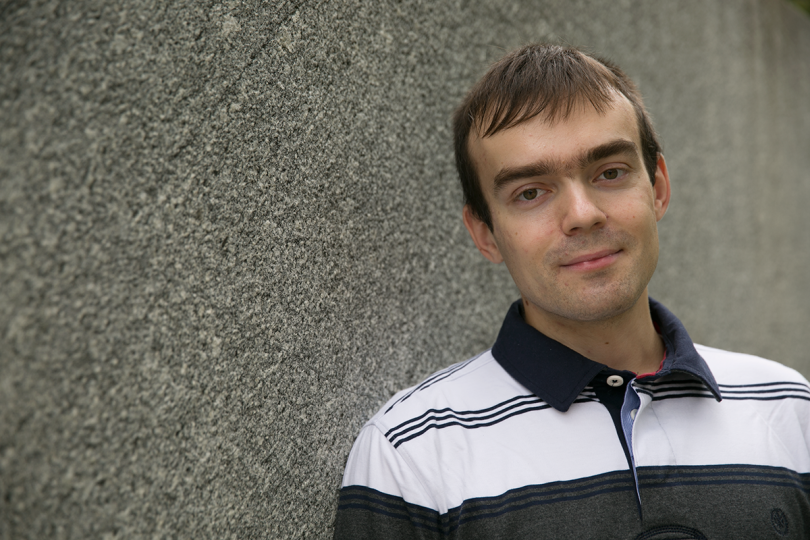
In 2015 Alexey Bufetov graduated from HSE Doctoral School of Mathematics, and is now working at MIT. He has talked to HSE News Site about his research and his career as a mathematician.
How a hobby grew into a research degree
My parents were physicists, my brother was a mathematician, so I was always supported as I pursued my education first at a mathematical school and then at MSU’s Mechanics and Mathematics Faculty. I always enjoyed mathematics, and I was quite good at it. It was really nice to see that my favourite subject, my hobby and pastime, was so compatible with my work.
There were two factors that influenced why I chose HSE as a destination for my research degree. First, the Faculty of Mathematics is home to a host of well-known mathematicians, and I really enjoyed working with that team. The opportunity to work with my academic supervisor, Grigori Olshanski, was a particular draw.
Second, full-time research degree students at HSE enjoy outstanding conditions, including a grant you can actually live on, laboratory time, and the opportunity to travel to scientific and research events. This enabled me not only to continue my research without worrying about making some extra money somehow, but I also had HSE support in taking part in summer schools, conferences, and work experience. That was particularly important for me.
On HSE’s Mathematics Faculty
The Mathematics Faculty is very new, but has already become recognized as the country’s leading mathematical faculty. Most of the strongest applicants (for example those who have won prizes in Russian national Olympiads in Math) are already enrolled in this faculty. I really hope they continue to develop as they have done to date.
It is not impossible that the person who first used stones to create fire was driven by curiosity rather than a need to cook meat, and this could be a very good motivation for researchers – and for humanity as a whole
I think the best thing about the Mathematics Faculty is its creative atmosphere. Members of the Faculty, researchers and students, all enjoy studying mathematics. In that kind of environment you work faster, it’s much more straightforward, and you’re more motivated.
On probability theory and pure science
I am involved in problems that occur at the confluence of different spheres. It involves a little algebra, a little combination theory, a little mathematical physics, but my main specialization is probability theory. In the first two years of my university studies I did a lot of courses in a number of different areas of mathematics, and I knew that research linked with probability would be interesting. However, mathematics can never be fully split into separate areas, it really is one subject.
However, any scientist or researcher is glad when they see that subjects, ideas, methods used in one area are also shared by another area, especially one that had not been seen as in any way connected. This doesn’t happen often in mathematics, and it is really nice when it does.
The best thing about the Mathematics Faculty is its creative atmosphere
Unlike most fields in mathematics, intuition plays a key role in probability theory. It’s easy to get an intuitive understanding of questions that are not easy to answer. Say, it is clear what a random integer between 1 and 6 is – just roll a dice. But a random real number between 0 and 1? What is a random integer? Back in the early 20th century mathematicians did not know how to construct a rigid probability theory that is also capable of explaining what we know intuitively.
It is clear that probability theory has a number of uses: in the economy, in statistical problems that we encounter all over the place – from which hand the goalkeeper needs to use to deflect the penalty, to what medicine you need to choose to treat an illness. It’s intriguing, but that is why some mathematicians even take a rather snobbish view of those who ‘dabble in probability’ – claiming they are too close to the applied disciplines and have strayed too far from pure science. Three out of four of the most recent Fields medals were, to some extent, linked with probability theory.
On how you can use mathematics
Of course, the overwhelming majority of mathematical work does not have any direct practical application. There are various types of ‘justification’ you can call on here. Firstly – economic. If vector space differentiation and the Law of Large Numbers were patented and could earn mathematicians a percent of the turnover, then mathematicians would live quite well indeed. But the relationship between science and society has always been somewhat different.
Another way would be to say that the mathematician’s involvement in teaching fundamental subjects is in itself a significant contribution to the general good. This is the approach seen in the United States: ‘Dear Mathematicians, teach mathematical analysis to engineers and bankers, and spend the rest of the time on your research.’ This system works but not everyone is happy with it.
I prefer the more highbrow approach, that humanity needs more than just goods and entertainment, it needs peace. And this is the key goal of any real science – mathematics included. I would not be particularly upset if my work never finds any application in ‘the real world’. It is not impossible that the person who first used stones to create fire was driven by curiosity rather than a need to cook meat, and this could be a very good motivation for researchers – and for humanity as a whole.
On working at MIT
I am currently a post-doc at MIT. It was difficult to decide to leave and go to work in a different country. I like living in Moscow and I don’t see any advantages to life in the West. But from the point of view of my work, it really is very helpful to work in different places, it expands your world-view, and for today’s international science and research environment this is very important. In the Spring semester at MIT I gave lectures on accidental processes and of course could not help but compare the approach to education in Moscow mathematics faculties and there. Accidental processes are the same everywhere – but there is still a significant difference.
Take organization: in American universities there are virtually no compulsory courses, all the courses are optional (and I don’t think that really works). The large number of formula, not theory, based math courses was also unusual. You just do not see that in Russian.
There are a host of advantages to working as a mathematician. It is a very free profession, the professional community comprises very engaging individuals
There is a significant difference in how students and teachers interact. For example, in America you don’t tend to address a particular student, the questions are put to the entire room and those who want to answer – answer. Most students are very motivated, they take their homework and lectures very seriously, and most of their studies take place during the semester – not the night before the exam as you often see in Russia.
You also have to remember that Russian and American universities exist in very different environments. Almost all US students pay huge sums of money to study and that has a clear impact on the educational process, both positive and negative. In Russia higher education is free. I have really started to value that – and started to understand that there is a kind of moral obligation, and it is good to somehow give something back.
About a career as a mathematician
The standard career for a mathematician looks like this: after qualifying he or she spends three years working as a post-doc, a temporary position like an Associate Professor. Then, they spend 5 years as an Assistant Professor in a different university and win their professorship. You have to get used to this process.
For example, there are a number of problems in mathematics which are really endless, even if you study them for years you may well not make any progress. And any advances in these areas are very interesting. These problems always have to be put off, because tackling them when you’re in a temporary position is very risky.
Overall, there are a host of advantages to working as a mathematician. It is a very free profession, the professional community comprises very engaging individuals. You can earn higher wages in programming or economics, of course. But the main thing is that you have the opportunity to really enjoy your work.
See also:

‘Employers Know That HSE Graduates are Well-Prepared, Analytical, and Adaptable’
Warda Tariq, from Pakistan, completed her Master’s in Data Science at HSE University–Moscow in 2024. She is now undertaking a PhD at the Faculty of Computer Science while working remotely as an AI/ML developer. Warda spoke to the HSE News Service about blending theory and practice, what an HSE education provides apart from academic knowledge, and her advice for making the most of university.
‘Start Working on Your Articles from the Very Beginning of Your PhD’
Andrés Castañón Rincón, from Spain, is a doctoral student at the HSE School of Philosophy and Cultural Studies in Moscow working on the history of Soviet Marxism philosophy. In his interview with the HSE News Service, he explains why studying Soviet Marxism is relevant today, talks about the advantages and challenges of his work in Moscow as an international researcher, and gives some advice to beginner PhD students.
HSE University Wins Seven Medals at International Mathematics Competition for University Students
HSE students were among the winners of the International Mathematics Competition for University Students (IMC), which was held in August in Bulgaria. The medallists are students of the HSE Faculty of Computer Science (FCS) programme in Applied Mathematics and Information Science and the Faculty of Mathematics programme in Mathematics.
‘Our Result Was Recognised Not Only Within the Project Defence but Also on International Scale’
This year, the European AI Conference (ECAI 2025) accepted an article titled ‘Multi-Agent Path Finding for Large Agents is Intractable’ by Artem Agafonov, a second-year student of the Applied Mathematics and Information Science Bachelor’s programme at HSE University’s Faculty of Computer Science. The work was co-authored by Konstantin Yakovlev, Head of the Joint Department with Intelligent Technologies of System Analysis and Management at the Federal Research Centre ‘Informatics and Management’ of the RAS and Associate Professor at the Faculty of Applied Sciences. In the interview, Artem Agafonov explained how he came up with the idea for the article and how he was able to present it at an A-level conference.
'Today, Human Existence Without Mathematics Is Difficult; Tomorrow, It Will Be Simply Impossible'
Mathematicians around the world share a common language and continue to collaborate despite the challenges of recent years. The hub of mathematical networking has been shifting to China, where scientists from various countries meet at conferences and other academic events. Partnerships with leading Chinese universities offer promising opportunities to strengthen existing ties and forge new ones. In this interview with the HSE News Service, Valery Gritsenko, Head of the HSE International Laboratory for Mirror Symmetry and Automorphic Forms, discusses this and other topics, including what AI is and why the state should engage with mathematicians.
HSE Scores Best Results among Russian Universities at International Olympiad in Uzbekistan
At the Third Al-Khorezmi International Mathematical Olympiad (AKHIMO), held at Urgench State University in Uzbekistan, students from HSE University's Faculty of Computer Science scored best results among participants from Russian universities. The olympiad also featured contestants from Brazil, the USA, China, India, South Korea, Malaysia, Japan, Vietnam, Serbia, Kyrgyzstan, Kazakhstan, Tajikistan, Turkey, Turkmenistan, and Uzbekistan.
‘Education is the Mother of all Disciplines’
Moses Oluoke Omopekunola, from Nigeria, is a second-year student of the Science of Learning and Assessment (SOLA) programme. Intent on pursuing a career in psychometrics, he has already joined the PhD programme in Education to deepen his knowledge of the theory and methodology of learning. In this interview with the HSE News Service, Moses explains how his master’s programme aligns with his future plans, recalls the challenges he has faced, and shares the most valuable lessons he has learned so far.
Russian Scientists Assess Dangers of Internal Waves During Underwater Volcanic Eruptions
Mathematicians at HSE University in Nizhny Novgorod and the A.V. Gaponov-Grekhov Institute of Applied Physics of the Russian Academy of Sciences studied internal waves generated in the ocean after the explosive eruption of an underwater volcano. The researchers calculated how the waves vary depending on ocean depth and the radius of the explosion source. It turns out that the strongest wave in the first group does not arrive immediately, but after a significant delay. This data can help predict the consequences of eruptions and enable advance preparation for potential threats. The article has been published in Natural Hazards. The research was carried out with support from the Russian Science Foundation (link in Russian).
'The Six Handshakes Rule Applies to Social Media'
Ivan Samoylenko specialises in graph theory; in his third year of university, he developed an idea that later became the foundation of a highly cited academic article. In this interview with the HSE Young Scientists project, he speaks about the Watts-Strogatz small-world model, being a performer in the Bolshoi Children's Choir, and making the choice between science and industry.
Russian and Chinese Scholars Share Experience of Transformation of Doctoral Education
The Russian and Chinese postgraduate education systems originally borrowed their institutional frameworks from the Soviet Union. However, in the 21st century, they have evolved along different paths. While key performance indicators for postgraduate programmes in Russia are declining, China is seeing a rapid increase in the number of postgraduate students. These contrasting trajectories and the reforms undertaken in each country in recent decades were the focus of a roundtable discussion held as part of the 25th Yasin (April) International Academic Conference.