

Summer School Teaches How to Work with Latent Data
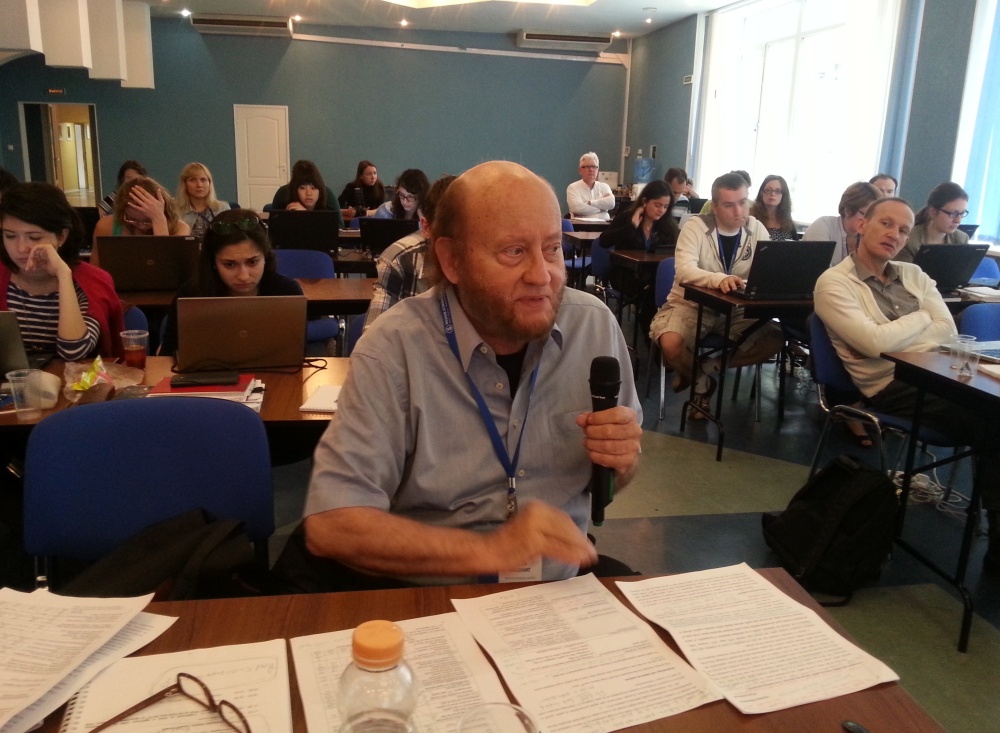

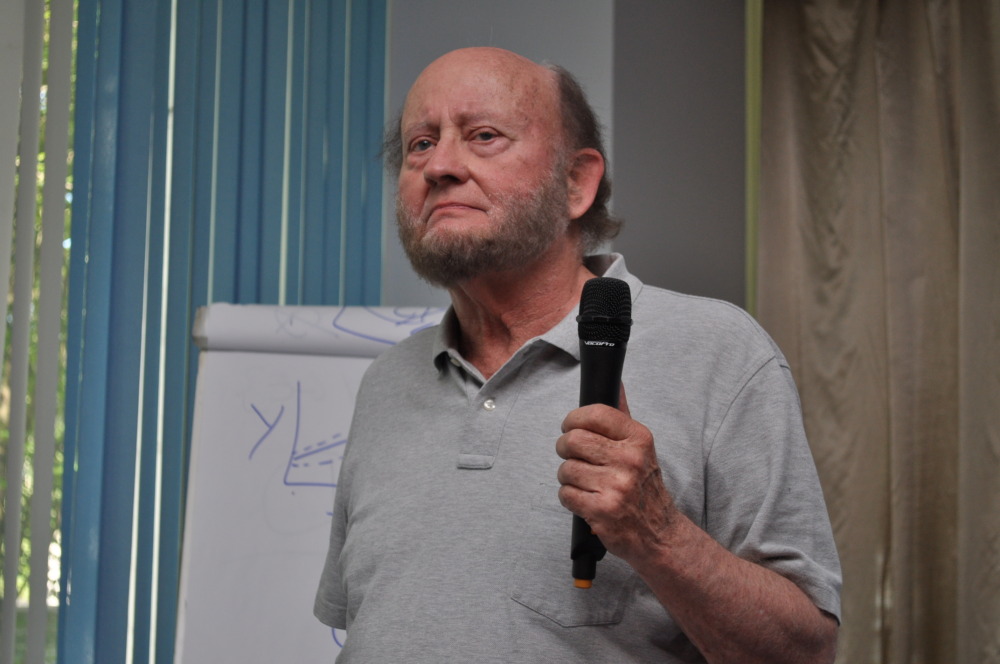

The fourth HSE LCSR summer school on Categorical Data Analysis is over. This year 40 young academics from universities and research centres in Russia, Ukraine, Belarus, Italy, Germany, Poland, Romania, Israel and the USA took part.
At the two-week summer school in Zelenogorsk near St Petersburg, they studied methods of working with categorical data (latent class analysis, loglinear regression and others). On the last day, the students presented the results of their mini-research, conducted during practicals on Professor Hagenaars’ course.
'Sociologists need to know how to work with categorical data', explained one of the school’s directors Tatiana Karabchuk. 'That is why we invited Jacques Hagenaars from the university of Tilburg and his PhD student Zhuzhu Bakk. Professor Hagenaars is one of the leading experts in the methodology of Categorical Data Analysis'.
The summer school programme also included elective courses given by the director of the LCSR, Michigan University professor Ronald Inglehart and the german political scientist, Professor Emeritus at the Centre for Social Sciences Research in Berlin, Hans-Dieter Klingemann.

Chia Liu, PhD Student at the Center for Demographic Studies in Barcelona (CED) talked about how the summer school helped her research:
'I am currently working on material deprivation of female headed households in Latin Amerca. We use IPUMS-I microdata, which requires categorization. I have benefited greatly from Professor Hagenaar's statistical expertise and wonderful suggestions from the staff and fellow students of LCSR'.

Olga Gasparyan, Junior Research Fellow at the HSE Laboratory of Political Research also found the school productive:
'This is the first time I’ve been to the LCSR summer school. At the moment I’m involved in a project on the relations between social expectations and political preferences in democratic and hybrid regimes. It was really useful to be able to present my research at the school and get feedback from my colleagues and teachers, and especially from such famous academics like Hans-Dieter Klingemann and Ronald Inglehart. It has given me an idea for a new approach to my research to study parties and their political programmes rather than states as a basis to determine political preferences'.
Ludmilla Mezentseva, HSE News Service
See also:

Cardiogenetics of the Future: Sequencing Helps Treat Heart Disease
Future cardiologists, geneticists, and IT specialists gathered at HSE University to learn how to 'read' DNA for diagnosing cardiovascular diseases. They explored modern sequencing methods and the complexities of working with digital twins of cardiac patients.
Archival Impulse: Dubna Hosts Summer School Organised by HSE University and JINR
The Joint Institute for Nuclear Research (JINR) in Dubna hosted the Archival Impulse Summer School, co-organised by JINR physicists, historians from the HSE Faculty of Humanities, and staff from the Archives of the Russian Academy of Sciences (ARAS). This first archival summer school continued the joint initiative of HSE University and JINR to examine and preserve the unique historical legacy of physicists.
Researchers Examine Student Care Culture in Small Russian Universities
Researchers from the HSE Institute of Education conducted a sociological study at four small, non-selective universities and revealed, based on 135 interviews, the dual nature of student care at such institutions: a combination of genuine support with continuous supervision, reminiscent of parental care. This study offers the first in-depth look at how formal and informal student care practices are intertwined in the post-Soviet educational context. The study has been published in the British Journal of Sociology of Education.
HSE Shares Its Experience of Urban Strategies at International Summer School in China
In the context of intensifying global geopolitical and technological competition, leading Chinese educational institutions—Zhejiang International Studies University and Peking University—organised an International Summer School. Their joint programme focused on studying global, regional, and urban development strategies. The HSE Faculty of Urban and Regional Development took part in this event.
HSE GSB and Alfa-Bank Host Summer School for Chinese Students
The international summer school Digital Product Management, a joint educational project by the HSE Graduate School of Business (HSE GSB) and Alfa-Bank, brought together over 30 students from leading Chinese universities.
HSE University Students and Postgraduates Take Part in Peking University International Summer School
In July 2025, Peking University hosted its annual Quantum Molecular Dynamics Summer School, which has moved onto an international stage. Its first foreign guests were students and postgraduates from the HSE Tikhonov Moscow Institute of Electronics and Mathematics (MIEM). They took part in an extensive academic programme and had the opportunity to visit a laboratory that works with optoelectronic materials and energy devices.
‘Student Ideas Shed Light on Key Challenges for Urban Development’
The first international joint summer school of the Vysokovsky Graduate School of Urbanism (GSU) at both the HSE Faculty of Urban and Regional Development and Brest State Pushkin University (BrSU), hosted by BrSU, has come to a close. The programme focused on studying buffer zones along the railway lines encircling the city centre. Participants included students from the GSU’s Urban Planning degree programme, as well as students from BrSU and Brest State Technical University.
Happiness as an Industry: Why We Want to Be Happy—And What’s Wrong with That
The expansion of ‘happycracy’ into everyday life unfolds against the backdrop of a diktat of positive thinking, mindfulness, and self-improvement. Yet researchers point to the hidden traps in the pursuit of happiness. Why can being happy sometimes be dangerous? Maria Kucheryavaya, sociologist and visiting lecturer at the HSE School of Communication, reflects on this in her column for IQ Media.
‘A Laboratory at 3,000 Metres’: HSE University–St Petersburg to Start Call for First Summer School in Himalayas
HSE University–St Petersburg has announced the call for the Summer School in the Himalayas, which will take place from June 30 to July 13, 2025. The Summer School is the follow-up to two expeditions in the Himalayas organised by the St Petersburg School of Social Sciences in 2024. The programme allows bachelor's, master's, and PhD students to immerse themselves in research on climate change and sustainability in local communities in the unique natural laboratory of the Himalayan region.
‘A Sociologist Is a Curious, Searching and Courageous Person’
One of the oldest programmes at HSE University-St Petersburg is the English-taught Bachelor's programme 'Sociology and Social Informatics'. It has existed for more than ten years, and over this time, the programme has helped many students gain interdisciplinary skills and find their own unique career paths. In this article, Academic Supervisor Anna Nemirovskaya explains how the programme has adapted to modern realities, what sociology truly is, and how one can implement a sociological education.