

Research that Will Help Fight Corruption
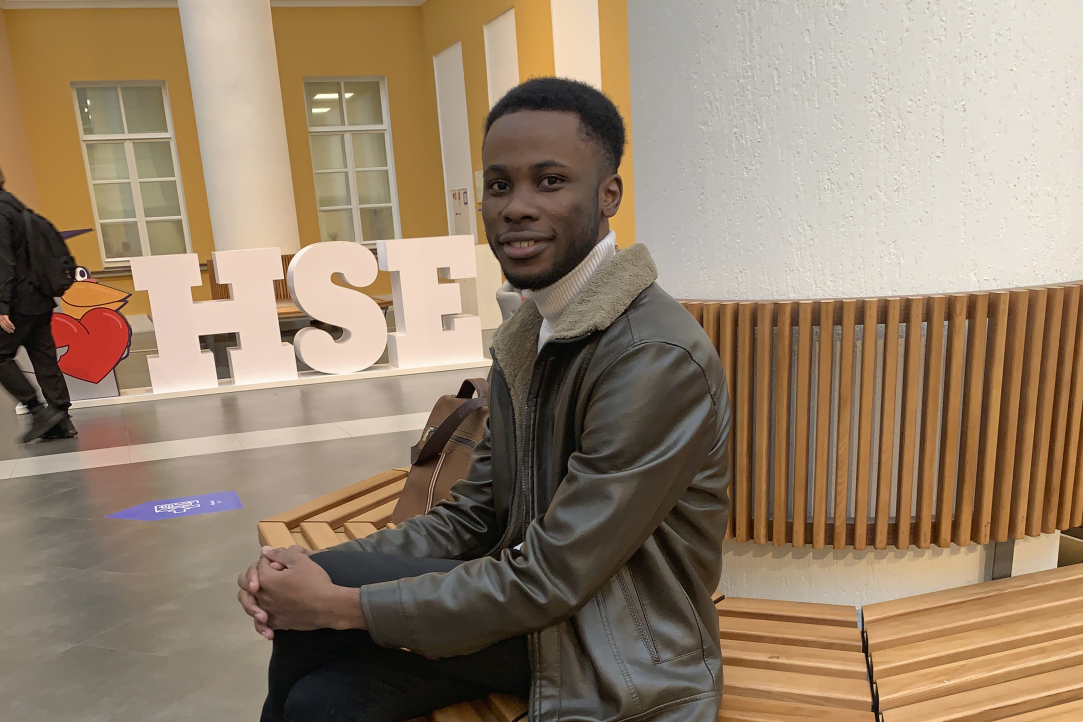
Emmanuel Adu Sarfo, 23, from Ghana, is a second-year master's student on the HSE Economics and Economic Policy programme. He is carrying out research on the ancient roots of corruption that influence its prevalence in different countries. Emmanuel talked to the HSE News Service about his studies and research at HSE University in Moscow.
Choosing HSE University: A Positive Experience
I found a person from my home country on LinkedIn doing his PhD at HSE, so I decided to look it up. I realised it was ranked highly and most of the reviews from students, particularly international students, were positive. But that alone did not motivate me well enough to apply. I was looking for a faculty where my research interest aligned with theirs. It did not take a long time to find Prof. Dmitry Veselov's profile and also the International Laboratory for Macroeconomic Analysis. I was interested in the broader field of macroeconomics at that time. I got in touch with Oxana Budjko, whose alacritous response to emails is amazing. She connected me with Prof. Veselov and we tried to have an online meeting prior to my coming to Moscow to study.
These combined made me realise how the faculty at this great university might care about their students. After this, it was not hard to choose HSE
Research: Understanding the Deep Roots of Corruption
I think HSE's well-organised way of integrating both undergraduates and masters students into research played a major role in what and how I decided to research. I had no particular topic prior to enrolling at HSE. I joined Dmitry Veselov and Cemal Eren Arbatli's project group: ‘Topics on Long-run Economic Growth and Development.’ I think this is one of the greatest decisions I made last academic year. This is where I discovered some gaps in the corruption literature. First, corruption occurs in all countries to some extent, regardless of their wealth, legal system, or political system. Secondly, despite corruption’s alleged negative impact on development, little is known about its deep-rooted pre-historical determinants. My term paper was an attempt to fill these gaps.
A successful study will give us an understanding of the (deep) roots of corruption, which is required to better assess the ways in which societies can fight it
Moreover, it will offer an intuitive explanation for the prevalence of corruption in countries regardless of their income level, legal system, colonial history, or political system. The study showed that higher diversity reduces corruption at the national level.
My next research will extend my term paper to the subnational population. Specifically, I want to explore the role diversity plays in influencing corruption at the ethnic level. I am excited to pursue an academic career conducting independent research, collaborating with other researchers, and teaching undergraduate and graduate students. Completing a PhD in economics is the ideal next step for me.
Studies: Achieving More than Expected
Studying at HSE has being rewarding. You get the chance to learn from top-notch faculty. You are largely able pursue your own interests within the programme to a large extent. I think the structure of the Research track of the Economics and Economic Policy programme is amazing and it helps students to adapt to the rigorous nature of studies at HSE. You get to share your research and get feedback from professors and colleagues in mentor's seminars, methodological research seminars, and in your project groups.
HSE seems to me to be a more of a wonderland, where you achieve what you never thought possible
Credit to the erudite faculty members. Some faculty have had a tremendous impact on me and most likely on my career trajectory. Professors Veselov and Arbatli have been instrumental in my HSE life. Professor Olga Kuznetsova has also been phenomenal as an academic mentor for the Research track. As a fast-paced environment, I feel it is quite prosaic to be throttled by academic activities. Almost every student I talk to has more than enough tasks to turn in for the week.
Living in Moscow: A Must-Visit for Every Art Connoisseur
I naturally think Moscow is a great place to live. Like other cities, however, it has its advantages and disadvantages. I would say that Moscow's disadvantage is its climate: it gets quite cold during winter. The advantages of this beautiful city are its architecture, culture, customs, parks, cafés, museums, etc.
The public transport system is very well-developed: there are buses, trams, bikes, and a metro
As someone interested in art and history, I would say that Moscow is a must-visit for every art connoisseur and historian. The city has numerous historical and contemporary museums and art galleries. Among the plethora of galleries and museums is The State Tretyakov Gallery, which hosts the world’s foremost collection of Russian fine art. Another is the Pushkin State Museum of Fine Arts, which showcases artworks from ancient times to the present day, such as paintings by Rembrandt, Botticelli, Van Gogh, and Picasso. The Moscow Museum of Modern Art, on the other hand, displays artworks created in the 20th and 21st centuries.
See also:

‘Put in the Effort, and You Will Learn a Lot’
Roosevelt Ogah is a first-year student of the master’s programme in Economics and Economic Policy at HSE University. He studies on the research track ‘Microeconomics and Macroeconomics’ and demonstrates very high academic performance. In his interview, he shares his experience of studying abroad for the first time and some tips on how to achieve high results in studies.
‘The Process was Challenging, yet Well-Organised’
Samuel Okai, 28, from Ghana, is a master's student of Strategic Corporate Finance in his final year at the HSE Faculty of Economic Sciences, majoring in assets pricing. In this interview, he shares his admissions experience and speaks about learning at HSE University, while offering some tips for those ready to succeed in their studies.
Russian Speaking Club: Practicing the Language and Meeting New Friends
For HSE Preparatory Year students, the Russian Speaking Club is a way to improve their language proficiency in a relaxed atmosphere. At this year’s first such event, they discussed online communications and social media. Michael Dzodzoe from Ghana and Leen Sabbagh from Syria shared their impressions with the HSE News Service.
‘I Hope to Make Meaningful Contributions to the Academic Community’
Why do international students at HSE University decide to pursue a career in academia? What fields in economics are relevant to PhD students? Richard Asiamah from Ghana and Alesya Bukreeva from Uzbekistan are current master’s students at the Faculty of Economic Sciences, but have already received scholarships from the faculty to continue their studies as doctoral students at the university. Below, they share their experiences, while Denis Melnik, Academic Director of the Doctoral School of Economics, suggests some tips for the application process.
‘HSE Has Made Me Confident and Brave’
Enrolment in undergraduate programmes is underway. International recipients of the Russian Government Scholarship can study at HSE University for free and get a place at an HSE dorm. Senanu Dekpo-Adza from Ghana and Hamisha Rijal from Nepal study at HSE University as part of the scholarship programme. They shared their experiences of admission and studies at HSE University with the HSE News Service.
Okro Soup, Bubble Tea, and Relleno: International Students Share Their New Year's Traditions
HSE University is home to international students from all over the world, many of whom will be celebrating the New Year in Russia for the first time. They shared their plans for the festive season with the HSE News Service and spoke about holiday traditions and dishes in their home countries of China, Ecuador, Pakistan, Ghana, Indonesia, Nigeria, Guatemala, and India.
2023 Admissions Now Open
The 2023 Admissions Campaign has started at HSE University. The range of available courses includes 89 bachelor’s and 182 master’s programmes across the university’s campuses in Moscow, St Petersburg, Nizhny Novgorod, and Perm. Among them are 13 English-taught bachelor’s programmes and 40 English-taught master’s programmes in such fields as architecture, Asian studies, IT, arts, history, mathematics, politics, psychology, economics, management, physics, chemistry, biology, law, literature and many others.
‘HSE University Does Not Settle for Mediocrity’
Joseph Naquentera from Ghana recently completed the HSE University Master’s programme in Applied Economics and successfully defended his thesis on ‘Effect of the Ghana Poverty Reduction Strategy on Employment’ at the Faculty of Economic Sciences. He shared his impressions of studies in Moscow with the HSE News Service.
‘I Want to See Studies Emanating from Africa Contributing Substantially to Cognitive Science’
Abdul-Raheem Mohammed from Ghana has recently defended a PhD dissertation in cognitive psychology at HSE University via remote procedure. Abdul-Raheem and his academic supervisor, Dmitry Lyusin, talked to the HSE News Service about their cooperation, the advantages and complications of remote PhD defence at HSE University, and the prospects of cognitive science in African countries.