

Production of the Future: AI Research Centre Presents Its Developments in Manual Operations Control Systems
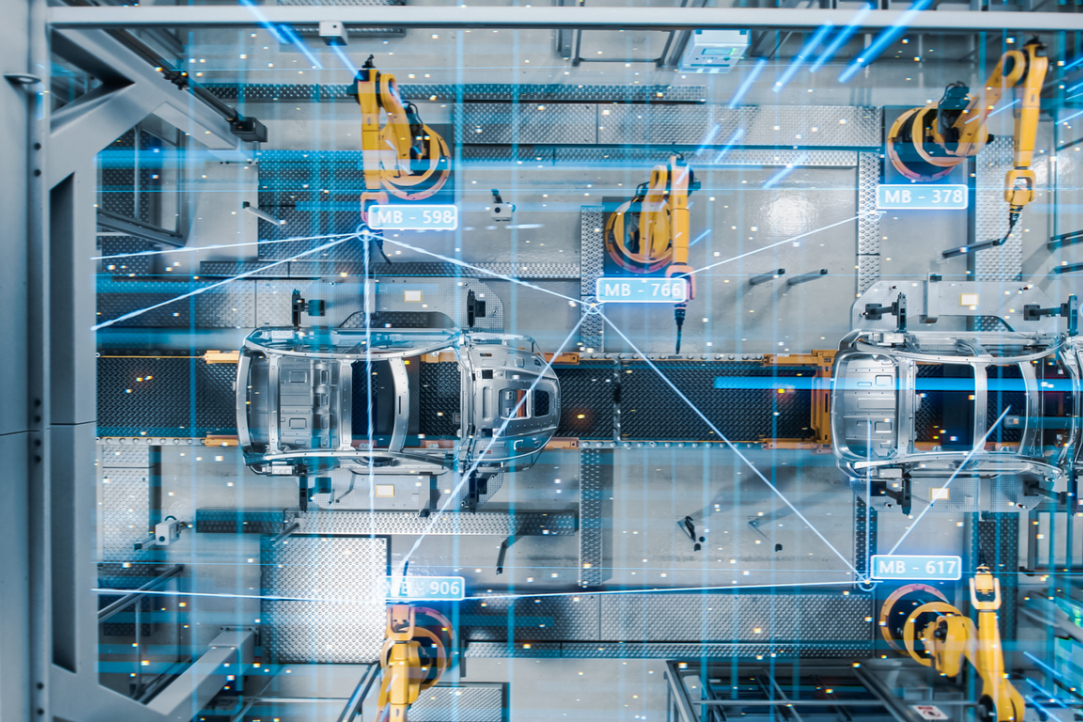
Researchers from the HSE AI Research Centre have built a system for the automated control of manual operations, which finds application in industrial production. The system facilitates the process of monitoring objects and actions, as well as controlling the quality of their execution.
Artificial intelligence technologies help automate human actions, simplifying their work, or completely replacing personnel. The automation of manual operations control in production goes even further: from selective quality control of products by the Quality Control Department to continuous monitoring of the entire assembly process.
Based on AI technologies, HSE scientists have developed a demonstration stand—one of the key components for testing developments before their implementation in production. Using computer vision, the automated system analyses the sequence of actions of the assembler, whether it is a robot or a human. This allows it to be determined if an important step was missed, or if an assembly action was incorrect. The system also evaluates compliance with safety techniques: the usage of personal protective equipment and absence of third persons or unrelated objects in the assembly area. With all actions logged in the system, individual performance indicators for each employee can be obtained. For the assembler, the system is useful because it alerts them if they forgot to perform a step or did it incorrectly. Ultimately, it significantly reduces the output percentage of defective products.

Viktor Minchenkov, project leader, Deputy Head of the Unit for Software Systems Development at HSE Tikhonov Moscow Institute of Electronics and Mathematics (MIEM HSE)
‘At the moment, we can track the sequences of semi knocked down and screw driving assembly. We can track the quantity and quality of an item placement on the workbench. We can track safety violations related to the use of personal protective equipment. In the final implementation, we can adapt the stand for controlling any technological process if it can be implemented through means of visual control.’
The project ‘Intelligent Automation of Manual Operations in Production’ of the AI Research Centre is being carried out by specialists from HSE Tikhonov Moscow Institute of Electronics and Mathematics (MIEM HSE) within the framework of the federal project ‘Artificial Intelligence.’
The main advantage of this developed system is that AI allows many actions to be performed equally well and even better than humans. One particular difference is that computer vision does not suffer from ‘fatigue’ as does human vision.

Sergey Slastnikov, Associate Professor at HSE School of Applied Mathematics of HSE Tikhonov Moscow Institute of Electronics and Mathematics (MIEM HSE)
‘Analogues of the developed system undoubtedly exist—there are quite a few local solutions for highly specialised tasks. In turn, we are developing our own approach, which potentially can be applied to a wider range of problems. As part of its testing, we are in collaboration with various domestic companies, both industrial and technological, for example, in the field of video analytics and IT services development. Several pilot projects have already been launched.’
The range of applications for this development is very wide. For example, the technology can be used as simulators for training with automatic assessment of the level of training or in video surveillance and video analytics systems, where malicious actions of humans can also be controlled.

Anton Sergeev, Director of the Centre for Software Development and Digital Services at HSE Tikhonov Moscow Institute of Electronics and Mathematics (MIEM HSE)
‘Our professional engineering and mathematical school and a project-based training model at MIEM allowed us to quickly put together a young but qualified team and implement computer vision technology for production. The created system is like an experienced digital mentor: it watches, advises, teaches, points out mistakes, and impartially and fairly evaluates efficiency. Data on process efficiency is automatically sent to the enterprise's ERP system.’
An important parameter of these systems is the speed of data collection (video or photos) for training embedded AI algorithms. This stage is also automated in the system and reduces the time and cost of implementation. The details of the approach were presented by the project team in the paper ‘Method of Automatic Images Datasets Sampling for the Manual Operations Control Systems’ in 2023.
See also:

‘Like Electricity, AI Can Bring Incredible Benefits’
Developments in the field of artificial intelligence are gradually taking over the world. AI has the potential to bring incredible benefits to the global economy and our quality of life, but it also creates new challenges. Panos Pardalos, Professor at the University of Florida, Academic Supervisor of the Laboratory of Algorithms and Technologies for Networks Analysis (Nizhny Novgorod), covered these issues, along with other related topics, in his recent report.
‘You Need to Know a Lot of Ideas and Algorithms, Come Up with Something Unconventional’
A student of the HSE Faculty of Computer Science, Andrey Kuznetsov, has become the winner of the 2024 Data Fusion Contest. He took first place in solving geoanalytics tasks, and also won the special ‘Companion’ category. The competition took place as part of the 2024 Data Fusion conference on big data and AI technologies. Researchers from HSE University presented the results of their work and demonstrated applied developments at the conference.
‘We Need to Learn to Communicate with Artificial Intelligence Services’
An online course 'What is Generative AI?’ has been launched on the Open Education platform, which will help students learn more about how to properly communicate with neural networks so that they can perform tasks better. Daria Kasyanenko, an expert at the Continuing Education Centre and senior lecturer at the Big Data and Information Retrieval School at the Faculty of Computer Science, spoke about how generative AI works and how to create content with its help.
Artificial Intelligence Tested by Kant Philosophy
The Baltic Federal University (Kaliningrad) recently hosted an International Congress entitled ‘The World Concept of Philosophy’ in honour of the 300th anniversary of the birth of the philosopher and thinker Immanuel Kant. The event brought together about 500 scientists and experts from 23 countries. HSE Rector Nikita Anisimov took part in the opening plenary session of the congress titled ‘Critique of Artificial Intelligence: Being and Cognition in the Context of Artificial Intelligence Development.’
HSE University to Reward Students Who Write Their Thesis Using AI
HSE University has launched a competition for solutions using artificial intelligence technology in theses work. The goal of the competition is to evaluate how students use tools based on generative models in their 2024 graduation theses (GT).
HSE and Yandex to Expand Collaboration in Training AI Specialists
Over the next ten years, the partnership between Yandex and the HSE Faculty of Computer Science (FCS) will broaden across three key areas: launching new educational programmes, advancing AI research, and exploring the application of generative neural networks in the educational process. Established by HSE University and Yandex a decade ago, the Faculty of Computer Science has since emerged as a frontrunner in training developers and experts in AI and machine learning, with a total of 3,385 graduates from the faculty over this period.
‘The Goal of the Spring into ML School Is to Unite Young Scientists Engaged in Mathematics of AI’
The AI and Digital Science Institute at the HSE Faculty of Computer Science and Innopolis University organised a week-long programme for students, doctoral students, and young scientists on the application of mathematics in machine learning and artificial intelligence. Fifty participants of Spring into ML attended 24 lectures on machine learning, took part in specific pitch sessions, and completed two mini-courses on diffusion models—a developing area of AI for data generation.
Researchers ‘Personalise’ the Selection of a Neural Network for Face Recognition on Smartphones
Researchers from HSE University in Nizhny Novgorod, MISIS and the Artificial Intelligence Research Institute (AIRI) have developed an algorithm that selects the best available neural network for facial recognition, taking into account the features of a mobile device. This new approach accelerates the selection of the most suitable neural network and allows the identification of people with an accuracy rate of up to 99%. The study was published in the IEEE Access journal. The source code is available on GitHub.
‘Bots Are Simply Imitators, not Artists’: How to Distinguish Artificial Intellect from a Real Author
Today, text bots like ChatGPT are doing many tasks that were originally human work. In our place, they can rewrite ‘War and Peace’ in a Shakespearean style, write a thesis on Ancient Mesopotamia, or create a Valentine’s Day card. But is there any way to identify an AI-generated text and distinguish it from works done by a human being? Can we catch out a robot? The Deputy Head of the HSE School of Data Analysis and Artificial Intelligence, Professor of the HSE Faculty of Computer Science Vasilii Gromov explained the answer in his lecture ‘Catch out a Bot, or the Large-Scale Structure of Natural Intelligence’ for Znanie intellectual society.
Neural Network Developed at HSE Campus in Perm Will Determine Root Cause of Stroke in Patients
Specialists at HSE Campus in Perm and clinicians at Perm City Clinical Hospital No. 4, have been collaborating to develop a neural network capable of determining the root cause of a stroke. This marks the world's first attempt to create such a system, the developers note.