

‘You Need to Know a Lot of Ideas and Algorithms, Come Up with Something Unconventional’
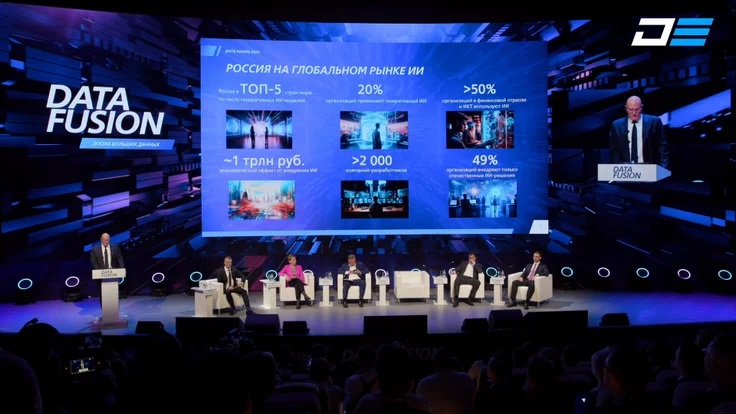
A student of the HSE Faculty of Computer Science, Andrey Kuznetsov, has become the winner of the 2024 Data Fusion Contest. He took first place in solving geoanalytics tasks, and also won the special ‘Companion’ category. The competition took place as part of the 2024 Data Fusion conference on big data and AI technologies. Researchers from HSE University presented the results of their work and demonstrated applied developments at the conference.
The 2024 Data Fusion Contest took place as part of the conference, with more than 1550 participants from 33 countries registered, including Russia, Armenia, the UK, Kazakhstan, the Netherlands, and the USA (for a full list, please see the contest’s website in Russian). The tournament involved both advanced IT specialists and those just starting their professional journey.
First place in the ‘Geoanalytics’ category was taken by Andrey Kuznetsov, a second-year student of the ‘Applied Mathematics and Information Science’ Bachelor’s programme at the HSE Faculty of Computer Science. He also won the special ‘Companion’ category for the best open solutions to each of the tasks published by participants before the end of the competition.
Andrey Kuznetsov, second-year student of the Bachelor’s programme ‘Applied Mathematics and Information Science’


‘During the contest, as well as completing the task, you had to review materials on the topic, necessary literature, and existing approaches and methods. In the competition, there were two tasks—'Geoanalytics' and 'Churn Models.' In the first one, information about clients' card transactions was given, and you needed to predict the probability of cash withdrawal at a particular ATM. In the second one, using bank data for six months, you needed to forecast the probability of a decrease in user activity over the next six months.
Machine learning contests usually take a long time. We were given almost two months to complete the tasks. To achieve good results, it is necessary to analyse solutions from past competitions, as well as spending a lot of time on training, practice, and studying new material. You need to know a lot of ideas and algorithms in order to come up with something unconventional.
Compared to previous years and other competitions in general, this time the tasks felt more challenging. The competition took place on a convenient and stable platform, with many experienced specialists participating. That is why the joy of victory is even stronger!’
Scientists from HSE University participated in Data Fusion 2024. Alexey Naumov, Academic Supervisor of the HSE AI Research Centre, presented cutting-edge research directions and some achievements of HSE scientists at the session 'Overview of Key AI Research in Russia.' 'One of our recent achievements was an article that made it into the top 5% at the international conference AISTATS 2024. We demonstrated that training Generative Flow Networks (GFlowNets) is equivalent to a certain regularised reinforcement learning task. This discovery allows the direct application of a large number of existing reinforcement learning techniques and algorithms to improve the performance of generative flow networks,' he explained.
This year, the AI Research Centre has already had 8 publications accepted at top conferences such as ICML, NeurIPS, ICLR, AISTATS, and others. Researchers are also working on diffusion models, which enable the generation of complex protein and molecule structures, as well as data lying on bounded manifolds.
The AI Research Centre also presented applied developments for industrial partners. For example, a specialised NLP model, developed for Sber, generates readable descriptions of reasons for customer inquiries in order to improve the interpretability of themes obtained from clustering the flow of customer inquiries. This solution allows the bank to speed up the processing of over 300,000 customer inquiries per day.
Other representatives of HSE University also took part in Data Fusion 2024. Sergei Kuznetsov, Head of the School of Data Analysis and Artificial Intelligence at the HSE Faculty of Computer Science, moderated the case session 'Does Symbolic AI Have a Future, or Will Neural Networks Win Everything?' discussing the prospects of symbolic AI in light of tasks related to creating trusted artificial intelligence. During this session, Alexey Neznanov, Associate Professor at the HSE School of Data Analysis and Artificial Intelligence, delivered a presentation on 'Knowledge Management and Hybrid Intelligent Systems in the Corporate Environment, 20 Years Later.'
Sergei Kuznetsov also took part in the session 'Progress or Regression: Where is Artificial Intelligence Leading Us—Experts on Trends' and held a discussion with Sankar Kumar Pal, President of the Indian Statistical Institute, on 'India's Experience: Development of AI Technologies and DS-Science.'

Olga Dragoy, Director of the HSE Centre for Language and Brain, participated in the plenary discussion 'The Intelligence of Large Generative Models—Is the Birth of Thought from Language Possible?', where experts discussed the possibility of extracting intelligence from speech, searching for a basis for AI development, and forming an environment in which AI will evolve.
HSE scientists also presented the results of their research at a poster session:
Konstantin Vishnevsky, Director of the Centre for Strategic Analysis and Big Data at the HSE Institute for Statistical Studies and Economics of Knowledge (ISSEK), and Maria Svarchevskaya, a leading expert at ISSEK, gave a presentation on 'The iFORA System for Intelligent Big Data Analysis.'
Alexander Kirdeev, Research Assistant at the International Laboratory of Bioinformatics of the HSE AI and Digital Science Institute, presented on 'Predictive Models in Personalised Medicine.'
Maria Sakirkina, Chief Analyst of the HSE Faculty of Geography and Geoinformation Technology, presented on 'Geoanalytics and Geodata: Evaluation of Natural Climatic Risks.'
The Data Fusion 2024 conference took place in Moscow on April 17th–18th. The event was attended by the Prime Minister of Russia Mikhail Mishustin, Deputy Prime Minister Dmitry Chernyshenko, First Deputy Governor of the Bank of Russia Olga Skorobogatova, President and Chairman of the Board of VTB Bank Andrey Kostin, President of Rostelecom Mikhail Oseyevsky, CEO of VK Vladimir Kiriyenko, and other businessmen and public officials, leading scientists, and experts in big data analysis and AI technologies.
See also:

White Papers of AI Conformity Assessment Published on HSE University Website
The Russian Technical Committee for the Standardization of ‘Artificial intelligence’ (TC164), together with the Chamber for Indo Russo Technology Collaboration and the RUSSOFT Non-profit Partnership of Software Developers, has published new White Papers related to Artificial Intelligence Conformity Assessment. It reflects the approaches to the standardization and ethical regulation of AI technologies in two pilot industries — healthcare and agriculture.
Space for Collaboration in Artificial Intelligence
The HSE Laboratory of Artificial Intelligence for Cognitive Sciences (AICS) has launched regular seminars, offering students and scientists from various universities and research centres the opportunity to share their latest research and discuss the most recent developments in artificial intelligence in a friendly and constructive atmosphere. The first seminar was held on May 15.
Scientists Propose Star-Shaped Diffusion Model
Scientists at the AI Research Centre and the Faculty of Computer Science at HSE University, the Artificial Intelligence Research Institute (AIRI), and Sber AI have come up with novel architecture for diffusion neural networks, making it possible to configure eight distinct types of noise distribution. Instead of the classical Markov chain model with Gaussian distribution, the scientists propose a star-shaped model where the distribution type can be selected and preset. This can aid in solving problems across various geometric modalities. The results were presented at the NeurIPS 2023 conference.
HSE Scientists Leverage AI to Accelerate Advancement of 5G and 6G Wireless Communication Systems
The HSE Artificial Intelligence Centre has developed software for modelling radio channels in 5G and 6G wireless networks, based on ray tracing and machine learning techniques. Their software solutions enable modelling radio wave propagation between transmitters and receivers and can convert ray tracing data into a frame sequence format, configure and train neural networks based on this data, and subsequently save the trained models.
‘Like Electricity, AI Can Bring Incredible Benefits’
Developments in the field of artificial intelligence are gradually taking over the world. AI has the potential to bring incredible benefits to the global economy and our quality of life, but it also creates new challenges. Panos Pardalos, Professor at the University of Florida, Academic Supervisor of the Laboratory of Algorithms and Technologies for Networks Analysis (Nizhny Novgorod), covered these issues, along with other related topics, in his recent report.
‘We Need to Learn to Communicate with Artificial Intelligence Services’
An online course 'What is Generative AI?’ has been launched on the Open Education platform, which will help students learn more about how to properly communicate with neural networks so that they can perform tasks better. Daria Kasyanenko, an expert at the Continuing Education Centre and senior lecturer at the Big Data and Information Retrieval School at the Faculty of Computer Science, spoke about how generative AI works and how to create content with its help.
Artificial Intelligence Tested by Kant Philosophy
The Baltic Federal University (Kaliningrad) recently hosted an International Congress entitled ‘The World Concept of Philosophy’ in honour of the 300th anniversary of the birth of the philosopher and thinker Immanuel Kant. The event brought together about 500 scientists and experts from 23 countries. HSE Rector Nikita Anisimov took part in the opening plenary session of the congress titled ‘Critique of Artificial Intelligence: Being and Cognition in the Context of Artificial Intelligence Development.’
HSE University to Reward Students Who Write Their Thesis Using AI
HSE University has launched a competition for solutions using artificial intelligence technology in theses work. The goal of the competition is to evaluate how students use tools based on generative models in their 2024 graduation theses (GT).
Production of the Future: AI Research Centre Presents Its Developments in Manual Operations Control Systems
Researchers from the HSE AI Research Centre have built a system for the automated control of manual operations, which finds application in industrial production. The system facilitates the process of monitoring objects and actions, as well as controlling the quality of their execution.
HSE and Yandex to Expand Collaboration in Training AI Specialists
Over the next ten years, the partnership between Yandex and the HSE Faculty of Computer Science (FCS) will broaden across three key areas: launching new educational programmes, advancing AI research, and exploring the application of generative neural networks in the educational process. Established by HSE University and Yandex a decade ago, the Faculty of Computer Science has since emerged as a frontrunner in training developers and experts in AI and machine learning, with a total of 3,385 graduates from the faculty over this period.