

April Conference Discusses Strategic Areas of Russia’s Development
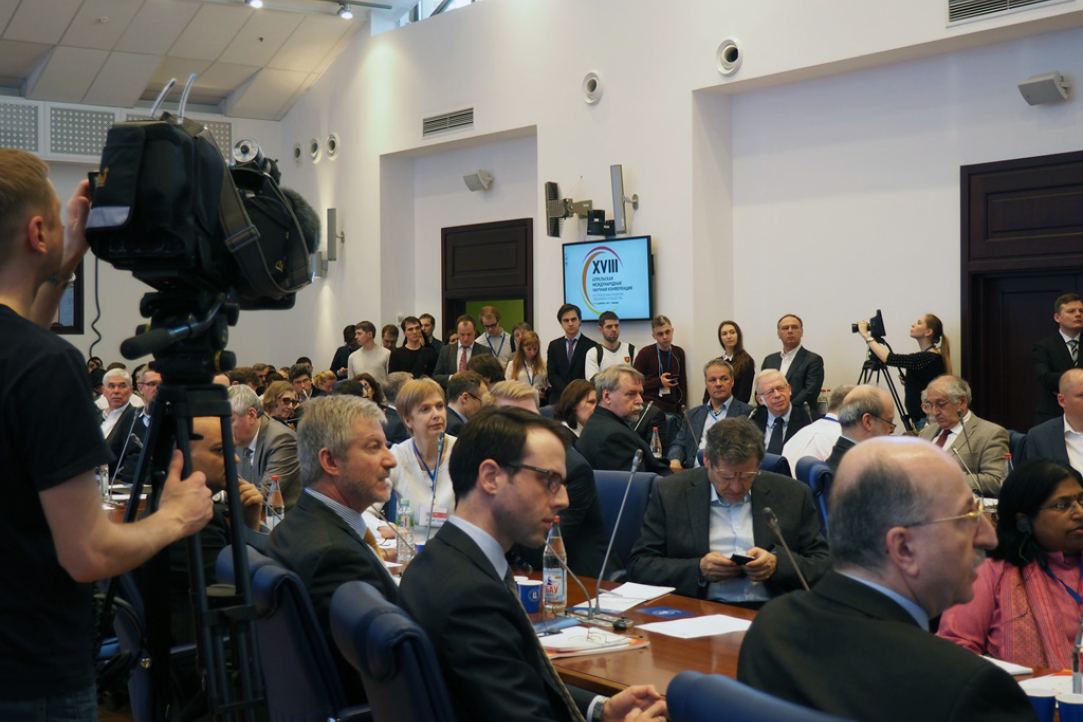
The XVIII April International Academic Conference has kicked off at Higher School of Economics (HSE). This major event includes expert discussions on the strategic problems facing Russia’s economic and social development. Representatives of the Russian Government will take part in the debates.
The expert and roundtable discussions are based on analyses prepared by the Centre of Strategic Studies (CSS). On April 11, Alexei Kudrin, Chairman at CSS, is speaking on the prospects for Russian economic growth. The discussants for his presentation include Anton Siluanov, Russian Minister of Finance, Ksenia Yudaeva, First Deputy Chairman of the Central Bank of Russia, Alexander Shokhin, President of the Russian Union of Industrialists and Entrepreneurs and President of HSE, among others.
On the same day, the conference participants will discuss the problems of technological development (keynote speaker: Vladimir Knyaginin, Vice President at CSS). Other important speakers include Arkady Dvorkovich, Deputy Prime Minister of the Russian Federation, Vassily Osmakov, Deputy Minister of Industry and Trade, and Andrey Fursenko, Assistant to the President of the Russian Federation.
Sergey Sinelnikov-Murylev, Rector of the Russian Foreign Trade Academy, will speak on issues regarding inter-budgetary relations. This discussion will be joined by Leonid Gornin, Deputy Minister of Finance, and Vladimir Lisin, Chairman of the Board of Directors at NLMK Group, as well as representatives of the City of Moscow and the Moscow Regional Government.
The first day of expert discussions will finish with the roundtable discussion ‘The State and Economic Development’ with the participation of Anton Siluanov, Alexei Kudrin, Maxim Oreshkin, Minister of Economic Development, Tatiana Golikova, Head of the Accounts Chamber of the Russian Federation, Yaroslav Kuzminov, HSE Rector, and other experts.
On April 12, discussions will be held with a focus on the problems of Russian education (keynote speaker: Isak Froumin, Academic Supervisor at the HSE Institute of Education), social policy (Lilia Ovcharova, HSE Director for Social Studies, will make a presentation, and Maxim Topilin, Russian Minister of Labour and Social Security, is expected to participate), and health care (Sergey Shishkin, Director of the HSE Centre for Health Policy, is presenting a paper).
On the following day, experts in public administration will get together to discuss a presentation by Maria Shklyaruk, Head of Institutions and Society at CSS. Furthermore, experts in international relations and trade will be discussing Russia’s position in the global economy (a major paper shall be presented by Natalia Ivanova, First Deputy Director at the RAS Institute of World Economy and International Relations).
Online broadcasts of the expert discussions are available at the conference website.
The academic part of the April Conference includes 35 topical sections and 240 discussion sessions in various areas of social studies.
See also:

Applications for Participation in XXVI April International Academic Conference Still Open
Applications can be submitted on the conference website until December 16, 2025. The programme has been developed around five research themes: Economics, Human Capital and Society, Instrumental Methods and Models, Foresight Research, and International Research. The heads of these areas have presented, in video format, the priority topics and sections for which they are expecting submissions.
Applications to Participate in April International Academic Conference Now Open
HSE University is now accepting proposals to present academic reports at the XXVI April International Academic Conference named after Evgeny Yasin. Applications can be submitted until December 16, 2025. The conference events will take place mainly on-site in Moscow from April 14 to 17, 2026.
24 Countries Represented at 25th Yasin International Academic Conference Held by HSE University
The Programme Committee of the 25th Yasin (April) International Academic Conference on Economic and Social Development has summed up the initial results. In 2025, 1,384 people from 24 countries and 29 Russian regions participated in the conference, with 335 of them delivering presentations.
Stuck in the Net: How Much Time Children Spend Online
On average, a schoolchild spends 48 hours a week on studies—equivalent to a six-day working week for an adult. This was highlighted by experts at the round table ‘Domains of Children’s Well-Being Evaluation for Human Potential and Evidence-Based Social Policy Development,’ held as part of the 25th Yasin (April) International Academic Conference.
Russian and Chinese Scholars Share Experience of Transformation of Doctoral Education
The Russian and Chinese postgraduate education systems originally borrowed their institutional frameworks from the Soviet Union. However, in the 21st century, they have evolved along different paths. While key performance indicators for postgraduate programmes in Russia are declining, China is seeing a rapid increase in the number of postgraduate students. These contrasting trajectories and the reforms undertaken in each country in recent decades were the focus of a roundtable discussion held as part of the 25th Yasin (April) International Academic Conference.
Nobel Laureate Proposes Solution to Markov Equilibrium Problem
In dynamic games, a Markov equilibrium involves strategies that guide players' behaviour based on the current state of the game, rather than its entire history. This approach is effective when players have access to complete information. But when uncertainty arises in the game—for instance, when players are unsure of who they are dealing with—this approach can become problematic. Eric Maskin, Nobel Laureate in Economics and Professor at Harvard University, addressed this issue in a paper presented at the XXV Yasin (April) International Academic Conference on Economic and Social Development held at HSE University from April 15 to 18, 2025.
‘The World Is Becoming More Complex and Less Predictable’: What Scientists Say about the Future
The future is now more difficult for researchers to forecast, and events that are hard to predict are playing an increasingly significant role. But there is good news too: scientists are confident that humanity will adapt to any changes. This was the focus of discussion at the International Symposium ‘Foresight in a Rapidly Changing World,’ which took place as part of the 25th Yasin (April) International Academic Conference.
Fragmentation and Bloc Formation: How the Global Economy is Changing
Sergey Dubinin, former head of the Bank of Russia and Professor of Finance and Credit at the Faculty of Economics at Moscow State University, has delivered an honorary address at the XXV Yasin (April) International Academic Conference. He spoke about the transformation of the global monetary and financial system, as well as the Russian economy.
More Children, More Happiness: HSE Experts Study Impact of Number of Children on Russians' Assessment of Happiness
Russians with children feel happier than those without children. At the same time, the number of children influences the assessment of happiness: the more children Russians have, the happier they feel. These conclusions were outlined inthe report ‘More Children, More Happiness: The Impact of the Number of Children on Russians’ Assessment of Happiness,’ presented at the XXV Yasin (April) International Academic Conference on Economic and Social Development, held on April 15–18 at HSE University. The study was conducted by Elena Churilova, Senior Research Fellow, and Dmitry Jdanov, Chief Research Fellowat HSE International Laboratory for Population and Health.
HSE Expands Cooperation with Gulf Countries
HSE University and the Centre for International Policy Research (Qatar) have agreed to collaborate in the field of social sciences, with plans for joint research, academic exchanges, and regular expert engagement. The agreement was signed during the roundtable ‘State Capacity and State Resilience in the Global South,’ held as part of the 25th Yasin (April) International Academic Conference at HSE University.