

‘Mirror Symmetry Was Discovered by Physicists, But Very Quickly Got the Attention of Mathematicians…’


The HSE International Laboratory for Mirror Symmetry and Automorphic Forms, which is among several international laboratories to recently open within the Higher School of Economics, was created in December 2016 as part of the Russian government’s mega-grants program.
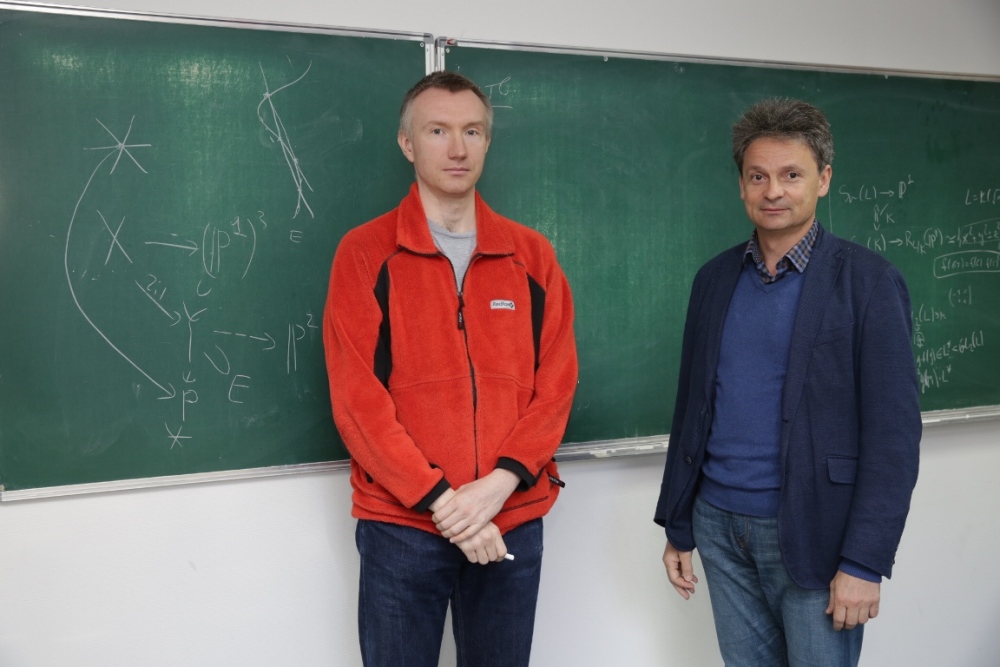
Below, the lab’s academic supervisor, Ludmil Katzarkov, along with deputy heads Valery Gritsenko and Viktor Przyjalkowski, explain why the laboratory is fully capable of becoming a unique multidisciplinary unit dedicated to the study of mirror symmetry, automorphic forms, and number theory.
The International Laboratory for Mirror Symmetry and Automorphic Forms is an important scientific platform for Russia and the world as a whole. In the lab, traditional areas of mathematics are combined with contemporary breakthrough methods, as demonstrated by the lab’s focus on homological mirror symmetry and automorphic form theory. In June, the laboratory organised its first large conference, inviting researchers from all over the world who represent the most diverse fields of mathematics, but are united by their interest in mirror symmetry.
According to the academic supervisor of the laboratory, American mathematician Ludmil Katzarkov, Moscow is a leading intellectual centre for anyone currently studying algebraic geometry, category theory, or mirror symmetry, which is a field that combines contemporary algebraic geometry with theoretical physics.
‘When I was asked to lead the laboratory, I immediately said yes. I was certain that I’d find junior researchers here with whom I could work to make developments on truly topical fields in modern mathematics. In the end, mathematics is a science for the young, and it’s where junior researchers are that the most impressive success can be found,’ Katzarkov adds.
I always felt deeply indebted to Moscow’s mathematics community, the people whom I met here and who taught me so much
The laboratory’s objective is to give young people access to the most relevant areas of contemporary science and to give them the opportunity to talk with leading scientists – the ones currently at the forefront of modern science. It is critical, Katzarkov notes, that young people feel like they are working with advanced science. ‘In mathematics, like in sport, how you feel is half the victory. Young people have to feel like successful researchers who are just as qualified as scientists at European or American universities,’ he says.
Mr Katzarkov himself studied in Moscow and says that this is where the best aspects of his mathematical career took place: ‘I always felt deeply indebted to Moscow’s mathematics community, the people whom I met here and who taught me so much.’
Some of the strongest characteristics of Moscow’s mathematics community are the seminars it offers. They ensure on-going communication among junior researchers, thereby allowing them to learn from not only their teachers, but each other as well. The laboratory is continuing this tradition. Katzarkov believes that the seminars are one of the most useful and interesting formats to do this: ‘In my time, I learned so much from my peers, in particular from Dmitri Orlov, a corresponding member of the Russian Academy of Sciences with whom we continue to work to this day. Dmitri was one of the first mathematicians to study mirror symmetry.’
The laboratory is set up in a way similar to the HSE Faculty of Mathematics. The faculty doesn’t have any departments and the researchers are united not by their fields of science, but by the problems that they are working to solve. Because of this, the organisation of the faculty allows researchers from various specialisations to work together and push people to cooperate irrespective of where exactly they work.
The spectre of topics that the laboratory works on encompasses algebraic geometry, number theory, and automorphic forms
‘We have colleagues here from countries all over the world, including America, the Netherlands, France, and more. The spectre of topics that the laboratory works on encompasses algebraic geometry, number theory, and automorphic forms. These three fields are connected to one another – on the one hand, automorphic forms belong to number theory, while on the other these are subjects of integrated analysis and are closely connected to complex manifolds,’ Valery Gritsenko explains. ‘Mirror symmetry was discovered by physicists, but very quickly got the attention of mathematicians. Contemporary physics allows us to talk about an elementary particle not only as a point, but also as an object that has both volume and an entire geometry inside. This viewpoint gives mathematicians material to develop new mathematical theories. Overall, it’s normal when new ideas initially arise in physics and then make their way to mathematics, where they receive a strictly mathematical formulation and the necessary language for description. Mirror symmetry is currently being studied in various fields of mathematics, including geometry, topology, number theory, infinite-dimensional Lie algebras, and more.’
‘Mirror symmetry allows us to study manifolds and their different proprieties using the appropriate methods,’ Viktor Przyjalkowski adds. ‘For example, algebraic geometry, which is my speciality, uses algebra to study the geometric properties of manifolds. Manifolds are sets of points in a multidimensional space, or in other words, they are sets of numbers that “zero out” all equations of a system. These sets take on several structures. One structure is algebraic and creates algebraic manifolds. But there are other structures as well, in particular symplectic manifolds, which are of a completely different nature compared with algebraic manifolds. In this way, a manifold can have two structures at the same time – both algebraic and symplectic. The hypothesis of mirror symmetry states that a manifold has a mirror-symmetrical object whose algebraic structure corresponds to the symplectic structure of the initial manifold, with the opposite also being true – the symplectic structure corresponds with the algebraic. In other words, mirror symmetry establishes a surprising connection between things that are completely different in nature, between things that seemingly have nothing to do with one another,’ Przyjalkowski concludes.
See also:

HSE University Wins Seven Medals at International Mathematics Competition for University Students
HSE students were among the winners of the International Mathematics Competition for University Students (IMC), which was held in August in Bulgaria. The medallists are students of the HSE Faculty of Computer Science (FCS) programme in Applied Mathematics and Information Science and the Faculty of Mathematics programme in Mathematics.
‘Our Result Was Recognised Not Only Within the Project Defence but Also on International Scale’
This year, the European AI Conference (ECAI 2025) accepted an article titled ‘Multi-Agent Path Finding for Large Agents is Intractable’ by Artem Agafonov, a second-year student of the Applied Mathematics and Information Science Bachelor’s programme at HSE University’s Faculty of Computer Science. The work was co-authored by Konstantin Yakovlev, Head of the Joint Department with Intelligent Technologies of System Analysis and Management at the Federal Research Centre ‘Informatics and Management’ of the RAS and Associate Professor at the Faculty of Applied Sciences. In the interview, Artem Agafonov explained how he came up with the idea for the article and how he was able to present it at an A-level conference.
'Today, Human Existence Without Mathematics Is Difficult; Tomorrow, It Will Be Simply Impossible'
Mathematicians around the world share a common language and continue to collaborate despite the challenges of recent years. The hub of mathematical networking has been shifting to China, where scientists from various countries meet at conferences and other academic events. Partnerships with leading Chinese universities offer promising opportunities to strengthen existing ties and forge new ones. In this interview with the HSE News Service, Valery Gritsenko, Head of the HSE International Laboratory for Mirror Symmetry and Automorphic Forms, discusses this and other topics, including what AI is and why the state should engage with mathematicians.
'Our Goal Is Not to Determine Which Version Is Correct but to Explore the Variability'
The International Linguistic Convergence Laboratory at the HSE Faculty of Humanities studies the processes of convergence among languages spoken in regions with mixed, multiethnic populations. Research conducted by linguists at HSE University contributes to understanding the history of language development and explores how languages are perceived and used in multilingual environments. George Moroz, head of the laboratory, shares more details in an interview with the HSE News Service.
HSE Scores Best Results among Russian Universities at International Olympiad in Uzbekistan
At the Third Al-Khorezmi International Mathematical Olympiad (AKHIMO), held at Urgench State University in Uzbekistan, students from HSE University's Faculty of Computer Science scored best results among participants from Russian universities. The olympiad also featured contestants from Brazil, the USA, China, India, South Korea, Malaysia, Japan, Vietnam, Serbia, Kyrgyzstan, Kazakhstan, Tajikistan, Turkey, Turkmenistan, and Uzbekistan.
‘It’s Thrilling to Have an Opportunity to Discuss Your Scientific Ideas with Interested People’
The International Laboratory of Dynamical Systems and Applications at HSE University–Nizhny Novgorod conducts in-depth theoretical and applied research, including the study of ocean waves, solar corona reconnections, volcanic phenomena, and ship stability. The lab’s researchers, who have received more than 20 significant research grants over the past five years, actively cooperate with Russian and international colleagues from China, Spain, the USA, the UK, Brazil, and other countries. Prof. Olga Pochinka spoke to the HSE News Service about the laboratory’s work.
Russian Scientists Assess Dangers of Internal Waves During Underwater Volcanic Eruptions
Mathematicians at HSE University in Nizhny Novgorod and the A.V. Gaponov-Grekhov Institute of Applied Physics of the Russian Academy of Sciences studied internal waves generated in the ocean after the explosive eruption of an underwater volcano. The researchers calculated how the waves vary depending on ocean depth and the radius of the explosion source. It turns out that the strongest wave in the first group does not arrive immediately, but after a significant delay. This data can help predict the consequences of eruptions and enable advance preparation for potential threats. The article has been published in Natural Hazards. The research was carried out with support from the Russian Science Foundation (link in Russian).
'The Six Handshakes Rule Applies to Social Media'
Ivan Samoylenko specialises in graph theory; in his third year of university, he developed an idea that later became the foundation of a highly cited academic article. In this interview with the HSE Young Scientists project, he speaks about the Watts-Strogatz small-world model, being a performer in the Bolshoi Children's Choir, and making the choice between science and industry.
‘HSE Is a Very Good Place: Intelligent Students, a Strong Teaching Staff’
Since March 2025, the HSE Faculty of Mathematics has welcomed a leading Russian mathematician, Doctor of Physical and Mathematical Sciences, Honorary Professor at the University of Edinburgh, National Professor of China, and recipient of the Lyapunov Prize—Sergey Kuksin. In an interview with the HSE News Service, he spoke about the role of the individual in mathematics, KAM theory, and why analysis is so relevant today.
Scientists Disprove Bunkbed Conjecture
Mathematicians from Russia, including two HSE graduates, have disproven a well-known mathematical conjecture that, despite lacking solid proof, had been considered valid for 40 years. The ‘Bunkbed Conjecture’ belongs to percolation theory—a branch of mathematics that studies the formation of connected structures in independent environments.